

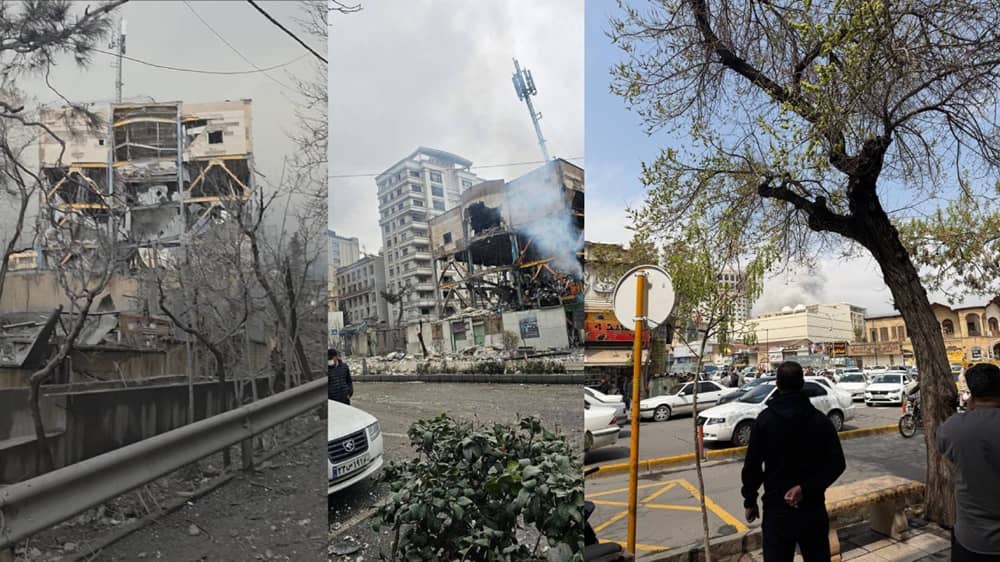
THIS PAGE WILL BE UPDATED WITH THE LATEST NEWS
UPDATE: 11:00 PM CET
‘Smuggled’ Video Shows Iran Rebels’ Explosive Fight Back Against Regime

Despite Iran’s internet shutdown video of armed acts of rebellion has come out of Iran showing attacks on symbolic regime targets.
This video shows acts of armed rebellion are being carried out in Iran by disparate groups aiming to overthrow the Ayatollah and Revolutionary Guard.
Members of the opposition MEK have attacked symbolic targets in Tehran and across Iran using automatic weapons and improvised weapons such as Molotov cocktails.
Information is scarce because of the nationwide shutdown of the internet. But these mobile phone videos show MEK rebel forces – operating as the National Liberation Army of Iran (NLA) using hit and run tactics to strike against regime targets.
Overnight Strikes Shake Tehran as War Spreads Across the Gulf and Deepens Global Alarm
Fresh strikes were reported across Iran early Tuesday, with Israel claiming new hits on security infrastructure and senior commanders, while the conflict spilled further into Iraq and the Gulf and triggered sharper diplomatic, energy and transport concerns worldwide.
Tehran Hit Again, and the Strike Map Widens
Inside Iran, Tuesday began with reports of repeated explosions in north Tehran, including near the Saadabad complex, while additional blasts were described in Ozgol, Farmanieh, Andarzgoo, Kamraniyeh, Elahiyeh, Fatemi, Valiasr, Enghelab and Azadi. Local sources reported overnight and morning strikes in Karaj, Shahriar, Qazvin, Hashtgerd, Shiraz, Tabriz, Abadan, Khorramshahr, Bandar Anzali, Chabahar and Konarak, with witness accounts describing precision strikes on three vehicles northeast of Tabriz. Israel said it had launched another wave of attacks on Iranian security and military infrastructure.
Who is Ali Larijani — has Israel killed Iran’s de facto leader? https://t.co/9ZvjJGK3sZ
— The Times and The Sunday Times (@thetimes) March 17, 2026
Senior Command Losses, Checkpoint Strikes and a Tightening Blackout
The sharpest blows on Tuesday fell on the regime’s internal security structure. Ali Larijani, secretary of the Supreme National Security Council, and Gholamreza Soleimani, commander of the Basij, were reported killed in the overnight strikes; by late Tuesday, Iranian state media had confirmed both deaths. Reports from Tehran described strikes on Basij bases, checkpoints and police positions in Kamraniyeh, Enghelab, Azadi, Fatemi and other parts of the capital, while Abu Zar Hejazi and other Basij commanders were also reported killed or targeted. Taken together, the pattern pointed to a campaign aimed not only at military sites, but at the regime’s domestic security machinery.
The military pressure was matched by a tighter information crackdown. The regime’s intelligence ministry said it had seized hundreds of Starlink terminals as the nationwide internet blackout entered its 18th day, while NetBlocks said the general public had been cut off from international internet access for more than 408 hours.
⚠️ Update: #Iran's internet blackout is now entering its 18th day after 408 hours without international connectivity for the general public. Chosen users are granted privileged access, while the remainder are left with a limited domestic intranet under increasingly tight control. pic.twitter.com/nujpYomBAa
— NetBlocks (@netblocks) March 17, 2026
Iraq and the Gulf Are Pulled Deeper In
Across the region, the conflict widened again. Iraqi security sources told Reuters that the U.S. embassy in Baghdad came under its heaviest rocket-and-drone attack since the war began. The Persian material also reported strikes on militia-linked sites in Baghdad’s Jadriya district and said Kataib Hezbollah had confirmed the death of Abu Ali al-Askari, while separate reports described explosions in Doha, a fire in the city’s industrial area blamed on interceptor debris, and Saudi claims of 21 drones intercepted before dawn as well as a possible strike on a U.S.-made early-warning radar at Al Qaisumah. In the UAE, authorities briefly closed airspace on Tuesday after new missile and drone threats, following Monday’s attack near Dubai airport and broader damage to energy and transport infrastructure that has pushed aviation and shipping disruption further across the Gulf; the Persian material also said Saudi and Egyptian leaders discussed the escalation by phone and that Washington was moving reinforcements, including additional airborne early-warning assets.
The Israeli military says it killed Gholamreza Soleimani, the head of the Iranian Revolutionary Guards' all-volunteer Basij force, which is used to suppress demonstrations in the Islamic Republic. Iran did not immediately acknowledge Soleimani's killing. https://t.co/rgRzJL1jfc
— The Associated Press (@AP) March 17, 2026
Oil, Aviation and Diplomacy Take Fresh Blows
The biggest verified additions from the last 24 hours point to a war still broadening, not narrowing. Brent settled at $103.42 and U.S. crude at $96.21 after renewed Iranian attacks on the UAE, while the White House said oil tankers were only beginning to “dribble through” the Strait of Hormuz again. Airlines warned of higher fares and route cuts as fuel costs surged and Middle East airspace remained heavily disrupted. .
UPDATE: 01:00 PM CET
Penetrating the Inner Sanctum

Amid the intense discussion surrounding the killing of Iran’s Supreme Leader Ali Khamenei in a U.S. airstrike, another development inside Iran, far less examined but significant, has begun to surface. According to accounts from the Iranian opposition, a coordinated operation involving several hundred members of the People’s Mojahedin Organization of Iran (PMOI/MEK) targeted the Supreme Leader’s compound in Tehran. Roughly 100 fighters were reportedly killed, wounded, or detained, while another 150 successfully withdrew.
Regardless of the finer details, the significance of such an episode would extend far beyond a limited tactical confrontation. Its importance lies not only in the losses sustained by the MEK, which are themselves substantial, but more importantly in what the operation suggests about the potency and wherewithal of an organized domestic opposition force — including its intelligence penetration, organizational depth, and operational capability within one of the most heavily protected political environments in the Middle East.
UPDATE: 08:30 AM CET
Maryam Rajavi’s Plan for a Free Iran

For years, when Iran was discussed in Europe, the debate seemed reduced to a false dichotomy: either the ayatollahs’ regime or chaos. This convenient simplification has been one of the main justifications for international passivity in the face of one of the most repressive theocracies in the world. Yet this narrative overlooks something fundamental: the Iranian people not only rise up periodically against dictatorship, but there is also an organized political alternative that has articulated a clear vision for the country’s future.
I met Maryam Rajavi in Brussels at the beginning of my time in the European Parliament. From that first encounter, I understood that her leadership represented more than just opposition to a dictatorship—it embodied a clear political vision for Iran’s future. During those years, I promoted within Parliament the AWARE program (Alliance of Women Against Radicalization and Extremism), focused on the role of women as a transformative force against extremism and radicalization, and Mrs. Rajavi was a strong ally of that initiative. At the same time, we developed extensive joint political work through the Friends of Free Iran group, a cross-party platform in the European Parliament in which I participated enthusiastically, leading from Spain the collective effort to support the democratic aspirations of the Iranian people.
Iranian Protesters Rally in Hamburg, Calling for Democratic Change and International Support
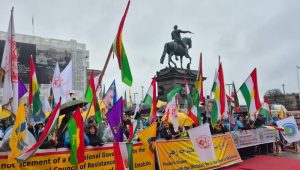
Speakers from Iranian communities, European political figures, and activists voice support for a democratic alternative to Iran’s ruling system during a major rally in Germany.
Iranian communities and supporters of democratic change gathered in Hamburg on March 13, 2026, to express solidarity with the Iranian people and call for the establishment of a democratic republic in Iran. The demonstration brought together activists, political figures, and members of the Iranian diaspora who delivered speeches emphasizing continued resistance against both clerical rule and the return of monarchy.
The rally, organized by Iranian communities in northern Germany, featured speakers who stressed that the struggle for freedom and independence in Iran must continue until the establishment of a democratic system chosen by the Iranian people.
Colombian News Outlet: Iranian Opposition Prepares for Provisional Government, Rejects Return to the Shah’s Dictatorship

The prominent Colombian news network “Noticias Uno” broadcast a special report on the political movements of the Iranian Resistance. The report highlighted the call by the National Council of Resistance of Iran (NCRI), led by Maryam Rajavi, to form a provisional government whose main goal is to restore full sovereignty to the Iranian people, firmly rejecting any attempt to reproduce previous forms of dictatorship, including the dictatorship of the Shah.
The report noted that “Noticias Uno” attended an extraordinary meeting of the NCRI as a witness, bringing together political figures and former ministers from the Western world to discuss post-war arrangements for Iran and the implications of the Iranian regime’s fall. The network explained that the discussions focused primarily on the Ten-Point Plan proposed by Maryam Rajavi, which aims to organize a smooth democratic transition in the country.
Inside Tehran Great Prison: Inmates Describe Water Shortages, Power Cuts, and Welded Cell Doors
New reports from human rights organizations reveal rapidly worsening conditions inside Tehran Great Prison (Fashafouyeh), where inmates say access to basic necessities such as water, food, electricity, and communication with the outside world has sharply deteriorated. Testimonies from prisoners describe a facility struggling with severe shortages, failing infrastructure, and growing fears for the safety of thousands held inside.
According to information gathered by human rights groups, several prisoners were transferred to Tehran Great Prison after Evin Prison was reportedly struck. While the transfer itself created difficulties, inmates say conditions inside the new facility have since worsened.
Rome Rally Backs NCRI Provisional Government and Democratic Republic in Iran

Rome, Italy — March 15, 2026: Freedom-loving Iranians and supporters of the People’s Mojahedin Organization of Iran (PMOI/MEK) rallied in Rome on Sunday to express their support for the National Council of Resistance of Iran (NCRI ) and the provisional government announced by Mrs. Maryam Rajavi, the President-elect of the NCRI.
Iranian Resistance Supporters in Bern Call for a Democratic Republic in Iran

Bern, Switzerland — March 14, 2026 — Once againو supporters of the Iranian Resistance, along with Kurdish compatriots, demonstrated outside the Iranian regime’s embassy, calling for the overthrow of the clerical dictatorship and endorsing the official announcement of a provisional government by the National Council of Resistance of Iran (NCRI). The rally highlighted support for the NCRI’s initiative as a viable democratic alternative for Iran following the death of Ali Khamenei.
Paris Rally Backs NCRI Provisional Government and Calls for a Democratic Republic in Iran

Paris – March 14, 2026: Supporters of the Iranian Resistance gathered at Place de la Bastille in Paris to express their support for the National Council of Resistance of Iran ( NCRI ) and the provisional government announced by Mrs. Maryam Rajavi , the President-elect of the NCRI. Demonstrators backed her Ten-Point Plan for a free, democratic, secular, and non-nuclear Iran, emphasizing that sovereignty belongs to the people—not to the ruling regime or to a return to monarchy.