

THIS PAGE WILL BE UPDATED WITH THE LATEST NEWS
UPDATE: 01:30 PM CEST
Britain Condemns Iranian Strikes on the United Arab Emirates
May 4 (Reuters) – British Prime Minister Keir Starmer on Monday condemned the Iranian drone and missile strikes targeting the United Arab Emirates.
Starmer called on Iran to engage in diplomacy to prevent further escalation in the Middle East, the prime minister’s office said.
“We stand in solidarity with the UAE and will continue to support the defence of our partners in the Gulf. This escalation must cease. Iran needs to engage meaningfully in negotiations to ensure the ceasefire in the Middle East endures, and a long-term diplomatic solution is achieved,” Starmer said.
Starmer Finally Proscribes Iran Terror Group Linked to UK Jew Attacks

A group focused on bringing Iranian terror to British soil which has been allowed to operate with near impunity because of legal buck-passing, is finally to be ‘proscribed’. The brutal Iranian Revolutionary Guard Corps, which is now virtually running Iran, is behind ongoing terror activities against the UK – both cyber warfare and operations on Britain’s streets. Just last month police investigating a suspected terror plot swooped on 10 Iranian men in north London. Four were detained under the National Security Act.
IRGC activities have also been linked to recent attacks on British Jewish communities and synagogues. The nationality of today’s knifeman who stabbed two Jewish men is currently unknown but a series of coordinated arson and attempted arson attacks targeting synagogues, Jewish community ambulances, Jewish charity buildings, and a Persian‑language media outlet in north‑west London, have been linked to the IRGC. The UK’s Independent Reviewer of Terrorism Legislation, Jonathan Hall KC, said there were indications that a proxy of Iran’s Islamic Revolutionary Guard Corps (IRGC) was behind the attacks. Even Keir Starmer described the perpetrators as “malign state actors”.
Iran Between the Terror of Executions and the Resistance, Writes Giulio Terzi di Sant’Agata
Iran is going through one of the most uncertain and difficult periods in its recent history. Under the weight of an unprecedented crisis of legitimacy, the theocratic regime has intensified its use of violence, turning the country into a vast open-air death row to crush any aspiration for freedom.
The figures coming out of Tehran are chilling. In 2025 alone, the regime carried out more than 1,639 executions, marking a 68% increase compared to the previous year. According to the UN Special Rapporteur on human rights in Iran, the real number likely exceeds two thousand, as only a portion of executions are officially recorded.
UPDATE: 07:30 AM CEST
How PMOI Resistance Units Keep the Spirit of the May 2 Martyrs Alive After 42 Years
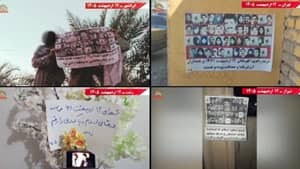
Across Iran, PMOI Resistance Units are actively taking to the streets to honor the martyrs of May 2, 1982. On this day, the regime’s security forces attacked several secret bases of the Mojahedin, murdering dozens of PMOI/MEK members, including Commander Mohammad Zabeti. Today, after 42 years, the spirit of these fallen heroes still lives on in the bold activities of the Resistance Units as they continue their path to establish a free and democratic republic of Iran. The Resistance Units organized a widespread campaign across multiple Iranian cities, including Tehran, Rasht, Arak, Shiraz, Sanandaj, Kerman, Kamyaran, Mashhad, Bandar Abbas, Khorramabad, Yasuj, and Iranshahr. In Tehran and Rasht, activists laid out flower bouquets alongside messages declaring that the martyrs “forged a shining legacy of heroic struggle and pure self-sacrifice.” In another act in Tehran, a flower bouquet was left with a message praising the martyrs as the “standard-bearers and the ones who prove the value of sacrifice and sincerity.”
Furthermore, Resistance members in Iranshahr, Bandar Abbas, and Yasuj held up placards and posters to remind the public of this historic sacrifice. They displayed messages stating that the martyrs stand as “enduring, unforgettable heroes of Iran” and represent the Mojahedin’s “great and blood-sacrificed offering to freedom.” In cities like Arak, Sanandaj, and Khorramabad, individuals and groups of the Resistance Units bravely held placards featuring images of the martyrs, with messages praising them as “flagbearers of self-sacrifice and honesty.”
The Execution of Rebellious Youth Exposes the Iranian Regime’s Fear of the Next Uprising

The Iranian regime has intensified its brutal wave of executions, targeting dissidents and courageous young protesters in a desperate bid to maintain control. In two days, the regime’s judiciary has hanged four young men: Mehrab Abdollahzadeh in Urmia, alongside Mehdi Rasouli, Mohammadreza Miri, and Ebrahim Dowlatabadi in Mashhad.
In the early hours of Sunday, May 3, 2026, the mullahs’ regime executed 28-year-old Kurdish rebellious youth Mehrab Abdollahzadeh in Urmia Prison. Arrested in October 2022 by the IRGC Intelligence Organization, he was sentenced to death in September 2024 by a sham Revolutionary Court presided over by the executioner judge Reza Najafzadeh. Abdollahzadeh was accused of participating in the elimination of Abbas Fatemieh, a criminal Basij member, during the 2022 uprising. The death sentence was carried out despite the complete absence of convincing judicial evidence and Abdollahzadeh categorically denying all charges one by one.
On May 4, the regime announced the executions of Rasouli, Miri, and Dowlatabadi. According to Mizan, the judiciary’s news agency, these youths were accused of “leading and directing rioters” and eliminating several Basij forces—paramilitaries directly involved in killing thousands of protesters.
Iran Regime Denies Family Visits to Female Political Prisoners in Evin Prison
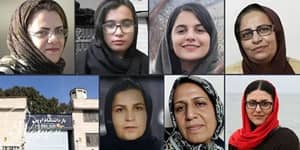
Reports from Evin Prison indicate an escalation of pressure on female political prisoners, with seven women denied family visits due to their participation in the protest campaign, “No to Executions Tuesdays.” The move comes amid intensified measures against political detainees. Prison authorities have informed the seven women that they will be barred from visit with their families for a period of three weeks. The decision has been directly linked to their involvement in protest activities associated with the campaign, including singing and chanting slogans.
The prisoners affected by this measure have been identified as Zahra Safaei, Forough Taghipour, Marzieh Farsi, Elaheh Fouladi, Arghavan Fallahi, Shiva Esmaili, and Golrokh Iraee.
According to available information, these women had previously been threatened by prison officials and warned that continued participation in the “No to Executions Tuesdays” campaign would result in punitive measures, including transfer to solitary confinement. The enforcement of visitation bans appears to reflect the implementation of those threats.
Iran: Baluch Woman Dies After Brutal Domestic Assault and Burning

Mahsa Barahoui, a 33-year-old Baluch woman from Saravan in Iran’s Sistan and Baluchestan province, died on Saturday, May 2, 2026, from severe injuries sustained in a violent assault and extensive burns.
Mahsa Barahoui, a mother of three, had been set on fire by her husband. According to local reports, the attack took place on the evening of Thursday, April 30, 2026. Barahoui’s husband, who was allegedly under the influence of narcotics, subjected her to a severe beating and attempted to strangle her. When she resisted, he poured gasoline over her and set her ablaze.
Neighbors intervened by climbing over the courtyard wall to enter the property. However, the transfer of this Baluch woman to a medical facility was delayed by approximately one hour. She succumbed to the severity of her burns two days later.
Tehran’s Strait of Hormuz Gambit: Desperation Masquerading as Diplomacy
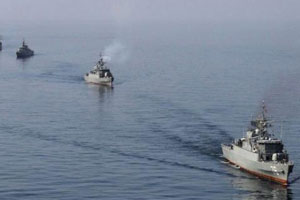
In recent weeks, a flurry of regional visits and urgent phone diplomacy by the Iran regime’s Foreign Minister Abbas Araghchi—coupled with a message attributed to Supreme Leader Mojtaba Khamenei directed at Gulf states—has exposed the other side of Tehran’s regional posture: one defined less by strength than by strategic deadlock and diminishing capacity.
For years, the Iran regime has anchored its regional policy in crisis generation, ideological export, and calibrated escalation. This approach has included missile and drone strikes, the mobilization of proxy networks, and deliberate disruption of critical infrastructure across neighboring and regional states. Such actions were not merely tactical—they were designed to project dominance and impose a narrative of inevitability.
However, this strategy has come at a cost. The attempt to weaponize the Strait of Hormuz—long considered a critical leverage point—appears to have backfired. Rather than consolidating influence, it has intensified the regime’s isolation and provided justification for expanded sanctions, tighter enforcement mechanisms, and increased scrutiny over its oil exports and shipping networks. Estimates suggest that these pressures now inflict hundreds of millions of dollars in daily losses on the regime’s already strained financial system.
Truth Under Siege: War, Censorship, and the Collapse of Journalism in Iran
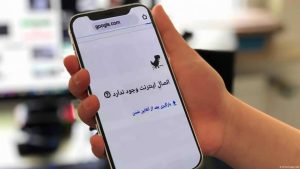
For journalists in Iran, truth has increasingly become a matter of national security—one that carries tangible risks. In a country long ranked among the most restrictive media environments globally, the recent war with Israel and the United States has pushed conditions into a more dangerous phase. Access to information has narrowed further, while the cost of publishing independent reporting has risen sharply.
Iran has consistently occupied the bottom tier of global press freedom rankings. According to the 2026 World Press Freedom Index by Reporters Without Borders, the country ranks 177th out of 180—below even Taliban-controlled Afghanistan. Yet what journalists and media watchdogs now describe is not merely continuity, but escalation: a wartime intensification of longstanding repression.
Authorities of the regime have historically moved to control public narratives during periods of political or security tension. However, reporters inside Iran suggest that wartime conditions have rendered this control more systematic and more rigid. One journalist working for a well-known domestic outlet told that editorial oversight has tightened significantly, with explicit directives issued from above regarding how events must be covered. The outlet’s website, he added, is inaccessible from outside Iran—while only a select group of media organizations linked to state or security institutions appear to retain relatively stable global internet access.
Fractures at the Top: Contradictions Expose Disorder Within Iran’s Power Structure
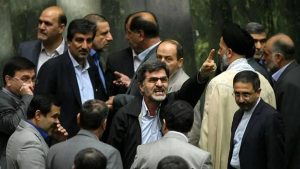
Recent statements by officials within the Iran regime, amplified even by state-affiliated media, offer an unusually clear window into the extent of internal disorder at the highest levels of power. What emerges is not merely routine political disagreements, but a pattern of contradiction, fragmentation, and institutional weakness that reflects a deeper structural crisis.
A report published on April 28, 2026, by the regime-affiliated outlet Khabar Online openly questioned the role of parliament, asking whether representatives have become “loudspeakers for hardliners” rather than functioning as a legislative body. The article highlighted how members of parliament, whether inside the chamber or appearing in media, have increasingly become sources of controversy rather than stability—an admission that underscores the erosion of institutional coherence.
Such observations, coming from within the regime’s own media ecosystem, are significant. They point to a reality in which formal governing bodies are no longer able to contain internal disagreements, and instead serve as platforms for their public show.
Children of Iran; The Silent Victims of War

Children do not analyze war; rather, they mainly experience it on an emotional level. In other words, what adults perceive as an external event becomes an internal feeling for a child—often a feeling of insecurity. In psychology, there is a concept called Basic Trust, which refers to the child’s fundamental assumption that the world is predictable and safe under normal circumstances. In wartime conditions, this trust is severely damaged. The sounds of explosions, violent images, and even parental anxiety convey the implicit message to a child that danger exists, even if the child does not fully understand its source. Whether through repetition or intensity, this experience can cement fear in the child’s mind and turn it into part of daily life, a condition known in psychology as Hyperarousal.
The constant repetition of emotional images and narratives can also shape the child’s relationship with the outside world from the very beginning through a sense of vulnerability and danger, a phenomenon referred to in scientific literature as the Social Amplification of Risk. In this way, war does not merely create fear; it also transforms social relationships. In an environment dominated by insecurity, other people are no longer simply friends, neighbors, or classmates for the child, but may instead be perceived as ambiguous, unfamiliar, or even threatening figures. This stage demonstrates the profound impact of wartime conditions on the child’s social experience.
CENTCOM Announces Launch of Plan for Safe Passage of Ships Through the Strait of Hormuz

The United States Central Command (CENTCOM) announced that about 15,000 American military personnel will participate in an operation called Project Freedom, which is scheduled to begin on Monday in the Strait of Hormuz. The operation was ordered by US President Donald Trump with the aim of ensuring the safe passage of ships and crews from non-belligerent countries through this strategic maritime chokepoint.
Trump described the measure as humanitarian in nature and said that some ships stranded in the Persian Gulf are facing shortages of food and basic necessities. At the same time, he warned that any attempt to disrupt the operation would face a decisive response from the United States.
According to CENTCOM, the military support for this mission will include the deployment of guided-missile destroyers, more than 100 naval and land-based aircraft, multi-purpose unmanned systems, and thousands of military personnel. The command also stressed that the operation is intended to support commercial vessels seeking free passage through one of the world’s most important trade routes.
May Day Rally in Gothenburg: Iran Resistance Supporters Condemn Executions, Back Democratic Republic
Gothenburg, Sweden — May 2, 2026 — Supporters of the People’s Mojahedin Organization of Iran (PMOI/MEK) rallied in Gothenburg to mark International Workers’ Day, protesting the execution of political prisoners and demonstrators in Iran.

Participants rejected both the Shah’s rule and the current clerical regime, while voicing support for the democratic alternative put forward by the National Council of Resistance of Iran (NCRI). The rally also called for an immediate end to executions in Iran and reaffirmed opposition to all forms of dictatorship.
MEK Supporters in London Condemn Executions, Call for Decisive UK Action Against the Iranian Regime
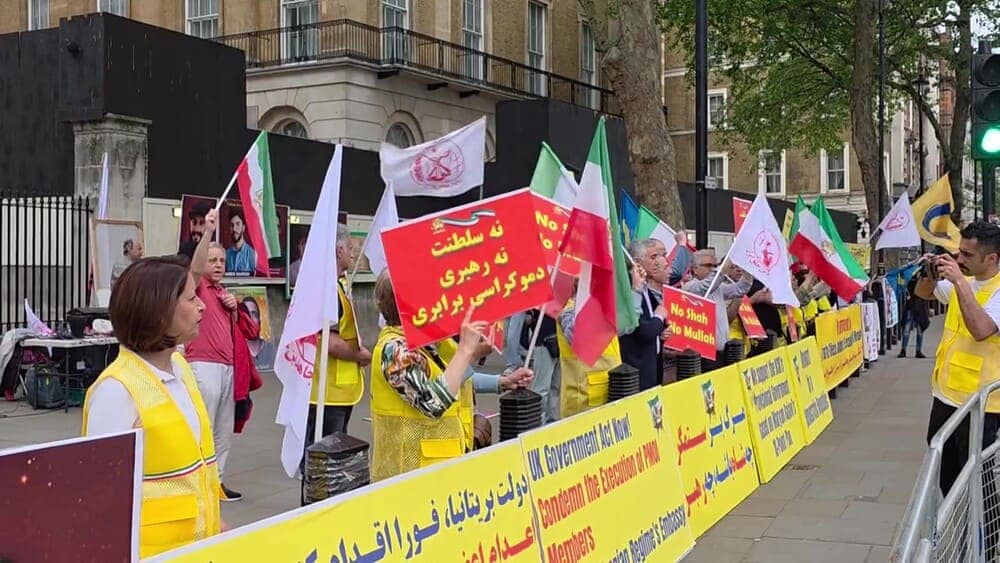
London, UK – May 2, 2026: Supporters of the People’s Mojahedin Organization of Iran (PMOI/MEK) held a rally to protest the execution of political prisoners, including PMOI members and protesters arrested during the January 2026 uprising in Iran.

Protesters called on the British government to take decisive action against the Iranian regime over its criminal executions and terrorist activities, including designating the Islamic Revolutionary Guard Corps (IRGC) as a terrorist organization and closing the regime’s embassy in London as a center of espionage and terrorism.