

THIS PAGE WILL BE UPDATED WITH THE LATEST NEWS
UPDATE: 07:30 PM CEST
National Council of Resistance of Iran Speaks Out on Trump Peace Deal

The National Council of Resistance of Iran (NCRI) has welcomed the ceasefire between Donald Trump and Iran, particularly the halt to attacks on infrastructure and civilian facilities, adding that this was the most appropriate decision at the most sensitive moment by the US. In a statement shared with the Express on Wednesday (April 8), Mrs Maryam Rajavi, the President-elect of the NCRI, which advocates for the overthrow of the Islamic Republic, expressed hope that the 15-day ceasefire “will lead to the end of the war and pave the way for peace and freedom”.
Mrs Rajavi stressed that lasting peace, “as the Iranian Resistance has stressed for the past 45 years, can only be achieved through the overthrow of the terrorist and warmongering dictatorship of the absolute clerical rule (Velayat-e-Faqih) by the Iranian people and the organised resistance, and the establishment of a democratic republic”. She added that the stopping of executions in Iran, as a demand of all the people of Iran, should be included in any international agreement.
NCRI Sees the Ceasefire as the “Most Appropriate Decision at the Most Sensitive Time”

Paris, Apr 8 (EFE). – The president of Iran’s National Council of Resistance (NCRI), Maryam Rajavi, said on Wednesday that the ceasefire reached last night between the United States and Iran to stop the war for two weeks and reopen the Strait of Hormuz is “the most appropriate decision at the most sensitive time”.
In a statement, Rajavi welcomed the ceasefire and expressed hope that it would lead to an end to the war and pave the way for peace and freedom.
The Iranian opposition leader particularly valued the suspension of attacks on infrastructure and civilian targets in her country.
The leader also insisted that a lasting peace can only be achieved through the overthrow of the “terrorist and warmongering dictatorship of the absolute clerical regime” by the Iranian people and organized resistance, as well as with the establishment of a democratic republic.
UPDATE: 12:30 PM CEST
Iranian Community in the Bay Area Concerned About Family Overseas

Hamid Azimi, a volunteer with the Iranian American Community of Northern California, said they are against the war. Instead, they are in factor of continued organized resistance to the regime.
“This war needs to stop so that the resistance units that the Iranian people have, led by Mrs. Maryam Rajavi, can take over and finish the job and bring about peace and stability to the Middle East,” Azimi told CBS News Bay Area. “People of Iran are not different from any other people in the world. We get worried when bombs are getting dropped on our country, on our relatives.”
He and the community have been rallying more across the Bay Area recently in support of the resistance movement.
Iranian Americans Weigh in on the Escalating Conflict in the Middle East

RICHMOND, Va. — Iranian Americans are weighing in on the escalating conflict between the United States, Israel and Iran, with some supporting military action and others emphasizing the need to protect civilians and empower the Iranian people.
In Washington, D.C., Majid Sadeghpour with the Organization of Iranian-American Communities supports freedom but said measures taken against the current Iranian government must be effective. Sadeghpour believes real change must come from the ground up through the Iranian people. He said they must be supported in their fight with well-thought-out planning that limits the loss of innocent life and critical infrastructure.
“It’s the people of Iran that have to do the heavy lifting here and we can weaken the regime with bombs, but certainly to overthrow it will not happen from the sky,” Sadeghpour said. “Everybody that’s involved in this war must do everything possible to protect the people. The innocent civilians and economic and civilian structure of the country. The main concern from the regime is not bombs from the sky, it’s a defiant population.”
From Zahhak to Today: When Power Feeds on Its Own Society

In Iranian mythological narratives, it is said that Zahhak, a legendary king, was originally an ordinary prince. The demon Ahriman approached him in the guise of an advisor and incited him to murder his father in order to seize power. Once in power, Ahriman kissed Zahhak’s shoulders, and from the spots of those kisses two serpents emerged. These serpents had to be fed each day with the brains of young men; thus, two youths were executed daily, and fear and terror spread throughout society.
This cycle of violence can be interpreted as an illustration of the “banality of evil”: a system in which killing is no longer an exceptional act, but becomes a routine practice, embedded in the very functioning of power in order to sustain itself. In such a structure, violence is not a deviation, but a condition of survival. Zahhak is therefore not merely a mythological figure, but a metaphor for regimes that, in order to endure, continuously feed on their own society. As recounted in Ferdowsi’s Shahnameh—the great Persian epic written nearly a thousand years ago—this cycle is ultimately broken by a popular uprising and the emergence of an alternative.
UPDATE: 08:00 AM CEST
Resistance Units Commemorate Executed PMOI Members, Defy Regime’s Execution Spree
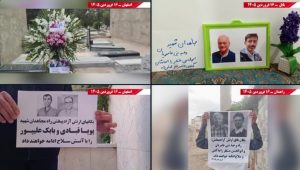
In a stunning display of bravery that shatters the Iranian regime’s illusion of control, the youth of Iran have taken to the streets to answer the mullahs’ latest wave of executions of PMOI/MEK members. On April 5, 2026, across major cities spanning from Tehran and Isfahan to Zahedan and Tabriz, PMOI Resistance Units launched a widespread mobilization. In a defiant video from the streets, a female Resistance Unit member boldly shouted, “To the blood of Pouya and Babak, we will stand till the end.” Dozens of other activities featured posters and placards of recently executed PMOI members bearing powerful messages, such as, “No surrender!” and “We swear on the blood of our comrades that we will stand till the end.”
115th Week of ‘No to Execution Tuesdays’ Continues After Execution of Six Veteran Members

The “No to Execution Tuesdays” campaign, marked by weekly hunger strikes led by prisoners, has now entered its 115th week. This milestone comes amid the execution of six of its longstanding members. Despite mounting pressure, participants have reaffirmed their commitment to continuing both the hunger strikes and their protest the death penalty.
Prisoners involved in the campaign have stated that they remain committed to the principles of “No to Execution Tuesdays” and will persist with their hunger strikes. This is taking place under conditions of severe communication disruption, as internet shutdowns and restrictions have significantly hindered the flow of information. Nevertheless, available reports indicate that the hunger strikes inside prisons have not ceased and continue despite these constraints.
Why Iran’s Executions Reflect Strategic Weakness, Not Strength
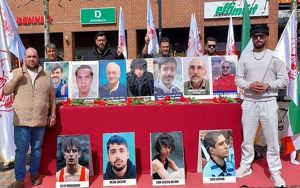
The execution of six members of the People’s Mojahedin Organization of Iran (PMOI/MEK) and affiliated Resistance Units between March 30 and April 4, 2026, followed by the killing of several defiant protesters, should not be understood as routine repression. These were deliberate political acts carried out at a moment of heightened domestic vulnerability and external pressure for Iran’s ruling establishment. At first glance, the timing may appear counterintuitive. Why would a government facing international tension and strategic uncertainty escalate executions at home? The answer lies in the regime’s own threat perception. Tehran does not appear to be acting from a position of confidence. It appears to be responding to a convergence of threats that the leadership increasingly views as linked: external confrontation, internal protest, and the organizational resilience of anti-regime networks.
Foreign Forces in Iran: Reports Signal Regime Turning to Militias Amid Internal Strain

New reports point to foreign militias entering Iran as internal security pressure rises, while warnings over child recruitment deepen concerns about manpower shortages. Foreign forces in Iran are drawing growing attention as fresh reports suggest the government may be turning to allied militias to reinforce internal security. Claims of Iraqi, Afghan, and Pakistani fighters entering the country have circulated widely in recent days, though many remain unverified by major international outlets.
Brussels Rally Demands EU Action Over Execution of PMOI Political Prisoners

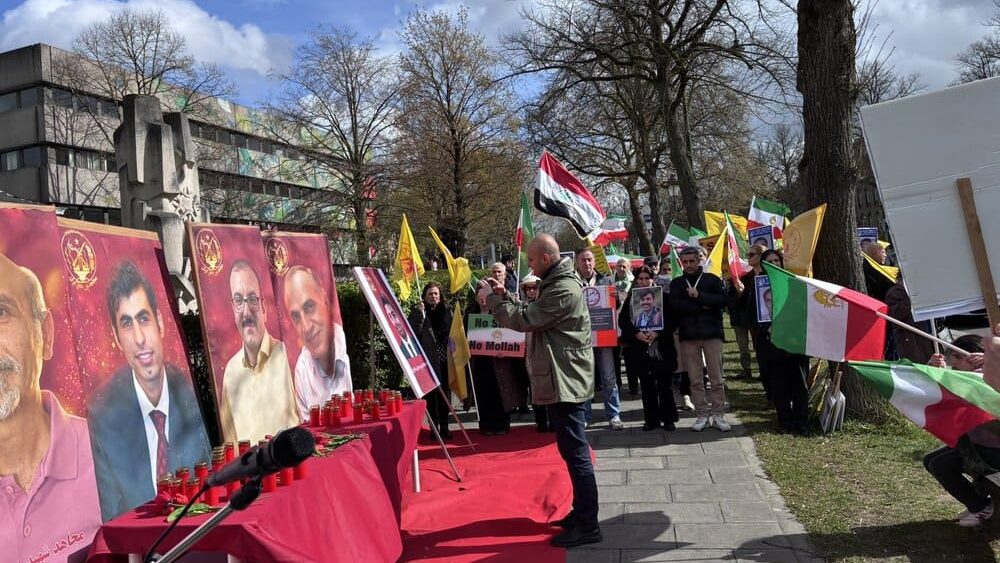
Brussels – April 5, 2026 – Supporters of the Iranian Resistance staged a rally outside the Iranian regime’s embassy in Brussels to protest the execution of six political prisoners affiliated with the People’s Mojahedin Organization of Iran (PMOI/MEK): Mohammad Taghavi, Akbar Daneshvar Kar, Babak Alipour, Pouya Ghobadi, Vahid Bani-Amerian, and Abolhassan Montazer.
Oslo: Iranian Resistance Supporters Rally Against Execution of PMOI Political Prisoners
1-#Oslo, April 4, 2026 — Supporters of the Iranian Resistance rallied outside the Norwegian parliament to condemn the execution of six PMOI political prisoners, call for regime change, and urge Norway to take action.#StopExecutionsInIran #NoImpunity4Mullahs pic.twitter.com/ixE5aYFtLx
— Iran Freedom (@4FreedominIran) April 7, 2026
Oslo – April 4, 2026: Supporters of the Iranian Resistance gathered outside the Norwegian parliament to protest the executions of six political prisoners affiliated with the People’s Mojahedin Organization of Iran (PMOI/MEK): Mohammad Taghavi, Akbar Daneshvar Kar, Babak Alipour, Pouya Ghobadi, Vahid Bani-Amerian, and Abolhassan Montazer.
The Head of the Iranian Regime’s Judiciary Called for Accelerating and Increasing Death Sentences
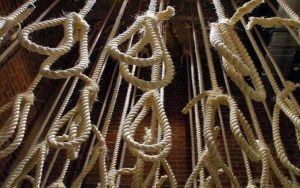
On Tuesday, April 7, Gholamhossein Mohseni Ejei, the head of the Iranian regime’s judiciary, called for accelerating and increasing death sentences. The regime judiciary chief emphasized speeding up rulings against what he called “enemy elements and agents,” while reports indicate a sharp increase in pressure on political prisoners and the implementation of death sentences in recent days. Mohseni Ejei called for accelerating and increasing death sentences. In a meeting with members of the judiciary’s high council, he called for the maximum use of laws, including the law intensifying punishment for espionage, to speed up the issuance of rulings. He also stressed the rapid implementation of punishments such as asset confiscation and executions in cases where the law permits and called for these rulings to be publicized in the media.