

Three-minute read
Caught between the humiliating prospect of diplomatic submission in Islamabad and a relentless campaign of external military strikes, the Iranian regime has turned its fury inward, formally abandoning the pretense of civilian law. Gholam-Hossein Mohseni-Eje’i, the Head of the Judiciary, declared on Sunday, April 19, that the nation’s legal system has moved to a “war footing.” Speaking to a summit of high-ranking judicial officials, Mr. Mohseni-Eje’i explicitly linked domestic dissent to foreign intelligence, asserting that any internal opposition now serves the strategic objectives of Israel and the United States and will be prosecuted as wartime treason.
The directive seeks to dismantle the standard procedural safeguards that have already been hollowed out over years of civil unrest. Under the new mandate, Mr. Mohseni-Eje’i has ordered his subordinate agencies to prioritize cases involving dissent, insisting that legal timelines be truncated to a matter of hours. He instructed that if a case is handed to an investigator in the morning, it must be returned for indictment by the same afternoon. According to state-run media reports, the judiciary chief even commanded prosecutors to go directly to prisons to confront defendants on-site, bypass traditional courtrooms, and expedite the path to sentencing.
“Those who act against the system in any way—whether through speaking, tweeting, sending a photo, giving a speech, or assassination—are all moving in the same direction,” Mr. Mohseni-Eje’i stated.
"Facing what observers describe as an increasingly volatile and “explosive” domestic climate, Iran’s clerical establishment has dramatically tightened its grip on society during #IranWar," writes @SaforaSM.https://t.co/BFMl6jDAaU
— NCRI-FAC (@iran_policy) April 10, 2026
A Digital Iron Curtain and Mass Detentions
As the judiciary accelerates its machinery of execution, members of the regime’s parliament have intensified their calls for a total and permanent internet blackout. Several MPs have petitioned for further restrictions on digital access, arguing that the “informational war” waged via encrypted apps is as dangerous as the kinetic strikes currently degrading the country’s infrastructure. This legislative push for total isolation comes amidst reports that security forces have been instructed to treat the possession of certain communication tools as prima facie evidence of espionage, further narrowing the space for independent reporting or civil coordination.
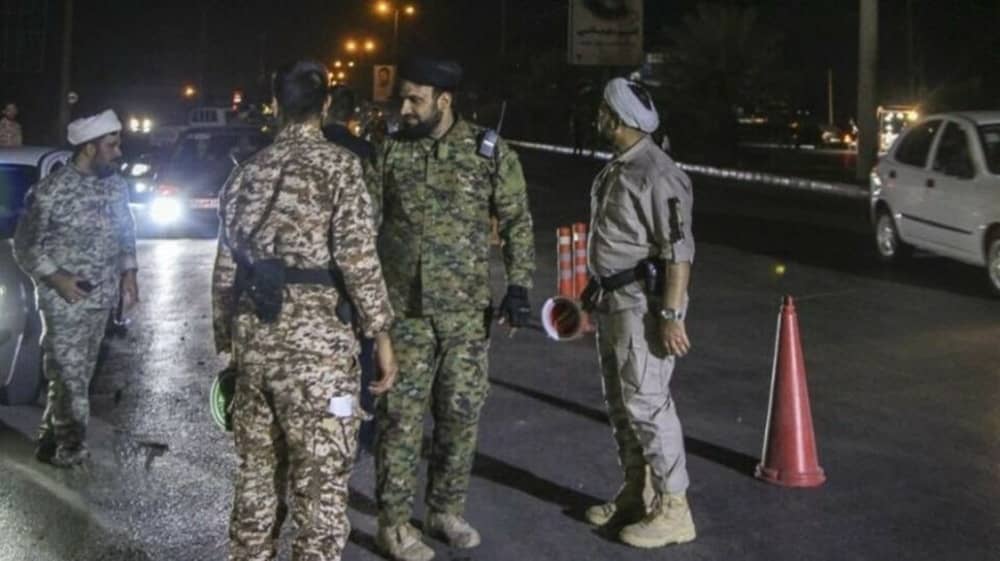
The digital crackdown is being enforced with aggressive physical measures. Ahmad-Reza Radan, the Commander of the regime’s State Security Forces, confirmed in a televised interview on Monday that authorities have arrested more than 1,400 individuals in recent sweeps. Radan claimed that over 400 of these citizens were detained specifically for “collecting and publishing images” of strike locations, a crime now prosecuted under the pretext of aiding foreign intelligence. Another 900 social media activists have been targeted for “disturbing the public mind,” a charge that often serves as a gateway to the more severe accusations of “waging war against God.”
This atmosphere of legal terror is intended to mask a deepening institutional paralysis at the heart of the state. Since the death of Supreme Leader Ali Khamenei during the initial waves of external strikes, the clerical hierarchy has been consumed by a “nest of rival fiefdoms.” While the Islamic Revolutionary Guard Corps (IRGC) attempts to consolidate power by bypassing traditional succession rituals, internal bickering among intelligence barons and the administrative elite has left the regime in a state of chaotic stasis. The result is a regime that is increasingly unable to stabilize the plummeting rial, even as it maintains a formidable capacity for domestic violence.
"In a clear sign of weakness, Iran’s regime has ramped up its use of foreign Shia militias and even child recruits to suppress domestic unrest, exposing the fragile state of its own security apparatus," @HakamianMahmoud writes. #IranWar https://t.co/iYNH4Xg7hS
— NCRI-FAC (@iran_policy) April 6, 2026
The Human Toll of a Leadership in Retreat
The cost of this “war footing” has been most acutely felt by Iran’s youth, who continue to bear the brunt of the state’s survival instinct. Human rights monitors report a harrowing spike in the killing of young protesters and students, many of whom have been targeted in the streets for defying local security cordons. The state’s strategy appears to have shifted from crowd control to a policy of elimination, intended to decapitate the pioneers of a growing movement before it can capitalize on the regime’s visible frailty. This campaign of state-sanctioned violence is being carried out by the IRGC Intelligence Organization and the Ministry of Intelligence, which have intensified their raids on every corner of society.
By framing every grievance as an act of foreign-sponsored espionage, the state is attempting to justify a political purge. The narrative that dissidents are “soldiers of the enemy” is being used to silence families of those killed by security forces, who are often threatened with arrest themselves if they attempt to hold public funerals. This strategy of preemptive repression highlights the regime’s fear that the external pressure for “unconditional surrender” and the ongoing naval blockade will embolden the population to finalize the internal revolution that has been simmering for years.
Ultimately, the scale of the arrests and the speed of the judicial process suggest that the clerical dictatorship is no longer acting as a state, but as an occupying force within its own borders. The “war footing” described by Mr. Mohseni-Eje’i is not a defense against foreign tanks, but a defense against the Iranian people. Analysts suggest that the move to shorten the interval between arrest and sentencing is a desperate attempt to create a climate of fear so pervasive that it can compensate for the state’s loss of coherence and its dwindling control over the nation’s future.