

Four-minute read
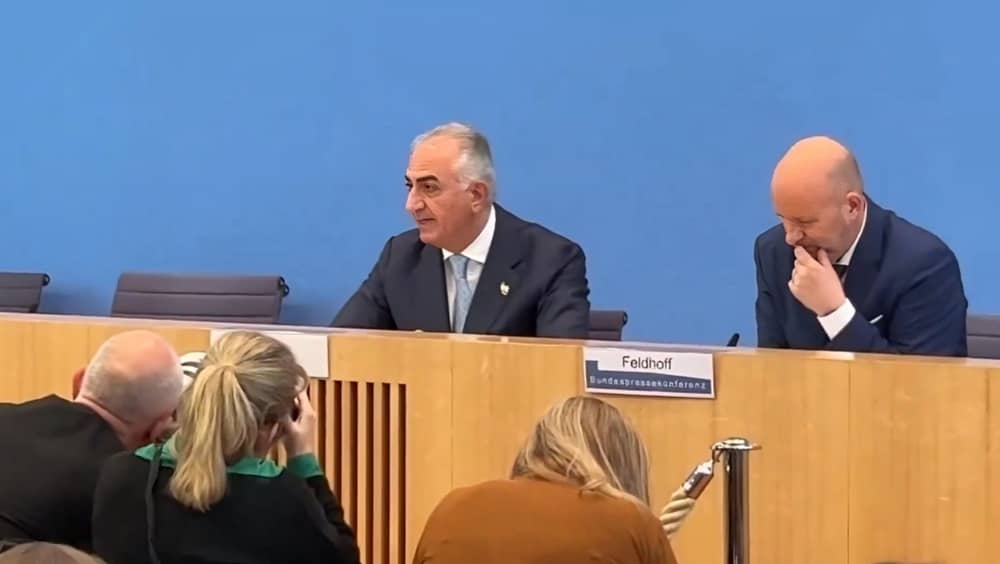
On April 23, 2026, Reza Pahlavi, son of the deposed Shah of Iran, held a press conference at the Bundespressekonferenz in Berlin as part of a multi-week European tour that had included a similar appearance in Stockholm. The stated purpose of the tour was to seek international support for his political agenda and to present himself as a viable alternative in Iran’s future. Yet the Berlin event, which lasted roughly two hours and drew a large number of German and international journalists, quickly became something very different: a test of Pahlavi’s political credibility, historical accountability, and democratic legitimacy.
The questions posed by European reporters were sharp, direct, and often uncomfortable. They focused only on the issues that Pahlavi has long tried to avoid: the dictatorship of his father, Mohammad Reza Shah; the legacy of SAVAK, the Shah’s feared intelligence service; the hereditary nature of monarchy; and the question of whether Pahlavi has truly distanced himself from the authoritarian model of the past.
Reporters also challenged him with his foreign ties and on the issue that he has become politically dependent on outside powers. Some questions suggested that by supporting or encouraging foreign pressure against Iran, Pahlavi has been seen not as an independent national figure, but as a political instrument in the hands of foreign governments. At several points, his responses appeared tense and defensive, especially when pressed on whether he condemns or distances himself from the abuses committed under his father’s rule.

The significance of the Berlin press conference lies not simply in what was asked, but in what Pahlavi refused to answer clearly. A democratic leader seeking to represent a nation scarred by dictatorship would be expected to confront the past honestly. He would be expected to acknowledge victims, reject political repression, and make a clear commitment to accountability. Pahlavi did none of this. His unwillingness to separate himself from the authoritarian legacy of the monarchy reveals the undemocratic nature of his political outlook.
The following day, April 24, 2026, Pahlavi released a roughly four-minute video message in which he sharply criticized the European media and the approximately 150 journalists who had attended his press conferences. His anger was revealing. The journalists had not invented the central problem; they had exposed it. They asked the questions that any serious democratic society would ask of a man whose political identity rests almost entirely on hereditary association with a deposed monarch.
Pahlavi’s frustration appears to stem from the fact that European journalists did not treat him as an unquestioned democratic alternative. Instead, they treated him as the son of the Shah and asked him to account for that legacy. This distinction matters.
The issue became especially important after the January 2026 uprising in Iran. During that uprising, many Iranians sought a democratic republic and an end to all forms of dictatorship. Organized resistance networks and local protest units played a central role in sustaining the demonstrations. For a moment, the regime appeared politically shaken, and its internal divisions became visible.
"The problem is not simply that Reza Pahlavi is not a #democrat. The deeper problem is that his own words have now exposed how hollow his democratic claims always were."https://t.co/tRAVE8tAgd
— NCRI-FAC (@iran_policy) April 16, 2026
Then Pahlavi’s sudden media emergence changed the narrative. Around January 18 and 19, images, slogans, and international broadcasts began presenting him as the supposed leader of a movement he had not built. His supporters claimed that millions of Iranians were calling his name, but critics argue that this narrative was artificially amplified through lobbying networks, media access, and coordinated social media activity.
This sudden monarchist framing gave the Islamic Republic a powerful propaganda tool. The regime could now portray the uprising not as a democratic revolt by the Iranian people, but as a foreign-backed attempt to restore the monarchy. For hardliners inside the regime, the specter of a Pahlavi return helped reunify a fractured base. It turned the uprising into a false choice between the current theocracy and the previous monarchy, rather than a struggle for a democratic republic.
This is why Pahlavi’s role is so controversial. Even if he lacks serious organizational power inside Iran, his media presence can still damage the democratic movement. By placing himself at the center of a struggle he did not organize, he risks diverting attention away from the forces actually active on the ground. Worse, he provides the regime with the perfect enemy: the return of the Shah’s son.
In a damning #investigation published by the Persian-language edition of Le Monde diplomatique, Reza Pahlavi’s carefully manufactured image as a moderate opposition figure falls apart, revealing a political figure increasingly driven by foreign networks, external sponsors, and…
— NCRI-FAC (@iran_policy) April 13, 2026
The comparison some critics draw to the “Chalabi model” is therefore significant. Before the 2003 Iraq war, Ahmed Chalabi was promoted in some Western circles as a ready-made alternative leader, despite his weak domestic legitimacy. Critics argue that a similar pattern is being attempted with Pahlavi: a figure with limited internal legitimacy is presented to Western audiences as a convenient solution to a complex national struggle. Such manufactured leadership can weaken genuine democratic movements by replacing real social organization with media spectacle.
The deeper problem is that Pahlavi has never answered the fundamental question: what exactly does he represent? If he represents democracy, why does he not clearly reject the authoritarian legacy of the monarchy? If he represents national independence, why is his political project so dependent on foreign platforms, foreign media, and foreign lobbying? If he represents the Iranian people, where is the evidence of sustained organization inside Iran after 47 years in exile?
His Berlin press conference showed that European journalists are no longer willing to accept vague slogans as proof of democratic credibility. They asked about history because history matters. They asked about SAVAK because victims matter. They asked about monarchy because Iran’s future cannot be built on hereditary privilege. They asked about foreign dependence because national leadership cannot be outsourced.
In an assessment, Col. Wesley Martin, former Senior Antiterrorism Officer for all Coalition Force – Iraq, portrays Reza Pahlavi’s Iran Prosperity Project (IPP) as an authoritarian scheme wrapped in the language of #democratic change.https://t.co/7YeC1vSGCq
— NCRI-FAC (@iran_policy) March 22, 2026
Pahlavi’s angry response to the media therefore revealed more than his irritation. It revealed the fragility of his political position. A leader confident in his democratic credentials would welcome difficult questions. A leader committed to transparency would answer them directly. A leader serious about national reconciliation would confront the pain of the past rather than dismiss those who raise it.
The future of Iran should not be reduced to a choice between a turban and a crown. The Iranian people have already suffered under religious dictatorship and before that under monarchical autocracy. Their struggle is not for the restoration of one form of authoritarianism over another; it is for the end of dictatorship itself.