

Four-minute read
The terrorist regime in Iran is crumbling under the weight of economic collapse, military humiliation, and the edge of revolt by a population exhausted by nearly half a century of theocratic rule. Yet the regime’s survival strategy has always relied on one quiet victory: convincing Iranians that the only alternative is worse. Into that vacuum step the monarchists — calling for a return to the former dictatorship and the tortures of SAVAK.
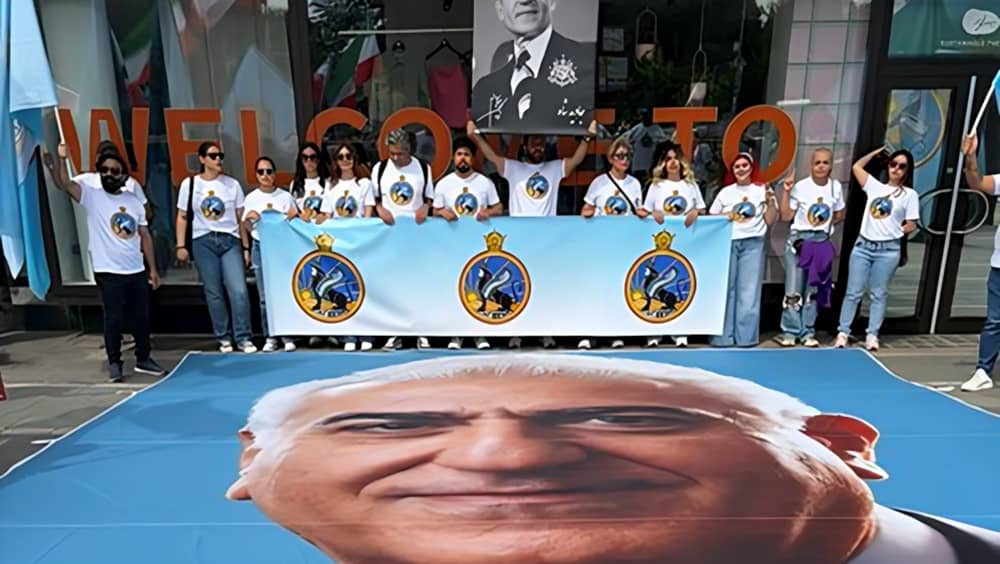
The clearest evidence is not in clandestine networks or street confrontations inside Iran. It is in the open spectacle — and the most damning example comes first: this weekend in Germany, monarchist marchers paraded in SAVAK T-shirts, waving SAVAK emblems and flags, openly romanticizing the Shah-era security apparatus responsible for systematic torture and disappearances.
Social-media timelines overflow with boasts about reinstating SAVAK and “dealing with” critics. These are not mobilization tactics. They are Instagram cosplay — gestures that cost nothing in blood or risk but hand the regime ready-made footage to broadcast on state television: See? This is what waits for you if the Islamic Republic falls.
The message lands with precision among a population that remembers the old dictatorship’s brutality as vividly as the new one’s.
5/5
Die Vertretung des Nationalen Widerstandsrates Iran in Deutschland NWRI verurteilt die Parade mit SAVAK-Symbolen in Regensburg aufs Schärfste, informiert die deutschen Behörden über diese beschämenden und einschüchternden Aktion und fordert entsprechende Gegenmaßnahmen:… pic.twitter.com/okkHrG2eR6— Masumeh Bolurchi (@MasumehBolurchi) May 10, 2026
The same SAVAK obsession appeared in the cultural sphere. A British-Iranian rapper released a track calling for smashing the IRGC and Basij — standard anti-regime fare — only to pivot immediately to equating the mullahs with the People’s Mojahedin Organization of Iran (PMOI/MEK).
“We don’t want mullah, neither MEK. Smoke ’em on site, show no mercy.”
The performance featured SAVAK T-shirts and logos, turning the song into yet another advertisement for the very security apparatus the monarchists now glorify.
These displays are not harmless nostalgia. SAVAK, the Shah’s secret police, was one of the world’s worst human-rights violators in the 1970s. Amnesty International’s contemporaneous reports documented widespread use of torture against political prisoners: electric shocks, whippings, beatings, water pumped into the rectum, prisoners strapped to heated metal tables, rape, and other forms of physical and psychological abuse to extract confessions. Detainees were routinely held incommunicado for months with no judicial oversight; many “confessions” were later repudiated in court, yet still formed the basis for unfair trials and executions.

When monarchists proudly wear SAVAK symbols and promote its return, they are not mounting a serious challenge to the mullahs. They are doing the regime’s propaganda work for free. They reinforce the exact binary the current terrorist regime has always sold: Choose us, or go back to the torturers of the old regime.
It is the largest single gift the monarchists can give Tehran — proving, in real time and on camera, that “regime change” might simply mean swapping one set of coercive structures for another.
Far from mounting any organized resistance inside Iran, the monarchists amplify the regime’s favorite narrative: that the only choices are turban or crown, with no credible third path. The mullahs could not buy better messaging.
Even the monarchists’ own longtime insiders now admit the hollowness. Reza Taghizadeh, who for years served as head of Farah Pahlavi’s office and a close adviser to Reza Pahlavi himself, appeared on Voice of America on May 9, 2026, and delivered a verdict that should echo through every exile living room: “I will not vote for Reza Pahlavi! In all these years, he hasn’t even laid one brick on another.” He went further, saying that Reza Pahlavi’s actions have provided some of the greatest services to the Islamic Republic itself.
How #Iran’s Clerical Regime Rebuilt SAVAK into a Global Repression Machinehttps://t.co/s3FhvmxhzA
— NCRI-FAC (@iran_policy) February 7, 2025
MAGA-style tactics and hardball advisers have raised Reza Pahlavi’s profile and divided his potential followers, @robertfworth writes. https://t.co/z8Oce75LbZ
— The Atlantic (@TheAtlantic) May 9, 2026
For years, polite analysts have pleaded for opposition unity, arguing that differences could be settled at the ballot box once the dictatorship falls. That framing misses the point. The monarchists do not function as one faction among many. Their entire posture — hereditary restoration, pride in the institutions of the ancien régime (especially its torture machine), and a willingness to attack any organized resistance that operates inside Iran — positions them as the regime’s perfect foil.
They are not rivals to the organized Resistance; they are the noisemakers the mullahs can safely point to and say: This is your alternative. Loud enough to dominate diaspora airwaves, ineffective enough to achieve nothing on the ground, and authoritarian enough to terrify anyone contemplating real rupture.
In the end, the terrorist regime’s greatest asset is not its Revolutionary Guards or its morality police. It is the existence of a so-called opposition current that keeps proving, in SAVAK T-shirts, rap verses, and public admissions of total inaction, that the choice on offer is not freedom but a different flavor of coercion. Until that current is replaced by something that feels like genuine rupture rather than recycled authoritarianism, the mullahs will continue to win by default. Iran’s people, watching from the streets they have bled on, already understand the difference. The monarchists, apparently, do not.