

Three-minute read
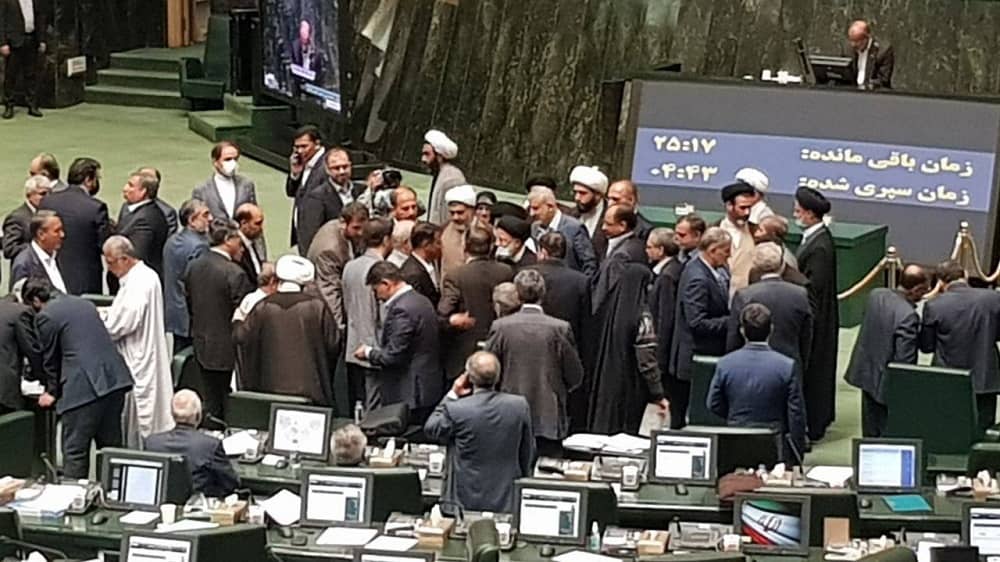
As of May 22, 2026, the terrorist regime ruling Iran is grappling with severe interconnected crises including deep factional rifts within the ruling elite, policy-driven hyperinflation and collapsing living standards, brutal crackdowns on worker protests, an 84-day internet blackout, and acute water shortages. Official admissions from state media reveal that government decisions — rather than external conflict — are fueling economic pain, while hardliners clash with the regime’s president Masoud Pezeshkian over diplomacy and military posture in the “neither war nor peace” phase following recent confrontations with Israel and the US. These dynamics signal growing regime fragility.
Elite Infighting Exposed
On May 22, 2026, senior regime figure Mohammad-Javad Larijani sharply criticized the government’s handling of Persian Gulf tensions on state television. He stated: “I am sorry that in the government apparatus, only the Vice President speaks clearly about the Strait of Hormuz; we have not heard even one word from the respected president!” Larijani called for suspending NPT commitments and accelerating parliamentary action on Hormuz management.
Meanwhile, Pezeshkian warned of internal collapse risks. In a television address, he declared: “They cannot conquer a country with missiles and bombs and planes, but with division, breaking and fighting they can! … We must try so that this unity, cohesion and empathy does not break.”
Former Foreign Minister Manouchehr Mottaki proposed aggressive escalation if conflict resumes, saying: “With the first shot by the Americans, we must immediately start a ground war… our warriors must take American bases in the region, take prisoners and confiscate their assets.”
The regime’s anniversary rallies were designed to signal survival. Yet the same period’s developments—nighttime anti-Khamenei chants, continuing strikes, the spread of #IranProtests messaging across dozens of cities, official acknowledgment of mass injuries, arrests reaching…
— NCRI-FAC (@iran_policy) February 11, 2026
Economic Policies Drive Hardship
Regime economist Hossein Raghfar admitted on May 20, 2026, that inflation is domestically driven. He told state media: “After the 12-day war, the currency price dropped from 93,000 to 83,000 tomans… but after the war they constantly raised the currency price up to 120,000 tomans.” Raghfar linked rising input costs directly to higher prices of cooking oil, eggs, meat, and essentials.
Dairy products face a new shock. The spokesman for Iran’s Dairy Industry Association announced on May 22 that prices would rise 20% from June 1 after raw milk increased 29% to 60,500 tomans per kilogram. He confirmed: “With the removal of preferential currency, it is estimated that at least 15% reduction in consumption has occurred.”
Daily Life Under Strain
State newspaper Jahan Sanat reported on May 19, 2026, a surge in “caloric poverty,” with rice prices tripling year-on-year and many families unable to afford basic staples. Fruit prices have skyrocketed, including cherries at 1.78 million tomans per kilogram.
Water infrastructure is in crisis. On May 22, Water and Wastewater Company CEO Hashem Amini reported 12% losses in aging networks, stating one percent reduction would cost 21 trillion tomans annually with no available funds. Energy Minister Abbas Aliabadi admitted weak water conditions persist in Tehran and central provinces despite good rainfall.
"The infighting is taking place while the regime hasn’t decided about the course—concession or going to #IranWar. Once the final decision is made, a major fracture is expected to weaken the regime severely, exposing it to the outburst of social anger that is witnessing these…
— NCRI-FAC (@iran_policy) May 12, 2026
Internet Blackout and Repression
The internet shutdown reached its 84th day on May 22, 2026, with over 1,992 hours of restricted global access, according to NetBlocks. Ordinary citizens face less than 2% connectivity, reserved mostly for regime-aligned users, exacerbating economic and social divides.
In Zanjan, a sanitation worker protesting wages described being run over by city council member Mojtahedi: “He turned on the engine and moved without paying attention… I fell and half my body went under the car.” Mojtahedi reportedly shouted: “I’ll hit you! I’ll pay your blood money.”
"The regime finds itself trapped between the prospect of renewed foreign #IranWar and the danger of a people’s armed uprising. As a result, Tehran is increasingly resorting to wartime posturing," @MansoreGolestan writes.https://t.co/y4QCukZXPw
— NCRI-FAC (@iran_policy) May 20, 2026
Stark contradictions
MP Ali Khazrian, a member of the parliamentary Security Commission, issued a stark warning on May 19 against any diplomatic concessions. He stated that even “a particle of retreat” in negotiations with America, or the removal of enriched uranium from the country, would send a “signal of weakness” and increase the risk of a tactical nuclear attack by the enemy.
In contrast, Mojtaba Khamenei used the second anniversary of Ebrahim Raisi’s death as a pretext to project and enforce regime unity, aiming to preemptively counter any signs of internal division. He wrote: “Today, we thank the blessing of the cohesion of the nation and the government and all the institutions of the Islamic Republic,” claiming it strengthens motivation for service and progress toward a bright future.
Yet this narrative clashes sharply with reality. Infighting has intensified over the regime’s survival, as it is being torn apart on two fronts. One side warns that continued war footing or prolonged economic siege will trigger nationwide unrest and “the collapse of society from within” due to factional quarrels. The opposing hardline camp, including figures like Mohammad-Javad Larijani and Saeed Jalili allies, argues that any show of weakness or negotiation will erode morale among the regime base, leaving the system vulnerable to an imminent popular uprising. These contradictions, acknowledged even in state media reports, reveal the deepening fragility of the regime as of May 22, 2026.