

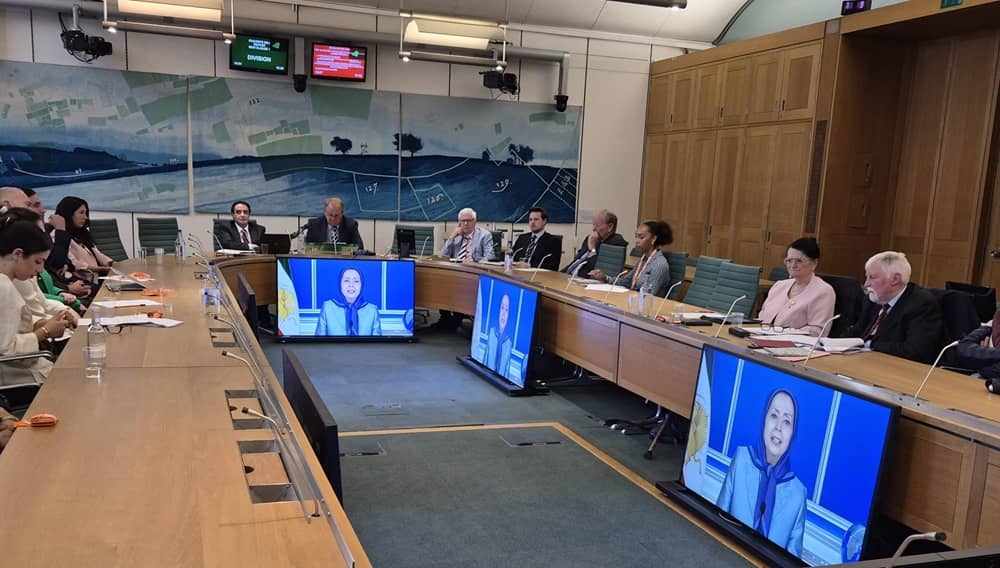
On June 10, 2026, at a pivotal conference held recently at the UK Parliament titled “Peace and Freedom with a Democratic Republic,” international dignitaries, cross-party lawmakers, and Anglo-Iranian activists convened to address the escalating human rights crisis in Iran. The landmark gathering sought to solidify international support for a democratic transition, highlighting the absolute necessity of abandoning failed appeasement policies in favor of decisive action. Participants emphatically called for the immediate terrorist proscription of the Islamic Revolutionary Guard Corps (IRGC) and championed the organized Iranian Resistance as the only viable pathway to establishing a secular, democratic republic for the Iranian people.
In her keynote address, the NCRI President-elect Mrs. Maryam Rajavi emphasized that Iran currently stands at a critical juncture between fear and hope, with the regime’s policies of war, plunder, and repression causing severe economic and social hardships, particularly for women. She noted that to prevent its own collapse, the regime has intensified its crackdown through mass detentions—including the recent arrest of 6,500 people, many of whom are PMOI supporters—and a surge in executions, taking the lives of 30 political prisoners in just 75 days. Despite this brutal suppression, she highlighted that the Resistance Units and the Liberation Army continue their operations against the regime’s centers of suppression, proving that the mullahs cannot destroy the people’s resolve and standing as the true “living hope for change in Iran.”
Furthermore, Mrs. Rajavi firmly warned that the remnants of the Shah’s dictatorship serve as a major obstacle to the current uprisings, arguing that their promotion of the former tyranny is ultimately a “gift to the clerical regime.” Reaffirming the popular slogan “No to the Shah, no to the Mullahs,” she stressed that the Iranian people outright reject both the current religious fascism and the past puppet dictatorship. Concluding with a strong call to the international community, she urged global leaders to officially recognize the provisional government, immediately designate the IRGC as a terrorist organization, expel the regime’s agents, and close its embassies, declaring this the only viable path to a non-nuclear Iran and lasting peace in the Middle East.
Conference at the UK Parliament: Peace and freedom with a democratic republic
The prospect of change gives hope to the people of Iran#FreeIran10PointPlanhttps://t.co/lAkN9DnrDx pic.twitter.com/G3hzHVajHV— Maryam Rajavi (@Maryam_Rajavi) June 10, 2026
Taking the chair, Bob Blackman MP warned that Tehran views regional conflict as an opportunity to violently eliminate the democratic resistance at home. He emphasized that the PMOI and NCRI remain the central targets of this repression because the regime’s “greatest fear is obviously the next uprising” driven by the expanding Resistance Units. Blackman detailed his long-standing campaign to proscribe the IRGC, citing recent Old Bailey evidence of their terrorist network projecting threats into Britain, and welcomed the government’s intention to bring emergency legislation forward. He sharply contrasted Maryam Rajavi’s Ten-Point Plan with the actions of the deposed Shah’s son, condemning monarchist supporters who “openly glorify the return of the Shah’s notorious secret police” and threaten journalists. Blackman called on the UK to formally engage with the NCRI’s provisional government and make all future relations with Tehran conditional upon ending executions.
Jim Shannon MP delivered an impassioned critique of Western diplomacy’s “greatest misunderstanding”—the false hope that the clerical regime could ever reform or put its citizens first. He argued that decades of engagement and “hostage diplomacy” have fundamentally failed. Highlighting the execution of PMOI members under fabricated charges of “enmity against God,” Shannon asserted it is the IRGC waging war against humanity. He praised the expanding Resistance Units and the NCRI’s Ten-Point Plan as the definitive democratic alternative. Shannon also voiced deep alarm at the harassment campaign by supporters of the Shah’s son, who use threats to silence dissent and glorify the SAVAK, which he labeled as synonymous with torture. Demanding immediate action rather than delays, he urged the UK government to urgently proscribe the IRGC and recognize that the Iranian people will “not exchange one form of authoritarianism for another”.
Stepping in to address the assembly, Toby Perkins MP cautioned that the current regional conflicts must not divert attention from Iran’s domestic legitimacy crisis or the regime’s deliberate strategy to eliminate the rising organized resistance. He stressed that the sharp increase in executions of PMOI members and protesters is a calculated effort to intimidate citizens from joining Resistance Units. Perkins argued that Tehran requires a constant state of war to maintain impunity and justify its political executions. To counter this, he urged the UK government to decisively abandon appeasement by proscribing the IRGC as a terrorist organization. He emphasized that any future agreements must explicitly demand an end to executions and the release of political prisoners. Perkins concluded that the UK must endorse the NCRI’s provisional government and Madame Rajavi’s democratic alternative, ensuring that the fight for a republic by and for the people of Iran is fully supported.
Struan Stevenson, former MEP from Scotland, painted a stark picture of a collapsing system turning to terror, noting the horrifying levels of executions, particularly targeting PMOI members. He praised the PMOI Resistance Units as one of the most remarkable movements of civil resistance today, continuously exposing the regime’s weakness despite facing torture and death. Stevenson categorically rejected both military intervention and the “endless negotiations” of appeasement. Furthermore, he issued a profound warning against those promoting a return to monarchy under Reza Pahlavi, condemning the shocking display of SAVAK symbols in Europe. Calling it akin to relying on the Gestapo, he criticized Pahlavi’s lack of a domestic network and apparent reliance on the IRGC for change. Stevenson affirmed that the true path forward is Maryam Rajavi’s Ten-Point Plan, which guarantees free elections, gender equality, and a democratic republic rather than hereditary privilege.
Echoing this call for indigenous democratic change, Harrow Councilor Matthew Goodwin-Freeman warned that the world is at a historic crossroads dealing with a despotic regime that funds terrorism globally through the IRGC, which he described as “the head of a serpent”. He stressed that regime change will not come from foreign airstrikes, but must originate from the brave citizens of Iran who risk their lives demanding justice. Goodwin-Freeman strongly condemned those advocating for a return to the monarchy, noting his past clashes with supporters of the Shah’s son, and urged them instead to focus on calling for the UK to proscribe the IRGC. Emphasizing the need for an end to mere rhetoric, he stated, “the time for words is over,” demanding that the international community support a peaceful transition to a government deriving its legitimacy from the people’s will rather than brute force.
Adding a legal perspective to the urgent need for action, Malcolm Fowler, a prominent British lawyer with over five decades of experience, focused on the enduring power of hope and the extraordinary courage of political prisoners who have survived massacres. He emphasized that the international community must maintain relentless pressure on the UK government to finally deliver on the proscription of the IRGC. Fowler vehemently criticized historical policies of appeasement, stating that the word “appeasement” ought to be banned as it is “no way to behave”. He insisted that Western nations must “play hardball,” making any diplomatic encounters or trade entirely conditional upon the regime behaving according to international norms and demanding that the UK formally recognize the provisional government in waiting. He reminded the assembly that the resilience of past and present survivors should empower ongoing efforts to achieve a free Iran.
There is no viable solution to the regime's nuclear weapons program in Iran except its overthrow.
The Middle East and the Persian Gulf will never find peace and stability until this regime is overthrown.
The global threat of terrorism will never end until its primary source,… pic.twitter.com/icXn0ufmfp
— Maryam Rajavi (@Maryam_Rajavi) June 10, 2026
Continuing the condemnation of dictatorial pasts, Councilor Robert Ward of Croydon drew upon his personal experiences living in pre-revolutionary Iran to debunk media narratives, noting that just as the Shah’s apparent security was an illusion, the current regime is equally terrified of being overthrown by the populace. Ward vehemently condemned the “staggering” contemporary suggestions of restoring the Pahlavi monarchy, recalling the grim reality of the SAVAK secret police where “people would occasionally disappear”. He stated he was “utterly baffled” by the desire to return to such oppression after suffering under the mullahs. Ward strongly welcomed the anticipated UK proscription of the IRGC, noting it is “long overdue” given their operations on British streets. Fully endorsing Maryam Rajavi’s Ten-Point Plan, he challenged anyone “to find something to disagree with,” and urged global solidarity in replacing the regime with a democratic government to ensure global stability.
Shifting focus to the international arena, Lord Hamilton of Epsom, a former Minister of State, provided a geopolitical analysis of the regime’s economic vulnerabilities. He noted that the Iranian leadership is currently under immense pressure and feeling “very vulnerable indeed,” with the domestic economy being severely punished. While discussing the broader implications of international sanctions, oil markets, and the potential closure of the Straits of Hormuz, Lord Hamilton emphasized that any true transition must result in genuine freedom for the Iranian people. He explicitly rejected the notion that transferring power to groups like the Republican Guard or relying on the Ayatollah’s son constitutes meaningful regime change, stating “there’s not much difference for people who want democracy and freedom in Iran”. He expressed deep admiration for the courage of the resistance campaign, hoping that their relentless fight against the “brutality of the regime” will eventually see democracy fully restored in Iran.
Highlighting the systematic abuses within Iran’s borders, Professor Sarah Chandler KC, former president of the Federation of European Bar Associations, delivered a scathing indictment of the regime’s judicial atrocities. She condemned the surge in executions of political dissidents and the systematic imprisonment of lawyers for simply doing their jobs, listing several advocates recently sentenced to prison on fabricated national security charges. Chandler pointed to the NCRI’s provisional administration proposals as the necessary framework for maintaining public order and organizing free elections post-regime collapse. This transition, she argued, must establish an independent judiciary and fair trials. She highly praised the courageous leadership of Maryam Rajavi and the prominent role of women in leading civil resistance against political repression. Concluding, Chandler demanded that the UK government support the Iranian people’s demands, asserting that “only the Iranian people can achieve genuine regime change and a democratic future”.
Building on the failure of diplomacy, Ladan Alizadeh, a leading pharmacologist and independent researcher, dissected the structural nature of the regime’s survival, which she argued is predicated entirely on internal repression enforced by the IRGC and the export of regional instability. She highlighted the critical role of organized Resistance Units operating at extreme risk inside the country, proving that Iranian society actively rejects the status quo. Alizadeh explicitly denounced both the former monarchical dictatorship and the current theocracy, stating the Iranian people want “no return to the past, and no continuation of the present”. She praised Maryam Rajavi’s Ten-Point Plan as the definitive blueprint for a democratic republic. To weaken the regime, she outlined three essential steps: holding the regime accountable for human rights violations, proscribing the IRGC as a terrorist organization, and officially recognizing the existing democratic alternative.
Mental health researcher and human rights advocate Narges Rahmanfard further illuminated the stark contrast between the regime’s projected strength and its actual vulnerability, citing deep economic hardship and public dissatisfaction. She noted a disturbing surge in executions aimed at silencing dissent, specifically highlighting the recent execution of at least eight PMOI Resistance Unit members, actions she categorized as reflecting fear rather than confidence. Rahmanfard issued a sharp critique of the remnants of the Shah’s dictatorship, stating that their attacks on human rights activists and PMOI supporters are “welcomed by the regime inside Iran” as a convenient distraction from its own crimes against humanity. Affirming that neither war nor appeasement can solve the crisis, she presented the NCRI’s Ten-Point Plan, which includes political pluralism and gender equality, as the essential roadmap for a peaceful transition to democracy.
Representing the diaspora’s ongoing trauma, Naghme Rajabi, President of the Association of Iranian Professionals, shared the tragic loss of her aunts to the regime’s executions and assassinations, illustrating the enduring brutality faced by dissidents. She unequivocally stated that years spent on appeasement and hoping for regime moderation were “precious time” wasted, just as military confrontation has only given the regime excuses to tighten its grip. Rajabi passionately promoted the Ten-Point Plan as the only serious democratic roadmap, actively rejecting any return to dictatorship. She delivered a blistering critique of the Shah’s son, Reza Pahlavi, stating that chasing fantasies on “fake oppositions” sidelines the organized resistance and benefits only the mullahs. Furthermore, she condemned the harassment of democratic activists by extremist monarchists promoting the SAVAK secret police. She urged the UK to recognize the Resistance Units and support a secular republic over the false choices of war or appeasement.
Neda Zabeti, a representative of the Anglo-Iranian Youth Association, spoke of the historical opportunity facing the Iranian people amidst regional conflict. Zabeti, who lost five family members to “outright murder by the regime,” emphasized that the current authoritarian system is not acting from confidence, but rather from a profound “fear of its own people, fear of dissent, and a fear of the democratic aspirations of the Iranian nation”. She firmly rejected both military intervention and decades of appeasement, arguing that concessions only “embolden repression”. Instead, she pointed to the organized resistance and Maryam Rajavi’s Ten-Point Plan as a proven, non-hypothetical framework for a free republic. Zabeti highlighted that principles like gender equality and religious freedom are deeply institutionalized within the National Council of Resistance of Iran (NCRI), declaring that “lasting democracy can only be achieved through the Iranian people and their organized resistance”.