

THIS PAGE WILL BE UPDATED WITH THE LATEST NEWS
UPDATE: 7:30 AM CEST
Iran’s Economy: A Hostage to the Clerical Dictatorship
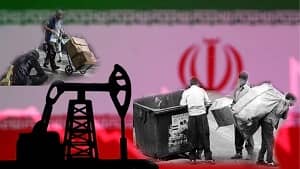
A sick political system inevitably breeds a sick economy. In an absolute dictatorship where freedom is eradicated, a healthy economy cannot exist. Iran’s cancer-stricken economy is the direct product of the regime’s totalitarian and oppressive policies. The economic crisis stems directly from the regime’s prioritization of tyranny over freedom and democracy.
Because of this, the economy has constantly teetered on the edge of a cliff, unable to be salvaged by any administration over the past two decades. Every government that has taken power has merely added another wall to the existing deadlock, making the structural problems more incurable. Today, the economy is trapped in one of its most sensitive and complex historical junctures, paralyzed by a state-controlled, command economy and non-developmental strategies.
In most parts of the world, the economy is the child of politics. However, in mullah-stricken Iran, the economy is the illegitimate offspring of the mullahs’ rule. This disease will never be cured unless the policymakers at the top are entirely removed. This reality has become so undeniable that even state-affiliated experts and media are forced to acknowledge it. On June 10, 2026, the state-run Jahan-e Sanat daily ran a striking headline that read: “Curing Iran’s sick economy by changing the policymaker.”
The Mullahs’ Greatest Nightmare: How the Post-Uprising Crackdown on Universities Exposes the Regime’s Fear of the Youth

The socio-economic and political situation in Iran has reached a hyper-critical stage. While the regime attempts to project strength and hide behind the noise of regional conflicts and negotiations, its true and overriding fear is an inevitable internal explosion. To prevent this, authorities have launched a hasty, brutal crackdown on universities, dispatching “disciplinary committees” to purge dissident students and strip universities of their core identity: freedom of thought.
Students currently find themselves trapped between two blades of the regime’s suppression machine: university disciplinary committees and the Revolutionary Courts. Despite the widespread suspension of in-person classes, a massive wave of suspensions and expulsions has been unleashed.
According to a June 1, 2026, report by the state-run Shargh newspaper, at least 352 students across four major universities in Tehran have been summoned or disciplined in just a few weeks. At Sharif University, five to seven students have been expelled, and over 20 suspended for up to three terms. At Beheshti (Melli) University, 25 students have been blocked from accessing educational systems. Iran University of Science and Technology has opened cases for over 100 students, while nearly 200 students at Tehran University have been summoned.
Iran: Imprisoned Mother Suffers Severe Nervous Breakdown After Learning of Family Tragedies
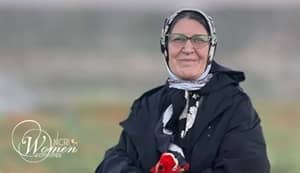
MASHHAD, Iran — An imprisoned mother, Ameneh Bayraghdari, has suffered a severe nervous breakdown inside the notorious Vakilabad Prison, and her physical condition is critical.
On June 9, 2026, the 61-year-old political prisoner from Fariman suffered a psychological collapse after receiving devastating family news. She learned that her husband suffered a stroke following her recent arrest and has been in a coma for months. Simultaneously, she was informed that her son is battling bone marrow cancer.
Ameneh Bayraghdari was arrested for the second time on May 2, 2026. For a mother whose husband is in a coma and whose son is fighting terminal cancer, continued imprisonment and the denial of her right to be with her ailing loved ones has created an intolerable psychological toll.
Bread Rationing and Soaring Prices Deepen Iran’s Cost-of-Living Crisis
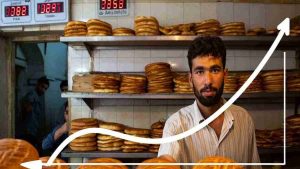
Iran’s worsening economic crisis has now reached one of the most basic necessities of daily life: bread. Reports from Tehran, Karaj, Isfahan, Razavi Khorasan, Mazandaran, and several other provinces indicate that, alongside both official and unofficial price hikes, some bakeries receiving subsidized flour have begun rationing bread sales, limiting the number of loaves each customer can purchase.
The development comes amid mounting economic pressure on Iranian households and growing public frustration over rising living costs. At the same time, public disputes among government officials, state-affiliated media outlets, and regime figures over responsibility for the country’s economic turmoil have become increasingly visible.
In several districts of Tehran, bakeries operating with subsidized flour have informed customers that they may purchase no more than three barbari loaves or two sangak loaves per visit. Some residents have also reported restrictions linked to bank cards, with purchases exceeding a certain number of loaves being blocked.
No Bomb Can Build Democracy, No Missile Can Replace the Will of a Nation

The Iranian regime’s decision on June 9 to launch dozens of missiles and ignite yet another regional confrontation has once again placed the Iranian people in the shadow of a dangerous and unnecessary war. As military retaliation targeted numerous regime military installations, it became clear—as it always does—that the ultimate victims of such adventurism are not those sitting in positions of power, but ordinary citizens already burdened by decades of repression, economic hardship, and political isolation.
At a moment when military tensions dominate headlines and fears of wider conflict continue to grow, a troubling reality has emerged inside Iran. Some citizens, exhausted by years of dictatorship, corruption, poverty, executions, and the systematic closure of all peaceful avenues for change, have begun to view the prospect of foreign military confrontation with a degree of hope.
This sentiment should not be mistaken for support for war. Rather, it reflects the depth of despair felt by millions of Iranians who have watched the regime crush dissent, silence opposition, and deny the population even the most basic political freedoms. When a society is deprived of meaningful pathways for change, some inevitably begin to look toward external events as a possible catalyst for transformation.
Privatization: The Transfer of Wealth to Power Circles in Iran’s Regime
Privatization has been one of the most significant economic policies of Iran’s regime over the past three decades. Regime officials have repeatedly presented this policy as a way to reduce the size of the government, increase efficiency, and strengthen the private sector. However, statistics published by official institutions show that a large portion of these transfers has been made not to an independent private sector but to entities affiliated with the ruling establishment, often through debt settlements. An examination of official data and recent examples of asset transfers presents a different picture of the privatization process in Iran.
The privatization policy entered a new phase on a large scale in 2005 following the implementation of the policies associated with Article 44 of the Constitution. Under these policies, approximately 80% of state-owned companies were supposed to be transferred to the private sector.
Execution of Ordinary Prisoners in Iran: Names That Must Not Be Forgotten

Although the Islamic Republic exploits the shadow and pretext of geopolitical challenges to level charges of espionage, enmity against God (moharebeh), and armed rebellion (baghi) against political prisoners and peaceful protesters in order to silence every critical voice, the shocking rate of executions in Iran against prisoners convicted of ordinary crimes must not be forgotten. This group of prisoners are themselves the primary victims of the regime’s flawed structural, social, and economic policies and the resulting absolute poverty, driven step-by-step toward delinquency.
Over a one-month period (from May 8 to June 8, 2026), the right to life was stripped from a vast number of ordinary crime prisoners; notably for charges where the possibility of a fair trial, due process, and an investigation into the root causes of the crime never existed. The forthcoming statistics represent only a fraction of the death sentences carried out regarding ordinary prisoners, the actual numbers of which are undoubtedly far higher than the names mentioned in this report due to information blockades and frequent internet shutdowns in Iran.
Why the Iranian Regime Rejects U.S. Deals: The Logic of Survival
Despite severe economic pressures, Tehran continues to resist agreements that could ease sanctions and unlock billions in assets.
The answer, according to this analysis, lies not in economics but in the regime’s fundamental logic of survival.
As Iran struggles with deep economic crises, a fundamental question arises: why do the Islamic Republic and the Islamic Revolutionary Guard Corps (IRGC) refuse to accept a nuclear agreement that could free blocked assets, lift oil sanctions, and pave the way for easier oil exports?
From a logical and pragmatic perspective, such an agreement could help revive the economy, reduce major livelihood challenges, and prevent the recurrence of a widespread uprising like the one that took place last January, which was met with severe repression and the killing of thousands. The answer, this analysis argues, lies in the Iranian regime survival strategy rather than in economic considerations alone.
MEK Supporters in Münster Mobilize for Paris Free Iran Rally Calling for Democratic Republic in Iran
Münster, Germany – June 10, 2026 – Supporters of the People’s Mojahedin Organization of Iran (PMOI/MEK) put up posters throughout Münster to mobilize support for the major Paris Free Iran Rally scheduled for June 20 in Paris under the slogan “A Democratic Republic for Iran.” The campaign aimed to encourage freedom-loving Iranians and international supporters to participate in the event, which is expected to draw more than 100,000 participants.

The activists rejected both monarchical and theocratic dictatorships and reaffirmed their opposition to executions, war, and the policy of appeasement toward the clerical regime. They emphasized that the only viable solution for Iran is the establishment of a democratic republic based on Mrs. Maryam Rajavi’s Ten-Point Plan.
St. Gallen, Switzerland: MEK Supporters Hold Book Stall and Exhibition Protesting Executions in Iran
St. Gallen, Switzerland – June 9, 2026: Supporters of the People’s Mojahedin Organization of Iran (PMOI/MEK) held a book stall and photo exhibition to protest the execution of political prisoners linked to the PMOI and of protesters detained during the January 2026 uprising. The event expressed support for the nationwide “No to Execution” campaign, called for immediate international action against the regime’s ongoing human rights abuses, and demanded the unconditional release of all political prisoners.

Wuppertal Event Denounces Iran Executions, Backs June 20 Paris Free Iran Rally
Wuppertal, Germany – June 9, 2026: Supporters of the People’s Mojahedin Organization of Iran (PMOI/MEK) held a photo exhibition to condemn the execution of political prisoners and protesters arrested during the January 2026 uprising. They called on the German government to take immediate action to halt executions in Iran and strongly condemned the mullahs’ regime, describing the executions as a blatant violation of human rights.

The participants also issued a strong call to action, urging freedom-loving Iranians and international supporters to join the major Free Iran rally in Paris on June 20 under the slogan “A Democratic Republic for Iran.”
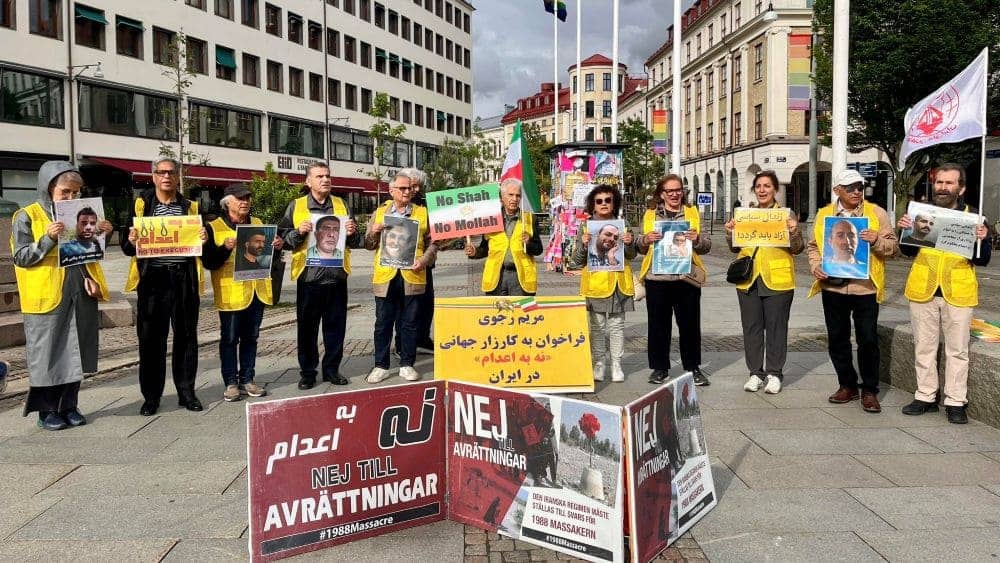
Gothenburg: MEK Supporters Mark 124th Week of “No to Execution Tuesdays” Across 56 Iranian Prisons
Gothenburg, Sweden — June 9, 2026: Supporters of the People’s Mojahedin Organization of Iran (PMOI/MEK) held a rally to mark the 124th consecutive week of the “No to Execution Tuesdays” campaign, a movement protesting the Iranian regime’s escalating executions and systemic repression. Protesters condemned the recent execution of political prisoners and demonstrators arrested during the January 2026 uprising.
Participants also highlighted the regime’s intensifying crackdown, the rising number of executions, and broader repressive measures, including nationwide internet shutdowns. They chanted slogans such as “Down with the executioner regime” and called for the immediate release of all political prisoners.