

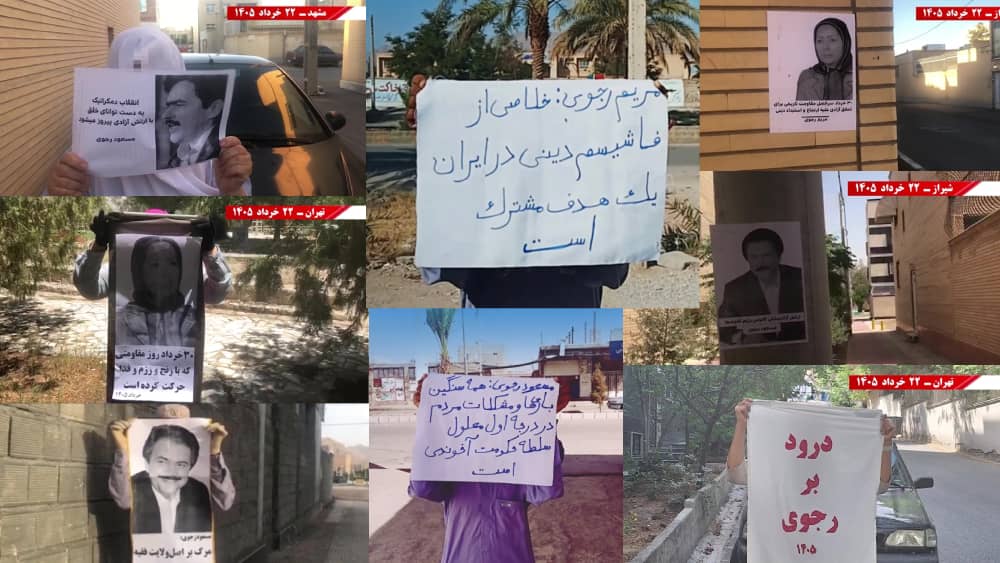
During the week of June 7–14, 2026, Iran witnessed a highly coordinated internal pushback against the regime’s capital punishment drive, led by MEK Resistance Units and political detainees. From anti-regime cell operations in major cities to a massive hunger strike spanning 56 prisons, the internal resistance directly challenged Tehran’s post-uprising crackdown. Operating despite localized internet shutdowns and thousands of recent state-ordered arrests, these underground networks successfully synchronized nationwide actions, exposing the regime’s internal crisis of social control.
June 13, 2026
To mark the 45th anniversary of the June 20 resistance, MEK Resistance Units launched coordinated cell operations across Tehran, Mashhad, Karaj, Isfahan, and Shiraz. Bypassing tight security perimeters, underground cells distributed resistance literature and displayed anti-regime slogans celebrating the Day of Martyrs and Political Prisoners, the founding of the National Liberation Army, and internal organizational milestones.
"As Iran navigates an era defined by deep societal friction and generational transition, the voices emerging from its prisons are doing more than protesting individual sentences," writes @MasumehBolurchi. #IranRevolution2026 https://t.co/o6z5rdbOyQ
— NCRI-FAC (@iran_policy) June 9, 2026
June 12, 2026
In Zahedan, Resistance Units executed a public placard campaign openly rejecting both the clerical regime and a return to monarchical rule. Activists posted signs reading “From Zahedan to Tehran, death to the oppressor, be it the Shah or the Leader,” setting a strict policy line against all forms of dictatorship. This deployment occurred despite the State Security Force announcing 6,500 nationwide arrests, including 567 individuals allegedly linked to the PMOI.
Concurrently, political prisoner Parisa Kamali smuggled an audio message from Yazd Central Prison condemning the regime’s systematic executions. Serving an eight-and-a-half-year sentence, Kamali demanded the immediate cancellation of death sentences for fellow detainees including Mohammad Javad Vafaei Sani, Farshad Etemadifar, Alireza Merdasi, Masoud Jamei, and Reza Abdali, while honoring prisoners like Vahid Bani-Amerian, Mohammad Taghvi, and Pouya Ghobadi.
June 12—Iran
PMOI/MEK Resistance Units commemorate the 45th anniversary of the June 20, 1981, uprising and express their solidarity and support for the upcoming rally of the Iranian Resistance.#100kFreeIranRally pic.twitter.com/4NQDIJ3Y4d— People's Mojahedin Organization of Iran (PMOI/MEK) (@Mojahedineng) June 14, 2026
June 9, 2026
Boxing champion Mohammad Javad Vafaei Sani smuggled a message from Vakilabad Prison in Mashhad after receiving his third death sentence, reaffirming his support for the MEK and active resistance.
Simultaneously, political prisoners launched the 124th consecutive week of the “No to Executions Tuesdays” campaign, holding hunger strikes across 56 facilities to protest 49 hangings carried out since late May. In Lakan Prison in Rasht, the death sentence for MEK supporter Yaghoub Derakhshan was confirmed via remote video show trials without legal counsel. In the overcrowded Sheiban Prison in Ahvaz, which suffers from severe water shortages, prisoners Farshad Etemadifar, Alireza Merdasi, Masoud Jamei, and Reza Abdali faced imminent execution, alongside new death sentences issued for Hassan Maslavi, Yasin Shahbakhsh, and Ali Kamali. The striking prisoners released a joint statement backing recent student street protests against educational injustice.
According to the movement’s tracking data, this coordinated hunger strike simultaneously took place in Evin, Ghezel Hesar, Karaj Central, Fardis Karaj, Greater Tehran, Qarchak, Khorin Varamin, Chubindar Qazvin, Ahar, Arak, Langerud Qom, Khorramabad, Borujerd, Yasuj, Asadabad Isfahan, Dastgerd Isfahan, Sheiban Ahvaz, Sepidar Ahvaz, Nezam Shiraz, Adelabad Shiraz, Firuzabad Fars, Dehdasht, Zahedan, Borazjan, Ramhormoz, Behbahan, Bam, Yazd, Kahnuj, Tabas, Birjand Central, Mashhad, Gorgan, Sabzevar, Gonbad-e Kavus, Qaemshahr, Rasht, Rudsar, Haviq Talesh, Ezbaram Lahijan, Dizel Abad Kermanshah, Ardabil, Tabriz, Urmia, Salmas, Khoy, Naqadeh, Miandoab, Mahabad, Bukan, Saqqez, Baneh, Marivan, Sanandaj, Kamyaran, and Ilam prisons.
🚨 Iran: Political Prisoner Parisa Kamali Condemns Executions – Simay Azadi Exclusive
In an exclusive voice message from Parisa Kamali, a political prisoner and PMOI supporter held in Yazd Central Prison, she declared:
“No to executions! They are nothing but a tool of terror… pic.twitter.com/cj1qtbd9Z6
— SIMAY AZADI TV (@en_simayazadi) June 9, 2026
Conclusion
The widespread domestic actions reveal that Tehran’s strategy of mass executions has failed to paralyze internal dissent following the January 2026 uprising. Instead, it has consolidated a two-front resistance structure: while external networks operate freely abroad, internal networks are actively breaking through internet blackouts and severe security crackdowns on the ground. This dual dynamic highlights an irreversible deadlock for the clerical establishment, showing that its survival relies entirely on a machinery of terror that no longer deters organized resistance.