

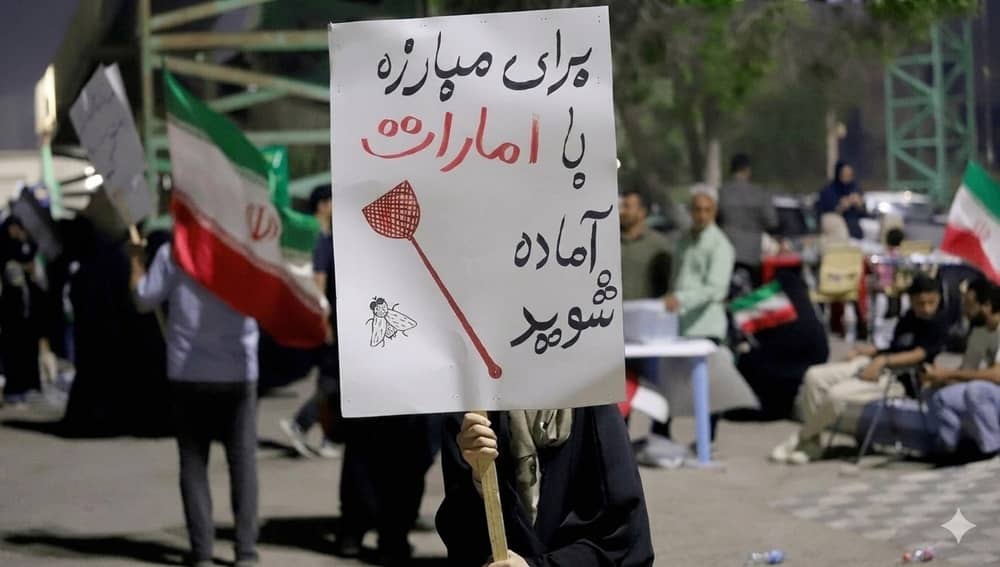
A brewing diplomatic settlement between Tehran and Washington has ignited an unprecedented domestic crisis within the Iranian regime, exposing severe structural fractures at the highest levels of the clerical establishment. As intense political warfare spills directly onto the streets of Tehran and Mashhad, the sudden prospect of an agreement has shattered the regime’s facade of unity. The crisis has drawn sharp battle lines between those who believe the system can survive through controlled concessions, and factions who view any compromise as a roadmap to eroding morale and exposing vulnerability before an increasingly explosive society.
On the night of June 13, 2026, highly organized groups of paramilitary Basij forces and hardline “Dalvapasān” (the Anxious) staged furious demonstrations. Gathering outside the Ministry of Foreign Affairs and across Tehran’s Ibn Sina Square, hundreds of shroud-clad protesters burned with rage against their own government. They directed their vitriol at Foreign Minister Abbas Araghchi and Parliament Speaker Mohammad Bagher Ghalibaf, the chief architects of the negotiations. Protesters chanted aggressive slogans, including “Araghchi, have some shame, let go of the country,” and “Ghalibaf, Araghchi, what about my Leader’s blood?”.
The sudden unrest highlights a deeper anxiety among ultraconservative factions who view any compromise with the West as a recipe that will erode morale among the regime’s core base. Inside the political apparatus, at least 16 members of the parliament openly joined the nightly street protests to denounce the secrecy surrounding the diplomatic tract. Hardliners argue that the proposed deal fundamentally weakens Iran’s geopolitical leverage while failing to guarantee concrete economic relief.
"The Iranian regime is tearing itself apart because every faction believes it alone knows how to preserve the clerical dictatorship," @MasumehBolurchi writes.https://t.co/kCPU2llM63
— NCRI-FAC (@iran_policy) June 6, 2026
The Hardline Backlash
Leading the domestic charge against the diplomatic framework are prominent figures within the regime’s ultraconservative core. Member of Parliament Mohammad Manan-Raisi physically joined the street protests, delivering a fiery speech that questioned the non-negotiable parameters of the pact. Manan-Raisi fiercely rebuked the administration, stating: “The memorandum of understanding that is about to be signed completely violates the red lines of the leadership. Do you really want to sign this agreement on the birthday of our martyred imam’s killer, Donald Trump? Sirs, have just an ounce of honor!”
The factional divide deepened further as hardline figures took to social media to systematically dismantle the state’s official diplomatic narrative. MP Kamran Ghazanfari explicitly challenged the state’s claims of diplomatic triumph. In a blunt post on X (formerly Twitter), Ghazanfari stated: “The claim that we have won and America has retreated is a lie”.
Simultaneously, MP Mahmoud Nabaviyan, a member of the National Security Committee who claims to have reviewed the final draft text, warned of permanent strategic submission. In an interview broadcast on state television, Nabaviyan declared that under the agreement, “we will officially become a colony of America”. He noted that while Iran’s primary maritime leverage—the immediate, unrestricted opening of the Strait of Hormuz—is guaranteed, “the lifting of sanctions and the release of frozen funds remain ambiguous”. Furthermore, Nabaviyan revealed that Iran’s enriched uranium stockpile would be forcibly diluted under the pact.
Power Dynamics in Iran and #MojtabaKhamenei’s Inner Circlehttps://t.co/eTfcnFH14Z
— NCRI-FAC (@iran_policy) June 3, 2026
Red Lines Challenged
The ideological opposition has extended deep into Iran’s powerful clerical bodies, including the Assembly of Experts. Mohsen Araki, a member of the Assembly’s presidential board, issued an uncompromising religious and political warning regarding the negotiations. Araki strictly noted that deviating even “a single hair” from the established boundaries of the Supreme Leader constitutes an explicit violation of Sharia law. He insisted that “we can only succeed with America through the path of power,” dismissing diplomacy as a dead end.
The state media apparatus has similarly fractured over the unfolding events. On June 14, 2026, Javan Online, a media outlet closely affiliated with the Islamic Revolutionary Guard Corps (IRGC), published a scathing editorial condemning the street protests. The outlet accused hardline speakers of sowing deep discord and “scattering the seeds of division and schism among the people”. Javan reported with alarm that protesters were openly calling for the dissolution of the Supreme National Security Council and threatening to tear down Parliament and the Foreign Ministry.
In an attempt to contain the escalating political civil war, Judiciary Chief Gholam-Hossein Mohseni-Ejei issued an urgent public appeal. Ejei cautioned factions against creating systemic vulnerabilities, warning: “Do not let ill-wishers infiltrate our unified ranks”. To appease the hardline base, he added that the judiciary maintains “absolutely no trust in the Americans”. Meanwhile, Mashhad’s influential Friday Prayer Leader, Ahmad Alamolhoda, reminded the public on state television that “no agreement will be acceptable until it is signed by the Leader.”
"Infighting has intensified over the regime’s survival, as it is being torn apart on two fronts. One side warns that continued war footing or prolonged #economic siege will trigger nationwide unrest and “the collapse of society from within” due to factional quarrels," Farid…
— NCRI-FAC (@iran_policy) May 22, 2026
The Succession Shadow
Behind the immediate fury over the Islamabad Accords lies an even more volatile political development: a direct battle over the future leadership of the clerical dictaotorship. In a highly revealing counter-attack, rival political figure Esmaeil Rashidi Kuchi published an explosive statement claiming the true, underlying targets of the hardline rebellion. According to Rashidi Kuchi, the street protests are not merely an objection to foreign policy, but a calculated preemptive strike against Mojtaba Khamenei, the newly designated leader within the regime’s hierarchy.
Rashidi Kuchi stressed that ultraconservative factions are terrified of being permanently marginalized by a shifting alignment at the highest levels of the Supreme Leader’s inner circle. “The extremists are officially calling for street riots,” Rashidi Kuchi warned, noting that they are “recklessly attacking the new leader” because “they know they are bound for the dustbin of history”.
In response to the domestic chaos, Minister of Culture and Islamic Guidance Abbas Salehi attempted to restore order by referencing an explicit written directive from Mojtaba Khamenei sent to Parliament on May 28, 2026. The directive explicitly commanded officials not to transform political differences into systemic internal warfare, urging them to act as a “manifestation of the nation’s cohesion”. Highlighting the profound anxiety gripping the establishment, the pro-Ghalibaf daily Sobhe-No ran a striking front-page headline on June 14, 2026, declaring: “The unity-breakers are at work”.