

THIS PAGE WILL BE UPDATED WITH THE LATEST NEWS
UPDATE: 9:00 PM CEST
Iranian Opposition Leader Welcomes End of War, Calls for Halt to Executions

Iranian opposition leader-in-exile Maryam Rajavi says that the National Council of Resistance of Iran, which has worked for freedom and peace for nearly five decades, welcomes any agreement that brings an end to the war and the suffering of the Iranian people.
According to the statement, no one in Iran wanted the war except the remnants of the mullahs’ regime and the Shah’s supporters. The NCRI argues that efforts to develop nuclear weapons, promote war, and interfere in the affairs of neighboring countries are all part of the survival strategy of the religious dictatorship ruling Iran, and that it will not abandon these policies as long as it is able to continue them.
The statement further stresses that war serves as a shield protecting the regime from popular uprisings, whereas peace and a ceasefire are, in the words attributed to Iran’s Supreme Leader Ali Khamenei, like “poison.” The NCRI maintains that overthrowing the regime is the responsibility of the Iranian people and their organized resistance.
Rajavi also emphasized that any international agreement aimed at ending the war should include a halt to the executions of political prisoners and the killing of protesters.
UPDATE: 6:00 PM CEST
Will the MOU Trigger a Popular Revolt in Iran?

Consider the answer to this question a Rumsfeldian “known unknown.”
Duane referred to the known unknowns and the unknown unknowns in the Memorandum of Understanding (MOU) with Iran this morning. Most of the acute questions around both involve the motives of the IRGC, whether Hezbollah will attempt to continue the war, the capability of the Lebanese government to disarm the IRGC proxy army, and, of course, the Strait of Hormuz, about which more in a moment.
One particular frustration with the announcement yesterday relates to the initial promise from Donald Trump that “help is on the way” to the Iranian people. The IRGC regime massacred tens of thousands of Iranians in early January after a currency collapse prompted a popular uprising. Part of the rationale for the war from both Trump and Benjamin Netanyahu was to free the people from the regime. Both spoke explicitly of a time at which the Iranians could rise up and take back their country. Instead, the US and other Gulf states have cut a deal with the oppressors, although Netanyahu clearly has been forced into accepting it.
Is that the end of a popular uprising? Or is it the beginning? The leader of one major Iranian resistance group argues that it’s the latter. Maryam Rajavi, the president-elect of the National Council of Resistance of Iran (NCRI), put out a statement yesterday in support of the MOU. The end of the war, Rajavi argues, is what will finally allow a popular uprising to succeed:
UPDATE: 5:00 PM CEST
The Diplomat’s In-Depth Interview with a Member of Iran’s Resistance Units

For years, a central question has persisted: does an organized resistance exist inside Iran—one that extends beyond spontaneous uprisings and periodic eruptions of popular anger?
While international attention remains largely focused on war, military strikes, and more recently the endless negotiations between the United States and Iran aimed at maintaining a fragile ceasefire—rather than achieving a truly lasting peace—the fate of the Iranian people once again appears to have been pushed into the background.
Yet it is inside Iran that a decisive struggle is unfolding.
The regime, uncompromising in international negotiations and reluctant to make even the slightest concession, does not appear likely to collapse as a result of external military intervention. It does, however, seem increasingly weakened and isolated within its own society. More than war, it is its own population that it fears.
Even the signing of an agreement, however imperfect, would not solve the regime’s internal problems—quite the opposite. In recent weeks, the near-daily executions of members of resistance units linked to the People’s Mojahedin Organization of Iran, as well as young participants in anti-government uprisings, have reflected an extreme intensification of repression.
National Council of Resistance of Iran Reacts to News of Peace Deal Between U.S. and Iran

Maryam Rajavi, president-elect of the National Council of Resistance of Iran (NCRI), reacted to the news of a peace deal between the U.S. and Iran on Sunday. “The Iranian Resistance, which for nearly five decades has sought freedom and peace, welcomes any understanding to end the war and the suffering of the Iranian people. In Iran, no one except the remnants of the mullahs and the Shah has wanted or wants war,” she said in a statement obtained by Just the News.
“The effort to produce nuclear weapons, warmongering, and meddling in the countries of the region are part of the survival strategy of the religious fascism ruling Iran, and it will not abandon them as long as it can,” she added.
She said that war is the regime’s “shield against popular uprisings, while peace and a ceasefire are, as Khomeini put it, like ‘poison’ for it.”
UPDATE: 7:00 AM CEST
PMOI Resistance Units Mark Anniversary of June 20 Uprising Across Iran Ahead of Historic Paris Rally
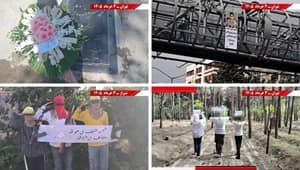
On June 12, 2026, the People’s Mojahedin Organization of Iran (PMOI/MEK) Resistance Units launched a widespread, highly coordinated anti-repression campaign across Iran. Marking the 45th anniversary of the historic June 20, 1981 uprising, these activists took to the streets to express their solidarity with the upcoming rally of the Iranian Resistance.
Operating under an atmosphere of severe domestic suppression, the Resistance Units and rebellious youth successfully executed simultaneous operations in Tehran and 16 other major cities. This nationwide campaign spanned across key provincial capitals and cities, including Karaj, Mashhad, Isfahan, Shiraz, Zahedan, and Qazvin. The actions serve as a stark reminder to the ruling clerics that the resistance movement remains deeply rooted inside the country and possesses the operational capacity to openly challenge the regime’s authority.
During the June 12 campaign, Resistance Units members utilized a variety of tactics to broadcast their anti-regime messages in public spaces, parks, and highways. Their activities included holding placards, installing posters of Iranian Resistance leader Massoud Rajavi and NCRI president-elect Maryam Rajavi, painting graffiti, and distributing flyers.
Iran: Primary School Teacher Dismissed from Education Ministry
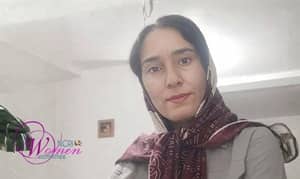
Forough Khosravi, a primary school teacher from Behbahan who worked in schools in Aghajari, has been dismissed from the Ministry of Education. According to her newly issued employment ruling, her employment status has been terminated under the designation “contract cancellation.”
The decision was communicated even though Khosravi had previously been sentenced in a separate case to a four-month temporary suspension from her teaching position. Her dismissal was carried out without following standard legal procedures and was based solely on a confidential letter. According to individuals close to her, she was never provided with a copy of the document.
Forough Khosravi had previously faced both judicial and security-related cases. A 15-year prison sentence issued against her in one case was suspended, while in another case she was sentenced to a four-month temporary suspension from public service due to her online activities and the expression of her views.
June 20, 1981: The Historical Record Challenges Tehran’s Narrative About the PMOI and Armed Resistance
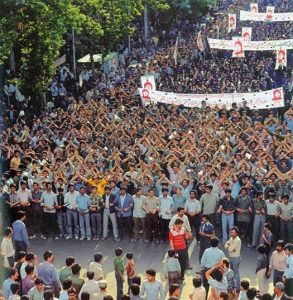
For more than four decades, the Mullahs’ regime has relied on a single narrative to explain the events of June 20, 1981: that the People’s Mojahedin Organization of Iran (PMOI/MEK) abruptly abandoned politics and launched an armed uprising against the state. This account has been repeated through state media, school textbooks, official speeches, and regime-sponsored films, becoming a central pillar of the regime’s historical propaganda.
Yet a closer examination of historical documents, eyewitness testimonies, and even statements made by former regime officials paints a very different picture. Rather than demonstrating that the PMOI initiated violence, the historical record suggests that armed resistance emerged only after years of systematic repression, political exclusion, and state-sponsored violence had effectively eliminated all peaceful avenues of opposition.
Between February 1979 and June 1981, a period commonly referred to by supporters of the Iranian Resistance as the “political phase,” the PMOI pursued a strategy based on peaceful political participation. The organization took part in elections, published newspapers and political analyses, organized public meetings, and sought to operate within the political framework that emerged after the fall of the Shah.
During this period, however, the newly established clerical regime increasingly moved to monopolize power. Political pluralism was gradually suppressed, independent voices were marginalized, and opposition organizations faced growing restrictions.
According to numerous historical accounts, by the late 1970s and early 1980s dozens of PMOI members and supporters had already been killed in attacks by security forces and pro-regime vigilante groups. Thousands more were arrested, assaulted, or injured while selling publications, participating in meetings, or engaging in political activities.
Iran’s Rental Housing Crisis Deepens as Families Spend Over 70% of Their Income on Rent
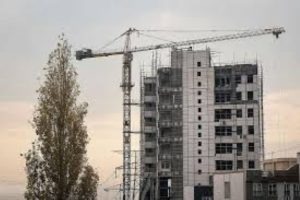
Iran’s rental housing market has become one of the most severe sources of economic pressure on households, as soaring rents, declining purchasing power, and years of inflation continue to erode living standards across the country. For millions of Iranians, securing adequate housing has evolved from a basic necessity into a daily struggle for survival.
In the latest acknowledgment of the crisis, Abdoljalal Iri, a member of the Iranian Parliament’s Civil Engineering Commission, stated that in some cities more than 70 percent of household income is now spent on rent. His remarks highlight the growing burden facing tenants and underscore the extent to which housing costs have outpaced earnings.
According to Iri, the relentless rise in rental prices has significantly reduced families’ ability to pay for other essential needs, including food, healthcare, education, and transportation. He also noted that many tenants have been forced to leave their neighborhoods and relocate to suburban areas, smaller apartments, or lower-quality housing in an effort to reduce costs.
Factional War Over a U.S. Agreement Spills into Iran’s Streets as Rifts Open Across Regime Factions
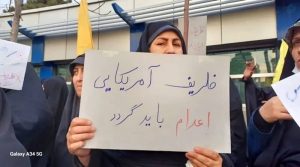
As reports of a final agreement between Iran’s regime and the United States grow louder, signs of a deep political crisis within the ruling establishment have also become more apparent. Disputes over the terms of a potential agreement have moved beyond closed-door discussions and have now spilled into street gatherings, official regime platforms, and media outlets affiliated with various regime factions.
On the evening of June 13, groups of hardline supporters of the regime held nighttime gatherings in Tehran and several other cities, strongly opposing the negotiation process and the officials involved in it. At Ibn Sina Square in Tehran, slogans such as “Ghalibaf, Araghchi, what about my leader’s blood?”, “Araghchi, have some shame, leave America alone,” “Death to Araghchi, dishonorable infiltrator,” and “Ghalibaf, Araghchi, resign, resign” dominated the gathering.
The anger of the regime-aligned protesters reached such a level that some speakers and participants accused government officials and the negotiating team of “treason” and attacked them with unusually harsh language. One protester outside the Foreign Ministry angrily insulted Abbas Araghchi, Iran’s regime foreign minister, blaming him for the country’s political deadlocks.
MEK Supporters in Aarhus Promote June 20 Paris Free Iran Rally for a Democratic Republic
Aarhus, Denmark – June 13, 2026: In the lead-up to the grand June 20 rally in Paris, supporters of the People’s Mojahedin Organization of Iran (PMOI/MEK) have launched activities in Aarhus to promote the event. Meanwhile, supporters in Aarhus are urging freedom-loving Iranians to join the June 20 Free Iran Rally, where 100,000 participants are expected to gather at Place Vauban in Paris’s 7th district, calling for an end to executions and expressing support for a democratic republic in Iran.

The June 20 Free Iran rally in Paris, to be held under the slogan “A Democratic Republic for Iran,” will reject both monarchical and theocratic dictatorships, emphasizing a third alternative based on democracy and popular sovereignty.
Malmö Rally Condemns Iran Executions, Calls for Joining the June 20 Paris Free Iran Rally
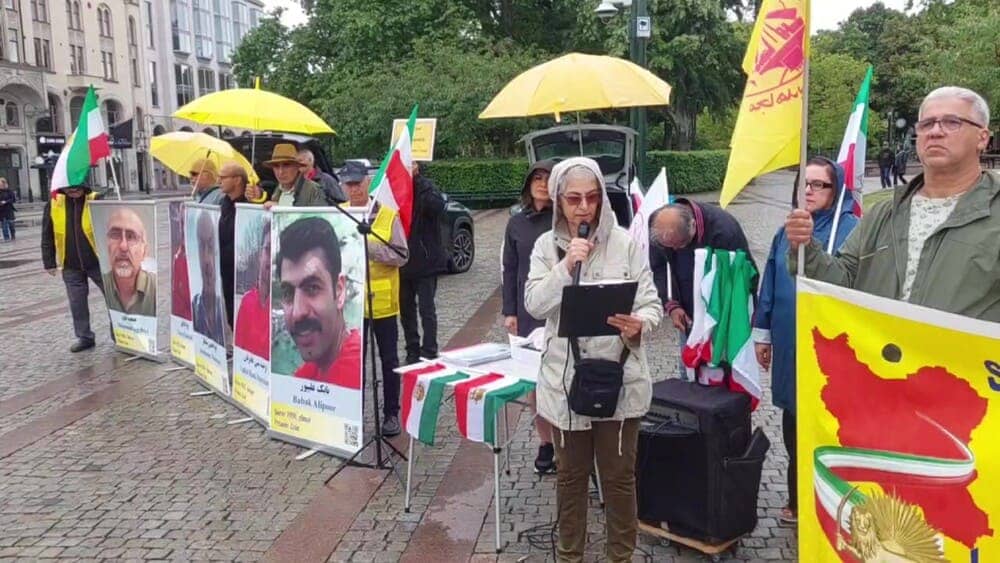
Malmö, Sweden – June 13, 2026: Supporters of the National Council of Resistance of Iran (NCRI) and the People’s Mojahedin Organization of Iran (PMOI/MEK) held a rally to protest the execution of political prisoners in Iran, including PMOI members and protesters detained during the January 2026 uprising.

Supporters of the Iranian Resistance expressed full backing for the National Council of Resistance of Iran (NCRI) and the provisional government framework presented by Mrs. Maryam Rajavi, President-elect of the NCRI. This framework is based on the Iranian Resistance’s Ten-Point Plan for establishing a democratic republic in Iran.