

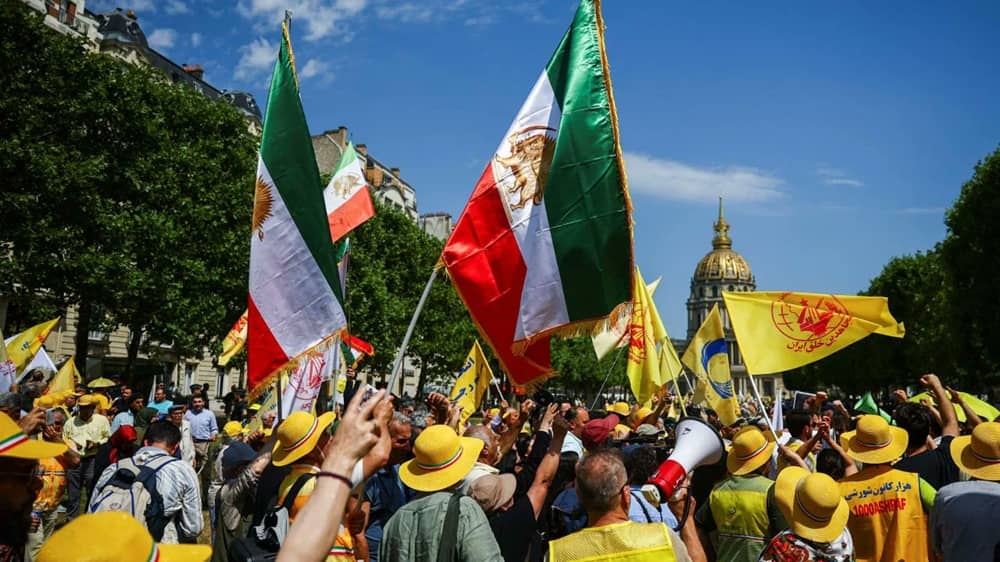
In a week-long wave of coordinated defiance from June 14 to 21, 2026, supporters of the National Council of Resistance of Iran (NCRI) and the People’s Mojahedin Organization of Iran (PMOI/MEK) launched a sweeping global mobilization — staging rallies and bookstands, dispatching long-distance bus caravans from cities across Europe and beyond, and mounting public actions — to condemn the Iranian regime’s escalating executions and demand a democratic republic. The campaign culminated on June 20 in Paris, where tens of thousands of Iranian exiles and international supporters gathered at Place Vauban, transforming the prohibited demonstration into a powerful display of resistance that underscored the regime’s growing international isolation and the expanding appeal of the NCRI’s democratic alternative.
June 20, 2026
Nearly 100,000 Iranian exiles and freedom supporters had been expected to take part in the June 20 demonstration in Paris, titled “Iran: No to Execution, Yes to Peace and Freedom.” Many had already arrived in the French capital after travelling for days in organised bus caravans and convoys from across Europe, while others had flown in from the United States, Canada, and Australia. For many of those who had reached Paris, the last-minute police ban on the planned demonstration near Place Vauban in the city’s 7th arrondissement came as a profound shock, as they had not been aware of the decision before arriving in the city.
In the hours that followed, many Iranians and supporters of freedom who were already present in Paris expressed their disappointment and concern in different parts of the city. Through chants, placards, and conversations with passers-by and the media, they conveyed the message that had brought them to France: no to executions, no to repression, and yes to peace, freedom, and democratic change in Iran.
They will do everything in their power to silence us…
You can kill our rally, but you can’t kill our voice! #ParisFreeIranRally#100kFreeIranRally pic.twitter.com/Q0SetbANkw
— OIAC: Organization of Iranian American Communities (@OrgIAC) June 20, 2026
Participants condemned the Iranian regime’s internal repression and political executions while expressing support for a democratic republic that rejects both monarchical and theocratic rule. Reuters images captured a woman holding a flag bearing the slogan “No Shah, no mullahs,” police maintaining a visible presence, and ordinary demonstrators gathered in the area. The mobilisation also marked the 45th anniversary of the historic June 20, 1981, demonstrations, serving as both a tribute to political prisoners and martyrs and a renewed call for accountability.
June 19, 2026
In the immediate lead-up to the Paris rally, supporters organized the departure of buses and caravans from multiple European cities toward Paris. Convoys set out from Malmö in Sweden and Aarhus in Denmark, while additional bus movements originated in Berlin, Hamburg, Heidelberg, and Munich in Germany, as well as from the Netherlands and Copenhagen in Denmark. In Paris itself, activists set up book tables and issued direct calls urging broader participation in the upcoming demonstration. More than 260 parliamentary groups, human rights organizations, trade unions, and civil society associations from across Europe and beyond released a joint statement of solidarity. The signatories, representing a wide spectrum that included the Italian Inter-Parliamentary Committee for a Free Iran, the Romanian Parliamentary Committee in Support of a Free Iran, Norwegian Friends of Free Iran Against Fundamentalism, the Dutch Group of Friends of a Free Iran, the British Committee for Freedom in Iran, and parallel bodies from Switzerland, Poland, Germany, and Australia, explicitly endorsed the rally as an act of solidarity with the Iranian people.
They paid tribute to the tens of thousands of Iranians who have lost their lives in the struggle for freedom and democracy, rejected any return to dictatorship whether under the Shah or the current clerical rulers, and expressed support for the NCRI’s initiative to form a provisional government based on its Ten-Point Plan. That plan, the statement noted, encompasses human rights protections, freedom, a democratic republic with separation of religion and state, pluralism, gender equality, abolition of the death penalty, rejection of discrimination, a non-nuclear Iran, an independent judiciary, and peaceful coexistence. Labor unions from Trondheim and other locations in Norway and Denmark, along with confederations in Spain, Romania, and Italy, joined the declaration, as did numerous NGOs from Italy, Germany, the United States, Australia, and Georgia.
Rassemblés à Paris pour lors d’un rassemblement pacifique prévu depuis deux mois en coordination avec la police.
Faire taire 100 000 voix pour un Iran démocratique et libre et contre les exécutions récompense la répression de Téhéran.
Le monde doit se tenir aux côtés du… pic.twitter.com/UuAsPEGqsZ
— Comité d'amitiés franco-iranienne (@cafi0120) June 20, 2026
June 16, 2026
In Gothenburg, Sweden, supporters of the People’s Mojahedin Organization of Iran held a rally marking the 125th consecutive week of the “No to Execution Tuesdays” campaign. Participants condemned the Iranian regime’s accelerating executions of political prisoners and demonstrators detained during the January 2026 uprising, while highlighting intensified crackdowns, nationwide internet shutdowns, and broader repressive measures. Demonstrators chanted slogans against the “executioner regime” and expressed explicit support for Maryam Rajavi, President-elect of the National Council of Resistance of Iran, urging the global expansion of the anti-execution campaign.
June 13, 2026
Also in Gothenburg, a separate rally protested the executions of political prisoners, including members of the People’s Mojahedin Organization of Iran and protesters arrested during the January 2026 uprising. Speakers and participants rejected both the former Shah’s rule and the current clerical regime, while affirming support for the democratic alternative advanced by the NCRI and its Ten-Point Plan, which emphasizes pluralism, gender equality, separation of religion and state, and respect for human rights. The gathering called on the Swedish government to take firm measures against the Iranian regime’s ongoing executions and alleged terrorist activities, including the closure of the regime’s embassy in Stockholm, described as a center for espionage and terrorism, and demanded the immediate, unconditional release of all political prisoners.
Try all they might, they will never silence the voices of the Iranian People. ⬇️https://t.co/lViIs8UJgx
— OIAC: Organization of Iranian American Communities (@OrgIAC) June 20, 2026
Throughout the third week of June 2026, parallel mobilization efforts took place in Bremen, Germany, and outside the Iranian regime’s embassy in Bern, Switzerland, where supporters promoted the Paris rally and called on freedom-loving Iranians to join the convergence at Place Vauban, with organizers projecting a turnout of up to 100,000 participants. These activities formed part of a broader European campaign in which supporters from distant cities undertook lengthy journeys by bus and caravan, expending considerable time and energy to reach the central demonstration in Paris.
The Iranian regime’s reliance on mass executions and intensified domestic repression has demonstrably backfired, transforming what was intended as a tool of intimidation into a catalyst for unprecedented international mobilization and unity among Iranian exiles and their Western allies. Far from projecting invincibility, the clerical leadership now confronts a stark internal deadlock: its strategy of terror has failed to silence dissent at home or abroad, instead fueling coordinated cross-border solidarity that bridges parliamentary bodies, trade unions, and human rights networks on multiple continents. The scale of the Paris convergence, achieved despite an official ban, and the explicit endorsement of a democratic republican alternative grounded in the Ten-Point Plan, underscore that the regime’s dual pillars of fear and ideological rigidity are eroding under the weight of sustained popular rejection. This dynamic reveals a leadership trapped between escalating brutality that only deepens its isolation and any meaningful reform that would threaten its survival, leaving the path toward a pluralistic, non-nuclear, and rights-based Iran increasingly visible to both Iranians and the international community.