

THIS PAGE WILL BE UPDATED WITH THE LATEST NEWS
UPDATE: 8:30 AM CEST
Resistance Units Target the Regime’s Repressive Apparatus Amidst a Wave of State Executions
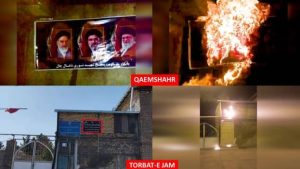
Across Iran, the PMOI/MEK Resistance Units are continuing their daring operations, sending a clear message of unbroken defiance against the regime’s escalating repressive measures and threats. As the ruling religious dictatorship grapples with a profound fear of collapse and accelerates its execution machine to terrorize a restive society, the Resistance Units are actively demonstrating that brutal state tactics cannot suppress the Iranian people.
In late June, Resistance Units carried out a highly coordinated wave of anti-regime activities spanning major cities nationwide, including Tehran, Isfahan, Shiraz, Mashhad, Karaj, Zahedan, and Kermanshah. The operations directly challenged the regime’s security apparatus by targeting and setting fire to the entrances and signposts of IRGC Basij bases, targeting a headquarters of the regime’s repressive security forces in Saqqez, and targeting a regime center for spreading fundamentalism and terrorism in Borujen.
Furthermore, Resistance Units systematically set fire to massive propaganda banners and posters featuring regime founder Ruhollah Khomeini, eliminated former supreme leader Ali Khamenei, current supreme leader Mojtaba Khamenei, and other eliminated senior regime officials. During a daytime operation in Isfahan, Resistance Units set fire to a poster of Mojtaba Khamenei while echoing the ultimate goal of the Iranian populace, chanting, “Down with the rule of the mullahs, viva the National Liberation Army.”
Iran: Female Lawyer in Shiraz Sentenced to 6 Years in Jail
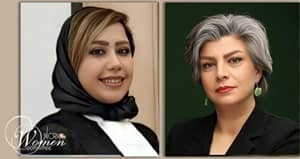
Elham Zeraatpisheh, a female lawyer, has been sentenced by Branch 1 of the Revolutionary Court in Shiraz to six years in prison, along with additional penalties.
At the same time, Astareh Ansari, also a lawyer, remains detained at Adelabad Prison in Shiraz without a final legal determination and without access to medical care.
According to the court’s ruling, Elham Zeraatpisheh was sentenced to five years in prison on the charge of “assembly and collusion against national security” and one additional year on the charge of “propaganda against the state.” The court also imposed supplementary penalties, including a two-year travel ban and the revocation of her passport.
On May 4, 2026, security forces intercepted and arrested Elham Zera’atpisheh, an attorney, in front of the Shiraz Implementation of Verdicts’ Courthouse. She was subsequently transported to an undisclosed location. This attorney had previously been targeted and detained by security forces during the 2022 nationwide protests.
Iran’s Housing Crisis Deepens After War, Leaving Millions Facing Rising Rents and Growing Uncertainty
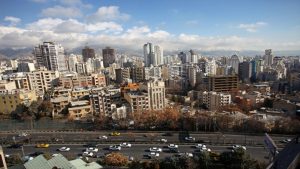
Long before the recent war, Iran’s housing sector was one of the country’s most severe economic and social challenges. For millions of tenants and low-income households, securing affordable housing had become increasingly difficult amid years of high inflation, declining purchasing power, and chronic shortages.
The aftermath of the recent conflict has intensified those problems. Damage to residential neighborhoods, the displacement of families, increased demand for rental housing, and slow reconstruction efforts have placed additional strain on a market that was already under immense pressure.
As a result, housing affordability has become an even greater concern for millions of Iranians struggling to cope with a worsening cost-of-living crisis.
According to the latest official figures, annual rent inflation in Iran has exceeded 33 percent, while year-on-year rental inflation stands at approximately 31 percent.
Iran Sentences 25-Year-Old Female Political Prisoner to Death, Prompting Urgent Calls for International Action

Iran’s campaign of repression against political dissidents has entered another alarming phase following the reported death sentence handed down to Arghavan Fallahi, a 25-year-old political prisoner and supporter of the People’s Mojahedin Organization of Iran (PMOI/MEK).
According to the National Council of Resistance of Iran (NCRI), Branch 15 of Tehran’s Revolutionary Court, presided over by the notorious Judge Abolqasem Salavati, sentenced Fallahi to death. The ruling was officially communicated to her lawyer on July 1, 2026 (10 Tir 1405). The NCRI described the verdict as a “criminal sentence” and warned that Fallahi’s life is in immediate danger unless the international community acts swiftly.
The NCRI has called on the United Nations, international human rights organizations, and governments worldwide to intervene immediately to prevent the execution.
The organization also renewed its longstanding demand for an independent international fact-finding mission to visit Iranian prisons and meet directly with political prisoners, arguing that increasing numbers of detainees face execution after proceedings that fail to meet basic international legal standards.
Iran Sees Surge in Public Protests as Economic Hardship Deepens After War
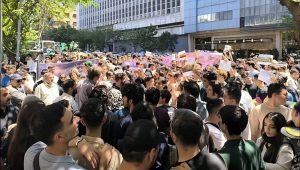
The death of Supreme Leader Ali Khamenei and the end of the recent war have pushed Iran into a new phase of political uncertainty and economic instability, triggering a sharp increase in public protests across the country.
Despite the regime’s efforts to project an orderly transfer of power and a return to stability, the weeks following the conflict have exposed mounting structural crises. Rather than restoring public confidence, the post-war period has been marked by worsening inflation, unemployment, declining living standards, and expanding social unrest.
Against this backdrop, workers, pensioners, students, farmers, truck drivers, healthcare workers, and numerous other social groups have taken to the streets, demanding solutions to long-standing economic grievances while increasingly criticizing government policies.
According to compiled reports, at least 135 separate protests, strikes, and demonstrations took place across Iran during June 2026, reflecting the breadth of dissatisfaction affecting nearly every sector of society.
War as Governance: Why Iran’s Rulers Cannot Survive Without Permanent Crisis

When Ruhollah Khomeini uttered those words during the Iran-Iraq War, many viewed them as revolutionary rhetoric. History, however, has shown that they became something far more consequential—a governing doctrine. For the regime built upon the doctrine of Velayat-e Faqih, perpetual confrontation has never been merely a security policy. It has been an indispensable mechanism for preserving power, suppressing dissent, and diverting public attention from mounting domestic failures.
Ali Khamenei later reaffirmed the same philosophy in different words. Defending the regime’s regional interventions, he argued that if Iran did not fight in Syria, Lebanon, and Yemen, it would eventually have to fight “in Tehran and Hamadan.” The statement revealed a worldview in which exporting conflict is considered essential to maintaining internal control.
Today, that doctrine is facing its greatest test.
With the recent regional conflict subsiding and diplomatic negotiations once again drifting into uncertainty, the regime can no longer hide behind the fog of war.
Iranian Regime Moves to Resume Oil Sales to Japan
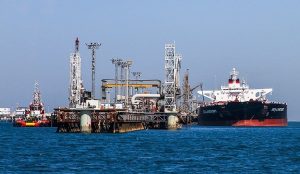
Reuters reported on Friday, July 3, citing three Iranian and Western sources, that Iran has begun negotiations to sell oil to Japanese companies.
The sources said that potential Japanese buyers of Iranian oil are seeking a longer exemption from U.S. sanctions and guarantees for safe shipping conditions in the Persian Gulf.
Under its recent memorandum of understanding with the Iranian regime, the United States authorized Iranian oil sales for a period of 60 days. Before this agreement, Iran’s oil exports were subject to U.S. sanctions. Those sanctions prompted many Asian buyers of Iranian oil, including South Korea, India, and Japan, to halt their imports. In recent years, China had been the only major buyer of Iranian oil.
The current U.S. Treasury Department exemption allowing the sale of Iranian crude oil, petrochemicals, and petroleum products remains valid until August 22, and it is still unclear whether it will be extended or allowed to expire.
Reuters said that Japan’s Ministry of Foreign Affairs and the U.S. Treasury Department did not respond to its requests for comment on the report.
Air and Ground Alert in Tehran as Khamenei’s Funeral Begins
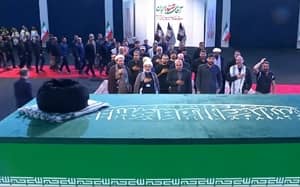
The second day of the funeral ceremonies for Ali Khamenei, the slain supreme leader of the Iranian regime, began at dawn on Saturday, July 4, at the Tehran Mosalla, a large prayer complex in the Iranian capital.
According to the schedule announced by the organizers, the public farewell ceremony began at 6:00 a.m. on Saturday, July 4, and will continue until 8:00 p.m. on Sunday. After the farewell ceremony in Tehran concludes, Ali Khamenei’s body will be transferred to the city of Qom for funeral prayers and another procession, followed by a ceremony in Iraq, before he is ultimately buried in Mashhad.
During Saturday’s ceremony, some participants chanted “O avengers of the martyred leader” and other slogans calling for vengeance. Elegies also included themes of revenge against the enemies of the Iranian regime. A red flag bearing the phrase “Kill Trump” was also seen among the crowd.
Iran’s regime’s Ministry of Intelligence also issued a statement on Saturday marking the state funeral and burial ceremonies for Ali Khamenei, declaring that it would take “revenge” against the United States and Israel for the killing of the former leader of the Iranian regime.
Manchester Event Highlights Iran’s Human Rights Abuses and Calls for a Democratic Republic
Manchester, UK – July 2, 2026: Members of the Academics in Exile Association in the UK, supporters of the People’s Mojahedin Organization of Iran (PMOI/MEK), held a book table and photo exhibition in Manchester to highlight Iran’s deteriorating human rights situation. The event drew attention to the regime’s intensifying wave of executions, including those of political prisoners and protesters detained during the January 2026 uprising.

Through photographs, publications, and testimonies, the organizers sought to draw public attention to the suffering of the Iranian people and their determination to reject all forms of dictatorship, whether monarchical and theocratic.