

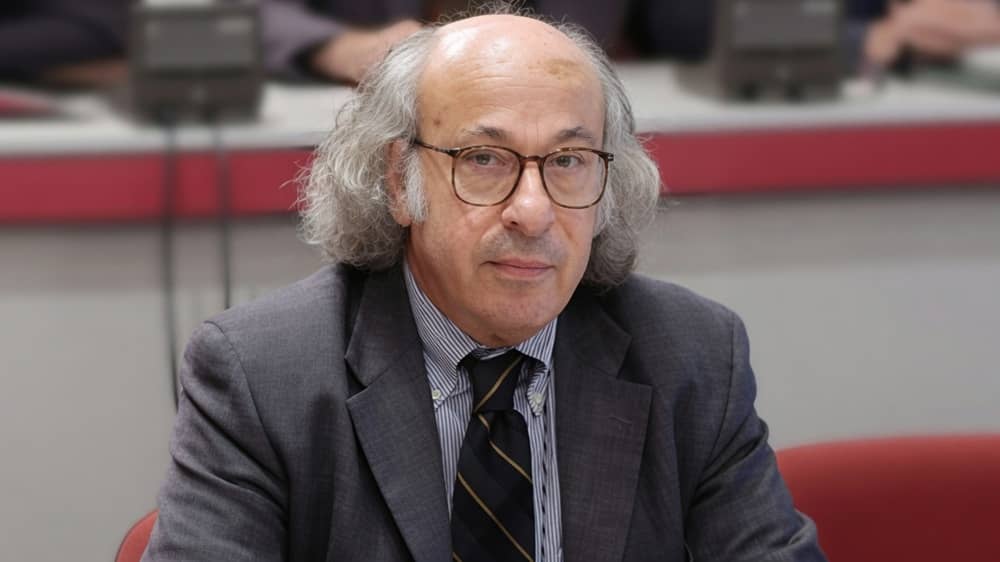
Reza Olia, the Iranian-born sculptor whose bronzes of political martyrs, resistance fighters, and slain protesters became powerful symbols of Iran’s pro-democracy movement in exile, died on Thursday, July 9, 2026, in Italy. He was 87. The cause was complications from kidney disease, according to the National Council of Resistance of Iran (NCRI), of which he had been a formal member since 1995.
For more than sixty years—across two dictatorships and countless acts of state-sponsored terror—Mr. Olia practiced a unique kind of art that was an act of defiance. Working from a studio in the medieval town of Fiano Romano, twenty-five miles north of Rome, he cast in bronze the likenesses of those the clerical dictatorship had executed or tortured, and those who fought back. Each statue was a refusal to let the regime write the final record.
His subjects ranged from Neda Agha-Soltan, killed during Iran’s 2009 protests, to Navid Afkari, the wrestler executed in 2020; from Reyhaneh Jabbari to Baktash Abtin, the dissident poet who died in prison. He also made busts of the Iranian Resistance’s own fallen, including Mohammad Hanifnejad, the founding leader of the People’s Mojahedin Organization.
I offer my deepest condolences on the sorrowful passing of Reza Olia, a distinguished master of art and resistance, who departed this life today, Thursday, July 9, in Italy.
My sympathies go out to the Chair and members of the National Council of Resistance of Iran (NCRI), as… pic.twitter.com/5rF3OAzD6P
— Maryam Rajavi (@Maryam_Rajavi) July 9, 2026
Mr. Olia’s art was never parochial. Fiano Romano commissioned him to sculpt a bronze of Enrico Berlinguer. He also created monuments to Italy’s partisan martyrs and a bust of Danielle Mitterrand, the French human rights advocate.
Maryam Rajavi, President-elect of the NCRI, called Mr. Olia “a rare and outstanding example of the committed artist whose name will endure in the history of Iranian art.”
A Painter’s Son
Born in Tehran in 1939, Mr. Olia grew up in a household steeped in art. His father, Mahmoud Olia (1899–1961), was a distinguished painter and pioneer of Iranian Impressionism—a favorite pupil of Kamal-ol-Molk, the father of modern Iranian art. Reza learned to draw and handle clay before he could fluently read.
After studying at Tehran’s School of Art, he left for Rome in 1959. At the Accademia di Belle Arti, he earned his diploma in sculpture in 1964 under Pericle Fazzini, and in 1965 a diploma in painting under Renato Guttuso, a towering figure of Italian social realism. A cascade of exhibitions followed across Italy and Europe throughout the 1970s and 1980s.
The International Gold Medal Of The Artists' House Granted To Reza Olia
n Friday, April 13th, the #Italian Artists' House awarded the International gold medal of the Artists to Mr. Reza Olia, sculptor and artist and a member of the NCRI. https://t.co/ZpfgzU0qtV #Iran pic.twitter.com/9ShA9NsosC— NCRI-FAC (@iran_policy) April 20, 2018
Between Two Regimes
In 1968, Mr. Olia returned to teach at the Faculty of Decorative Arts in Tehran. However, after publicly dissenting against the Shah’s government over the restoration techniques being employed at Persepolis, he returned to Italy. He settled permanently in Fiano Romano and was granted political asylum, never returning to Iran.
When the NCRI was founded in Paris in 1981, Mr. Olia was among the first to rally to its cause. He became the movement’s most prominent cultural figure in Italy, using his art to keep the Iranian struggle visible to European society.
On March 16, 1993, Mohammad Hossein Naghdi, the NCRI’s representative in Italy, was assassinated in Rome by agents of the regime. Afterward, the Italian government placed Mr. Olia under state protection—a security detail that remained with him for the rest of his life. He continued working without ever softening his message.
NCRI member Mr. Reza Olia: The #IranRevolution is led by courageous women who have been fighting for over 40yrs against the Iranian dictatorship. I remember that Mrs. Rajavi announced 30 yrs ago that the strength of change is in the hands of women.https://t.co/R1QnHWfSeY
— NCRI-FAC (@iran_policy) December 7, 2022
The Art of Witness
His vast oeuvre includes works held at the Museo dei Bozzetti in Pietrasanta and the Iranian Resistance’s museum. In 2018, he was awarded the International Gold Medal by the Casa degli Artisti in Rome, an honor he dedicated entirely to the political prisoners of his homeland.
Beyond sculpture, Mr. Olia authored Daughters of Iran, a book documenting the resilience of women political prisoners, and Bronze and Refuge, an Italian-language memoir spanning his fifty years in exile.
Mr. Olia belonged to an artistic and moral lineage that is difficult to replicate. He used his immense talent not for fame, but to give permanent form to people his government wanted the world to forget. Reza Olia is survived by his life’s work—and by the cause to which he gave it.