

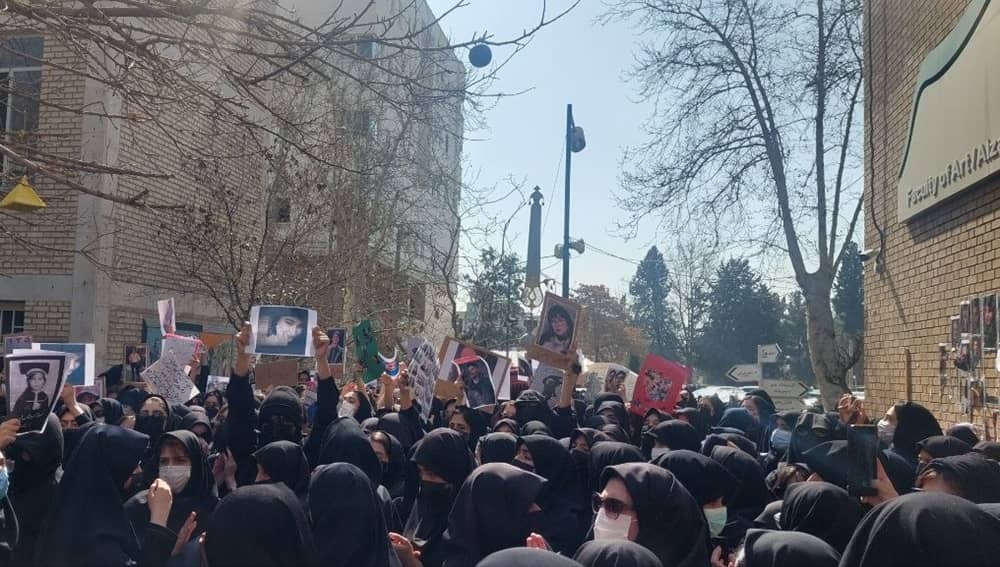
In the chaotic hours of July 8, 2026—the twenty-seventh anniversary of Iran’s student uprising—while the clerical dictatorship was preoccupied with the burial theatrics of its Supreme Leader and maintaining a fragile posture following recent missile exchanges with the United States, a network of dissident students executed one of the most audacious acts of internal defiance the theocracy has faced in years.
First, in an action carried out by student supporters of the MEK, more than 600 government-controlled websites at four major universities went dark and were replaced with the faces of Maryam and Massoud Rajavi, leaders of Iran’s organized resistance movement. Within hours the operation expanded: 900 sites across twelve universities had been commandeered. The front pages of servers belonging to K.N. Toosi University of Technology, Tarbiat Modares University, the University of Isfahan, Kharazmi University, the University of Judicial Sciences, and the sprawling Islamic Azad University system—including VADANA, the nationwide virtual-learning platform serving hundreds of thousands of students—all carried the same slogans: “Death to the ruthless King Mojtaba,” “Curse be upon the tyrant Khamenei,” and “Long Live Rajavi”.
The timing was surgical. Iran’s security apparatus was stretched between funeral logistics and military operations; the internet had been throttled since the January uprising that, according to human rights monitors, killed as many as 7,000 people. Yet student supporters of the MEK managed to breach centralized academic servers and transmit evidence of the operation out of the country — a feat that presupposes months of preparation, compartmented cells, and technical expertise the regime has long struggled to eradicate.
Anyone identified faces imprisonment, torture, or execution.
🚨 #Breaking Iran: Student Group Supporting PMOI Takes Over 600 University Website Pages
The group @sarbedaran405 said it temporarily replaced the homepages of more than 600 webpages across the websites of K. N. Toosi University of Technology, Tarbiat Modares University,… pic.twitter.com/BdUZPx1wcv
— SIMAY AZADI TV (@en_simayazadi) July 8, 2026
The Regime’s Own Alarm
The reaction from Tehran’s security establishment was swift—and, for observers, remarkably candid. Boultan News, an outlet closely tied to IRGC intelligence, published an editorial under a stark Persian proverb: “Do not underestimate the enemy nor be heedless of him, for heedlessness is the mother of all calamities”. The article openly named the MEK as the “main and internal enemy of the system” and demanded to know why critical university infrastructure had been left so vulnerable while “the armed forces respond to the foreign enemy with an iron fist”. In a rare admission of vulnerability, the editorial warned that ignoring this domestic threat during a period of national mourning was “an unforgivable treason” and lamented the “chaos” across the nation’s academic networks.
Multiple state-affiliated technology outlets—Digiato, Zoomit, and the IT news agency ISTNA—confirmed the breach independently, each stating that the MEK had claimed responsibility. The state-run Student News Network (SNN) also reported severe disruptions. Azad University, which hosts millions of enrolled students, took VADANA offline entirely and, as of this writing, has issued no official statement explaining the disruption.
🚨 Exclusive | Iran: Resistance Units Broadcast Anti-Khamenei Slogans During Funeral Procession in Mashhad
Exclusive footage obtained by Simay Azadi shows members of the PMOI Resistance Units broadcasting the slogans "Curse Khamenei, Hail Rajavi" at two locations in Mashhad… pic.twitter.com/2l5UoD9RLu
— SIMAY AZADI TV (@en_simayazadi) July 9, 2026
The panic was not confined to cyberspace. In Mashhad, during the funeral procession itself on Thursday afternoon, loudspeakers broadcast banned slogans—”Curse upon Khamenei, hail to Rajavi”—in two separate locations (near 15 Khordad Square and the Reza bazaar), an act of physical defiance in one of the regime’s most tightly controlled shrine cities.
The students who seized those servers did so knowing the price. In the email they smuggled to the outside world, they framed their purpose in a single sentence: “Honoring the students martyred by the dictatorship… We seek to shatter the endless cycle of kings and clerics in Iran’s history. Let’s break through the heavens and build something entirely new”.
The regime’s own intelligence organs have now told the country, in print, not to underestimate them. That may be the most consequential admission of all.