

THIS PAGE WILL BE UPDATED WITH THE LATEST NEWS
UPDATE: 7:30 PM CEST
Britain Finally Caught Up to What Iranian Dissidents Knew All Along

On Monday, the United Kingdom took one of the most consequential steps in its policy toward the Iranian regime by designating the Islamic Revolutionary Guard Corps as a terrorist organization. The decision criminalizes membership in, support for, or public promotion of the Guard in Britain and reflects a fundamental reassessment of the threat posed by the regime’s most powerful institution.
For many observers, the announcement appeared to be a dramatic policy shift. In reality, it was the culmination of years of parliamentary debate, growing security concerns, and mounting evidence of the Guard’s activities, as well as sustained advocacy by British lawmakers, security experts, Iranian human rights campaigners, and the organized Iranian Resistance led by the National Council of Resistance of Iran and its president-elect, Maryam Rajavi.
The decision did not result from a single incident. It resulted from the gradual convergence of intelligence assessments, political consensus, and persistent public advocacy.
UPDATE: 1:00 PM CEST
Bread, Bombs, and Bankruptcy: Iran’s Theocracy Faces Its Final Reckoning

The Islamic Republic has entered the most dangerous phase of its 47-year existence. Every option before the ruling clerics carries enormous risk. Every decision accelerates the crisis. Every attempt to cling to power deepens the misery of the Iranian people. Only weeks ago, Tehran’s leaders claimed victory after surviving a bruising confrontation with Israel and the United States. Today, that illusion lies in ruins. The fragile ceasefire has collapsed, American strikes have resumed, Iranian missiles have targeted neighboring Gulf states, commercial shipping in the Strait of Hormuz has come under attack, and the regime has succeeded in alienating almost every country in the region. Far from projecting strength, the clerical establishment appears increasingly isolated, desperate, and unpredictable.
For decades, the regime relied upon a strategy of asymmetric warfare. Hamas in Gaza, Hezbollah in Lebanon, the Houthi movement in Yemen, and an array of Shi’ite militias in Iraq formed Tehran’s so-called “Axis of Resistance.” They served as buffers against direct confrontation while extending Iranian influence from the Mediterranean to the Red Sea. That strategy is rapidly unraveling. Hamas has suffered devastating losses. Hezbollah has endured sustained military pressure that has severely weakened its operational capabilities.
UPDATE: 7:30 AM CEST
Protests Erupt Across Iran as Khamenei’s Funeral Charade Concludes

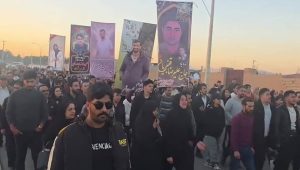
Four months after the death of Ali Khamenei, the Iranian regime orchestrated a massive, state-sponsored funeral procession designed to project an image of power, unity, and stability to both domestic and international audiences. The regime desperately needed a political and security maneuver to mask its profound vulnerabilities following the massive nationwide uprisings earlier in the year.
However, this prolonged spectacle proved to be nothing but an empty facade. The moment the state-mandated mourning ended, the true face of Iran re-emerged on the streets. The immediate resurgence of nationwide protests—driven by severe economic grievances and explicit political demands—proves that the regime’s expensive propaganda and coercive measures have failed to solve any underlying crises.
The prolonged funeral ceremonies were never about mourning; they were a desperate attempt to intimidate the public and force the illegitimate, hereditary succession of Khamenei’s son, Mojtaba. The so-called massive crowds showcased by state media were largely manufactured through coercion. Security institutions threatened Kurdish state employees with dismissal if they did not board buses to Tehran and Qom, while families dependent on the State Welfare Organization and the Relief Committee faced threats that their financial aid would be permanently cut off if they refused to participate.
UK Proscribes Iran’s IRGC as Terrorist Organization: “A long overdue Action”

The United Kingdom announced on July 13, 2026, that it has proscribed Iran’s Revolutionary Guards (IRGC) as a terrorist organization, using new powers under the National Security Act to target what the government described as state-sponsored proxy activity on British soil. The move follows years of warnings by British security agencies about IRGC-linked operations in the UK.
According to Reuters, the British government concluded that the IRGC had been linked to threats against individuals in Britain. Prime Minister Keir Starmer said the new measures would make it easier to “prosecute and lock up anyone carrying out their dirty work here in Britain.”
It will be a criminal offence under the National Security Act to express support or have any relations with the IRGC or its related organizations, and one could be sentenced to 14 years in prison. The legislation bans the IRGC and its front companies activities in the UK.
In a statement issued on July 13, the British Committee for Iran Freedom called the designation “a crucial, long-overdue step” against “one of the world’s most dangerous instruments of state-sponsored terrorism, domestic repression, and regional destabilization.”
Iran: Transfer of 60 Inmates Sparks Protest in the Women’s Ward of Evin

The transfer of 60 inmates to the overcrowded women’s ward of Evin Prison sparked protests and clashes with prison guards on Sunday, July 12, 2026.
Sixty female prisoners with financial convictions were transferred on Sunday from Qarchak Prison to the women’s ward of Evin. The transfer took place while the facility was already struggling, further intensifying the overcrowding at the women’s ward of Evin, which previously suffered from a severe shortage of space.
Forty-nine of the new arrivals have entered the women’s ward, while others are still being held in the quarantine section.
Following the relocation, inmates in the ward protested the deteriorating conditions. Prison guard officers immediately entered the area and threatened the women with separating death-row prisoners from the rest.
Mahsa Nouri (Masoumeh) and Masoumeh (Farah) Nassaji were violently transferred to solitary confinement after protesting this situation.
Masoumeh Nassaji, 64 years old, suffers from asthma, and is presently deprived of access to her much-needed medications.
The Politics of Permanent Crisis: Why Iran Must Reject Both Theocracy and Monarchy
One of the defining lessons of Iran’s modern political history is that authoritarian movements rarely survive without a constant state of crisis. Whether they seek to preserve power or reclaim it, they depend on fear, polarization, and instability to silence alternatives and justify extraordinary measures.
Today, this dynamic is visible not only within the Iranian regime’s ruling establishment but also among monarchist factions that portray themselves as the country’s inevitable future. Though they present themselves as ideological opposites, both camps increasingly rely on remarkably similar political strategies: portraying external confrontation and national crisis as opportunities to consolidate power.
The tragedy is that while these rival camps compete for authority, ordinary Iranians bear the consequences.
Following the death of Ali Khamenei, the regime has worked to project continuity and strength during a sensitive transition period. Public displays surrounding his funeral, accompanied by highly organized mobilizations and calls for revenge, served a broader political purpose beyond mourning.
Iran’s Power Crisis Deepens After Khamenei’s Funeral as Blackouts Spread Across the Country

Only days after the conclusion of Ali Khamenei’s week-long funeral ceremonies, millions of Iranians are once again confronting a familiar crisis: widespread electricity outages. As temperatures climb across the country, residents report increasingly frequent power cuts without prior warning, along with severe voltage fluctuations and partial failures of the electrical grid.
While regime officials attribute the crisis to soaring temperatures, increased demand for air conditioning, and damage allegedly inflicted during recent military strikes, the expanding blackouts once again highlight years of neglect, underinvestment, and mismanagement of Iran’s energy infrastructure.
Mohammad Elahdad, CEO of the state-owned electricity company Tavanir, told members of parliament on July 12 that more than 2,000 points of Iran’s electricity network were damaged during the recent 40-day conflict. According to him, the country lost approximately 4,200 megawatts of generating capacity, with damages exceeding 60 trillion tomans.
Iran Regime’s Deepest Fear: Why the Prospect of Another Uprising Haunts Tehran
For years, countless analyses of Iran have focused on geopolitical tensions, nuclear negotiations, sanctions, or regional conflicts. While these factors undoubtedly shape the country’s political landscape, they often overlook the central conflict that has defined Iran for more than four decades: the ongoing confrontation between the Iranian people and the ruling clerical regime.
This omission is particularly striking because the regime itself repeatedly identifies the Iranian people—not foreign governments—as its principal adversary. Recent statements from senior officials provide a revealing glimpse into Tehran’s greatest anxiety: the possibility of another nationwide uprising.
The regime’s own president, Masoud Pezeshkian, recently acknowledged that worsening public dissatisfaction could quickly translate into mass protests.
“What I fear is that we will fail to properly serve the people, they will become dissatisfied, and they will come into the streets and protest.”
U.S. Conducts New Wave of Strikes Against Iran’s Regime, IRGC Attacks Bahrain, Kuwait, Jordan
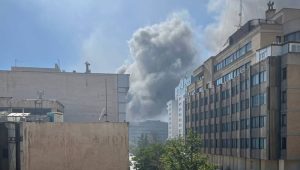
As the United States completed its latest wave of attacks against the Iranian regime, the Islamic Revolutionary Guard Corps (IRGC) announced attacks on Bahrain, Kuwait, and Jordan.
Hours after the United States completed a new wave of strikes against military targets belonging to the Iranian regime, the Islamic Revolutionary Guard Corps (IRGC) announced that it had targeted U.S. bases in Jordan, Bahrain, and Kuwait in several phases using missiles and drones. At the same time, the U.S. Central Command (CENTCOM) announced the completion of its operation against dozens of military targets inside Iran.
The military confrontation between the United States and the Iranian regime entered a new phase early Monday. Hours after the United States launched and completed a new wave of strikes against Iranian military positions, the IRGC announced that it had carried out several phases of retaliatory operations against U.S. military bases in Jordan, Bahrain, and Kuwait. U.S. officials have not yet confirmed or denied these claims.
The U.S. Central Command (CENTCOM) announced on the social media platform X that the latest wave of offensive strikes against military targets in Iran had concluded and that U.S. forces had struck dozens of targets across the country using precision-guided munitions.
Ship Traffic Through Strait of Hormuz Falls to Lowest Level in Weeks

Shipping data show that the number of vessels transiting the Strait of Hormuz on Sunday fell to its lowest level in recent weeks. At the same time, the resumption of attacks between the United States and the Iranian regime, along with strikes targeting ships in the Middle East, has heightened concerns over maritime safety.
Reuters reported on Monday, July 13, that according to vessel-tracking data from Kpler, only six ships transited the Strait of Hormuz on July 12, the lowest number recorded in the past five weeks. Among the tankers leaving the strait was the very large crude carrier (VLCC) Humanity, carrying 2 million barrels of Iranian oil.
Another tanker, Captain Andreas, also exited the Strait of Hormuz carrying about 500,000 barrels of refined petroleum products from Kuwait.
According to the data, three empty oil tankers also entered the Persian Gulf to load crude oil. Most tankers switched off their identification transmitters while transiting the Strait of Hormuz.
Halt Executions of 12 Isfahan Protesters; Urgent International Action Needed
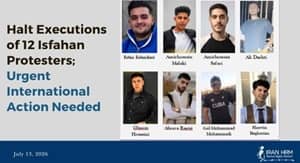
With the escalation of international crises and the deep economic deadlock in Iran—which fosters broader popular protests—the Islamic Republic has accelerated its execution machine to institutionalize repression and terror across society. The regime attempts to guarantee its survival by tightening the noose of suppression around the necks of potential protesters. The indiscriminate issuance of death sentences against detainees serves as the primary tool of the security apparatus to prevent the eruption of public rage.
During the nationwide protests of January 2026 (Dey 1404) in Isfahan, a judicial case known as the “Isfahan Alikhani Square Case” was initiated. In this event, according to claims by judicial and security authorities, four members of the Basij and the repressive Special Forces Unit were killed. Following this incident, at least 59 individuals were arrested and prosecuted. The case was tried in Branch 1 of the Isfahan Revolutionary Court, presided over by Mohammad Barati Dorcheh and Mohammad Tavakoli (also known as Vakili), with Mohammad Nakhjavan serving as the prosecutor. All trial proceedings for the 59 defendants were conducted in just three one-hour sessions; an unlawful process that, from the outset, constituted a glaring example of a show trial.
Iran’s Economic Crisis Deepens as Banking Outages Halt Trade

According to the latest official data and reports published in the Tehran press, the Iran economic crisis has entered a new phase of recession accompanied by infrastructure disruptions. Assessments by domestic and international statistical agencies show that financial imbalances and macro-monetary decisions have directly impacted commercial performance and the daily livelihoods of society. In less than a few seconds, any foreign observer looking at this data can grasp the depth and dimensions of this structural stalemate.
Reports from the Central Bank and the Statistical Center of Iran indicate a decline in gross domestic product at constant prices; the Central Bank’s preliminary estimate puts economic growth for the year 1404 at negative 0.7 percent, while the Statistical Center puts non-oil growth at negative 0.3 percent. Meanwhile, the International Monetary Fund has predicted that Iran’s economic growth rate will drop to negative 5.4 percent in 2026, a figure that makes Iran the only economy with negative growth in the world during that year.
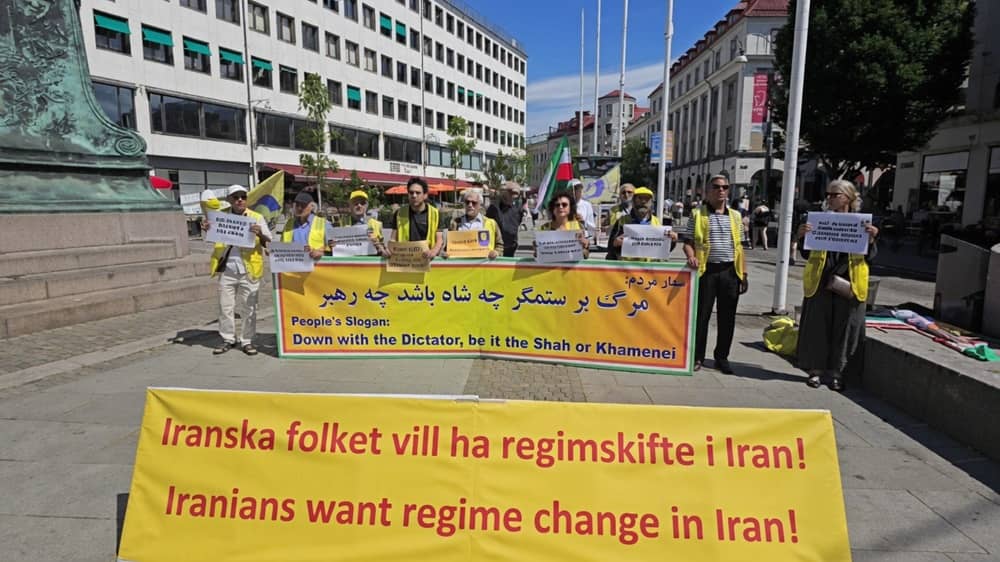
PMOI Supporters Rally in Gothenburg, Call for Democratic Republic and Regime Change
Gothenburg, Sweden — July 11, 2026 — Supporters of the People’s Mojahedin Organization of Iran (PMOI/MEK) held a rally in Gothenburg, calling for the establishment of a free and democratic republic in Iran and voicing opposition to the ruling clerical regime. Participants chanted slogans demanding regime change and called for the closure of the Iranian regime’s embassy in Sweden, which they condemned as a hub for terrorism and espionage.

Protesters rejected both the former monarchy and the current religious dictatorship, stressing that Iran’s future must be determined by a democratic alternative. They also expressed strong support for the MEK’s Resistance Units operating inside Iran, recognizing their role in organizing protests and challenging the regime from within.
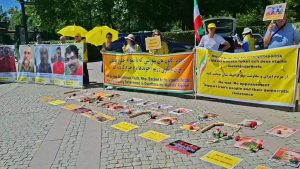
Romania: MEK Supporters in Bucharest Hold Exhibition Protesting Executions in Iran
Bucharest, Romania – July 11, 2026 – Supporters of the People’s Mojahedin Organization of Iran (PMOI/MEK) held a photo exhibition and book table to protest the Iranian regime’s escalating use of the death penalty, particularly against political prisoners.

The event called for the complete abolition of capital punishment in Iran and the immediate release of all political detainees, especially those facing imminent execution. Organizers also urged that senior regime officials be held accountable before an international tribunal for crimes against humanity.