

THIS PAGE WILL BE UPDATED WITH THE LATEST NEWS
UPDATE: 2:30 PM CEST
UK Outlaws Two Iranian Groups Over Antisemitic Attacks in Britain
LONDON, July 13 (Reuters) – Britain’s government on Monday targeted Iran’s Islamic Revolutionary Guard Corps and another Iran-linked group after a string of antisemitic attacks on British streets, using proscription-like powers designed to tackle state-backed threats.
The power would effectively outlaw support for those groups and give police and intelligence agencies new powers to tackle any threats linked to them.
“These new powers will make it easier to prosecute and lock up anyone carrying out their dirty work here in Britain,” Prime Minister Keir Starmer said in a statement.
The IRGC, which is already subject to British sanctions, has served as an elite military force loyal to the Islamic Republic’s Supreme Leader since being established after the 1979 Islamic Revolution.
Britain said the second Iran linked-group, the Islamic Movement of Companions of the Right, had claimed seven attacks linked to Jewish and Israeli communities, and Persian-language media, including the antisemitic arson attack on four Hatzola ambulances in Golders Green on March 23.
UPDATE: 7:30 AM CEST
How PMOI Resistance Units Shattered the Regime’s Hollow Funeral Charade
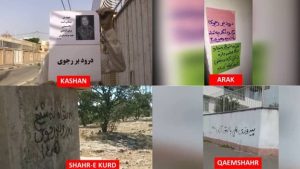
On July 10, in direct defiance of the heavily militarized, state-sponsored funeral ceremonies for the eliminated supreme leader Ali Khamenei, PMOI/MEK Resistance Units carried out 40 anti-regime activities across Iran. These courageous acts shattered the regime’s desperate attempts to project stability, echoing the Iranian people’s true desires for regime change and reiterating their commitment to the struggle for a free, democratic republic.
Undeterred by the suffocating security atmosphere, Resistance Units mobilized in major cities across the country, including Tehran, Mashhad, Isfahan, Zahedan, Kermanshah, and Rasht. Through placards, posters, and graffiti, they delivered a resounding message to the clerical dictatorship. In Mashhad, units wrote “Khamenei is dead. The nation awakens” in six public locations. In Tehran, members held placards reading “Salute to Rajavi” and installed posters declaring “Long live the National Liberation Army.” In Zahedan, protesters displayed messages stating “Down with Khomeini and Khamenei.”
Furthermore, the Resistance Units clearly laid out the Iranian people’s vision for the future. In Arak, units installed a placard in a public place with the message: “No to monarchy, no to the mullahs’ rule. Yes to a democratic republic.”
Iran Regime’s Post-Khamenei Power Struggle Fuels Nuclear Blackmail and Escalating Threats
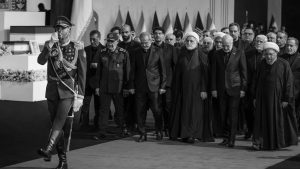
The carefully orchestrated funeral spectacle for the regime’s slew Supreme Leader Ali Khamenei was intended to project unity and stability. Instead, as soon as the state ceremonies concluded—and even while they were underway—the Iranian regime’s long-suppressed internal conflicts resurfaced with renewed intensity.
At the center of this latest confrontation lies the collapse of the regime’s understanding with the United States. Rather than presenting a coherent strategy for navigating the mounting international pressure, competing factions within the ruling establishment have turned on one another, exposing deep disagreements over diplomacy, security, and the regime’s future direction.
What is emerging is not merely another factional dispute. It is a struggle over survival, with increasingly dangerous implications for regional stability and the international community.
Hardline figures have launched an aggressive campaign against officials who supported negotiations with Washington, portraying any diplomatic engagement as a humiliating failure.
Cleric Hamid Rasaei publicly attacked Parliament Speaker Mohammad Bagher Ghalibaf for defending the agreement, demanding that the regime formally abandon the diplomatic process altogether. Similar attacks came from IRGC-affiliated figures, including Saeed Ghasemi, who dismissed the understanding as worthless from its inception and openly called for preparing for war rather than pursuing negotiations.
After Khamenei: The Regime’s Greatest Threat Is the Legacy He Left Behind
The burial of Ali Khamenei marks the end of an era, but it does not mark the end of the crisis that has consumed Iran for decades. If anything, it has stripped away the central figure who held together competing power centers while leaving behind the political, economic, and ideological structures responsible for the country’s decline.
For the regime’s new leadership, the challenge is no longer simply succession. It is whether the system built around absolute clerical rule can answer the demands of a society that has repeatedly rejected it.
The question confronting Tehran is therefore straightforward: can the regime reform itself without dismantling the very foundations on which it has depended for nearly half a century?
The evidence suggests it cannot.
For years, the regime invested enormous resources in controlling narratives, manipulating statistics, and dominating state media. Yet propaganda cannot substitute for functioning institutions or economic stability.
Bread Price Hikes Push Iran’s Cost-of-Living Crisis to the Breaking Point

For decades, many Iranians believed that no matter how severe the country’s economic hardships became, bread—the foundation of the national diet—would remain within reach of every household. Families might be forced to give up meat, dairy products, fruit, or even rice, but bread would continue to provide the minimum nutrition needed to survive.
That assumption is now collapsing. The implementation of new bread prices across numerous provinces in recent weeks has triggered widespread concern among millions of low-income families. For many of Iran’s poorest households, bread is no longer merely a staple food—it is often the primary, and sometimes the only, affordable source of daily calories.
Its rising price marks more than another inflationary increase. It signals that Iran’s economic crisis has reached the final line of defense protecting millions from outright food insecurity.
South Khorasan’s Water Bankruptcy: How Decades of Mismanagement Turned Drought into an Environmental Catastrophe
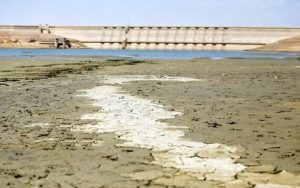
South Khorasan is no longer confronting a temporary water shortage or a passing drought. After 26 consecutive years of below-average rainfall, the depletion of groundwater reserves, and accelerating land subsidence, the province has entered a far more dangerous phase—one local officials themselves describe as “water bankruptcy.”
The term is significant. It reflects a reality in which natural water reserves are being consumed faster than they can ever be replenished. While climate change has intensified the problem, South Khorasan’s environmental collapse is equally the result of decades of unsustainable groundwater extraction and policies that ignored the province’s severe ecological limitations.
Far from being an isolated provincial issue, South Khorasan has become one of the clearest examples of the broader environmental crisis unfolding across Iran under decades of failed resource management.
The province has endured continuous drought since the 1999–2000 water year, making it one of Iran’s longest-running climate emergencies.
IRGC Announces Closure of Strait of Hormuz After Firing on a Ship

While the United States had demanded that the Iranian regime confirm that the Strait of Hormuz would remain open, Iranian state-run media reported that the Islamic Revolutionary Guard Corps (IRGC) Navy announced the closure of the strategic waterway after firing on a ship in the Persian Gulf.
Reuters also reported, citing the IRGC Navy, that a vessel which the IRGC claimed was attempting to transit the Strait of Hormuz through an “unauthorized route” was stopped with warning shots after allegedly ignoring repeated warnings.
In a statement, the IRGC claimed that several vessels, “incited by foreign powers,” had attempted to travel outside designated shipping lanes and had ignored issued warnings. The statement also claimed that one of the vessels had endangered maritime security by turning off its identification systems and was therefore targeted with warning fire.
The statement further said that, due to what the IRGC described as “insecurity caused by the unlawful intervention of foreign powers,” the Strait of Hormuz will remain closed until further notice and until what it called “U.S. interference in the region” comes to an end. It added that no vessel will be permitted to pass through the waterway.
Third Round of U.S. Strikes Against Iran’s Regime After IRGC Closes Strait of Hormuz
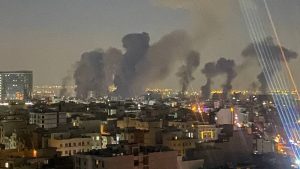
The United States Central Command (CENTCOM) announced that U.S. forces have launched the third round of strikes against the Iranian regime this week following an attack by the Islamic Revolutionary Guard Corps (IRGC) on the Cyprus-flagged container ship M/V GFS Galaxy in the Strait of Hormuz.
CENTCOM said in its statement that the vessel caught fire during the attack and sustained heavy damage to its engine room. It also said that one civilian crew member is missing, leaving the ship unable to continue its voyage.
The U.S. Central Command emphasized that the operation is intended to reduce the Iranian regime’s ability to attack commercial shipping and ensure freedom of navigation through the Strait of Hormuz. It added that the operation will continue under the orders of the Commander-in-Chief of the U.S. Armed Forces.
U.S. Secretary of Defense Pete Hegseth wrote in a post on X minutes after the new operation began: “Iran made a poor choice. Now they pay.”
New Iranian Leader Pledges ‘Divine Mission’ of Revenge Following Father’s Burial
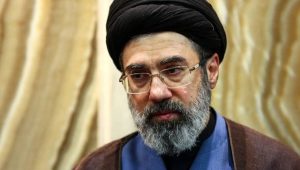
Tehran — Iran’s newly appointed Supreme Leader, Seyed Mojtaba Hosseini Khamenei, has issued a stark warning to international adversaries, declaring that avenging the death of his assassinated predecessor and father is an irreversible “divine mission” that will be carried out by operatives worldwide.
The written statement, released by Iranian state media on Saturday and dated July 8 (18 Tir), marks the first major strategic and security declaration by the low-profile cleric since he assumed power following the assassination of Ayatollah Ali Khamenei earlier this year. The message coincided with the conclusion of an extensive, multi-day state funeral procession across the Shiite centers of Iran and Iraq.
While the text does not explicitly name the United States or Israel, its release follows heightened regional military maneuvers and a recent warning from U.S. President Donald Trump, who threatened “overwhelming” retaliation against Tehran in the event of any plots targeting American officials.
Berlin Exhibition Condemns Iran Regime’s Wave of Executions and Voices Support for Freedom
Berlin, Germany – July 11, 2026 – Supporters of the People’s Mojahedin Organization of Iran (PMOI/MEK) held an exhibition to protest the Iranian regime’s increasing use of the death penalty, particularly against political prisoners. The event also expressed solidarity with the “No to Executions” campaign.

The event called for the complete abolition of capital punishment in Iran and the unconditional release of all political prisoners, especially those at risk of imminent execution. Organizers also urged that senior regime officials be held accountable before an international tribunal for crimes against humanity.
Malmö Rally Calls for a Democratic Republic in Iran, an End to Executions, and to Save Arghavan Fallahi
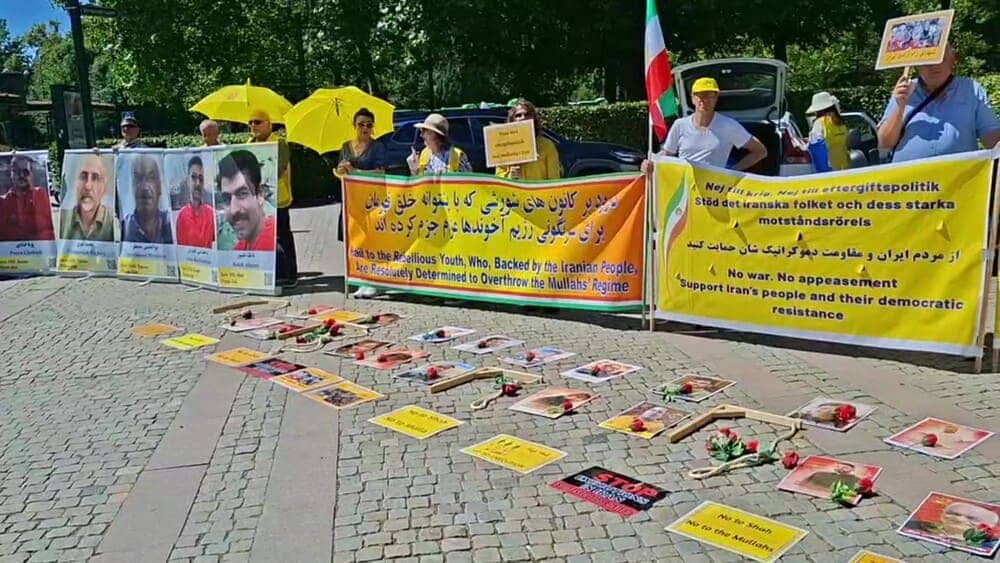
Malmö, Sweden – July 11, 2026: Supporters of the People’s Mojahedin Organization of Iran (PMOI/MEK) and he National Council of Resistance of Iran (NCRI) held a rally to condemn the executions of political prisoners in Iran, including PMOI members and protesters detained during the January 2026 uprising. They called for a democratic republic in Iran and an end to the mullahs’ executions.

The demonstrators protested the regime’s executions while holding photos of Arghavan Fallahi, a 25-year-old political prisoner and PMOI supporter sentenced to death by Tehran’s Revolutionary Court, they chanted: “Don’t execute Arghavan!”