

Across major international cities, freedom-loving Iranians and supporters of the National Council of Resistance of Iran (NCRI) and the People’s Mojahedin Organization of Iran (PMOI/MEK) orchestrated a series of coordinated rallies, photo exhibitions, and public demonstrations during the week of July 18–25, 2026. Driven by a surging execution wave inside Iran—including the recent execution of 26-year-old PMOI member Mehdi Khanaki—and capitalizing on the United Kingdom’s landmark decision to designate the Islamic Revolutionary Guard Corps (IRGC) under state threat national security laws, the global diaspora movement demonstrated an organized front against the clerical dictatorship in Tehran. From Europe to Australia, demonstrators amplified the voices of political prisoners, backed the ongoing “No to Execution Tuesdays” hunger strike campaign, and rejected both theocratic rule and any return to monarchy in favor of a democratic republic.
July 25, 2026
In Stockholm, Malmö, Heidelberg, and Paris, NCRI and PMOI supporters launched synchronized demonstrations and public photo exhibitions condemning the clerical judiciary’s escalating execution wave. Demonstrators in Stockholm, Malmö, and Heidelberg focused their actions on highlighting the systematic use of capital punishment to suppress dissent, displaying portraits of recently executed dissidents and political prisoners on death row. In Paris, activists organized a major exhibition featuring photographs of victims from the historic 1988 massacre as well as protesters killed during the January 2026 uprising. Concurrently, supporters in Paris set up public book stands to engage the French public, providing documentation on human rights abuses and calling for international isolation of the regime.
— Academics In Exile Association (@iranianacademic) July 25, 2026
July 24, 2026
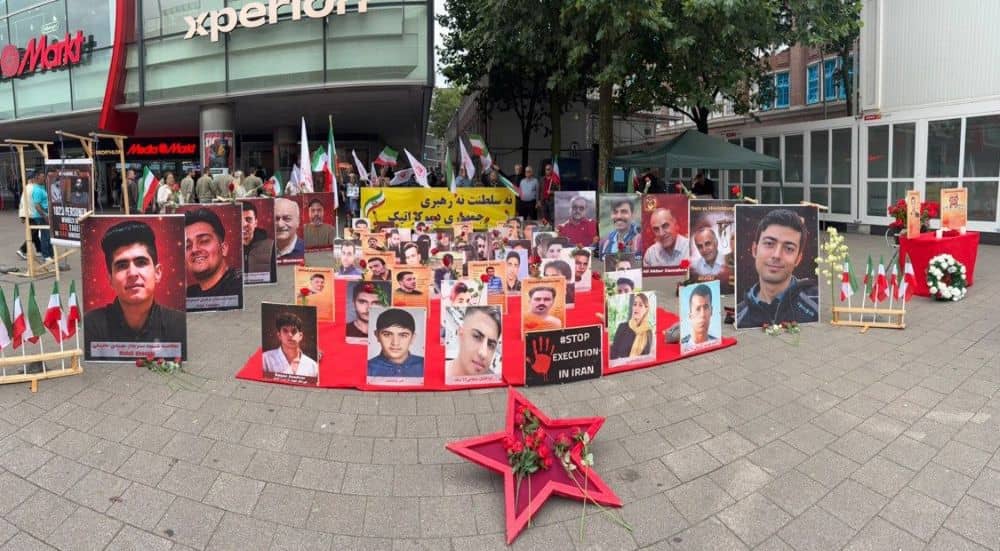
Activists and supporters of the NCRI held a rally and memorial photo exhibition in Hamburg to pay tribute to executed political prisoners and protesters killed during the January 2026 uprising. The gathering prominently honored recently executed political prisoner Mehdi Khanaki and commemorated the first anniversary of the executions of PMOI members Mehdi Hassani and Behrouz Ehsani. Participants in Hamburg carried portraits of the victims and called on the German government to adopt a firm foreign policy, abandon economic concessions, and take concrete action to demand an immediate halt to capital punishment in Iran. Organizers also urged the international community to respect the Iranian people’s rejection of all dictatorial systems, whether monarchical or theocratic.
1- July 25 | Place de la République, Paris. Supporters of the PMOI (MEK) and the National Council of Resistance of Iran (NCRI) held a photo exhibition marking the anniversary of the 1988 massacre of Iran's political prisoners. #StopExecutionsInIran #FreeIran2026 pic.twitter.com/V61mGUsjPO
— Iran Freedom (@4FreedominIran) July 26, 2026
July 22, 2026
In Paris, NCRI supporters continued a multi-day public campaign by organizing a photo exhibition and information table centered on human rights violations in Iranian prisons. The event highlighted the plight of political prisoners and demonstrators arrested during the January 2026 uprising who face imminent death sentences. Activists in Paris expressed direct solidarity with the approximately 1,500 death row prisoners participating in hunger strikes at Ghezel Hesar Prison, amplifying their demands for the abolition of the death penalty and urging international human rights bodies to intervene.
2-Malmö, Sweden – July 25, 2026: PMOI supporters rallied against escalating executions by the mullahs’ regime, urging action to halt all executions and save lives of political prisoners. They called for a democratic republic in Iran.#StopExecutionsInIran #NCRIAlternative pic.twitter.com/37TfS3xtr3
— Iran Freedom (@4FreedominIran) July 26, 2026
July 21, 2026
Diaspora activists in Gothenburg gathered for a rally aligned with the 130th consecutive week of the “No to Execution Tuesdays” campaign, an ongoing strike movement against the regime’s execution apparatus. Demonstrators in Gothenburg raised alarms over the heightened risk facing political detainees following widespread internet disruptions and intensified judicial crackdowns in Iran. Protesters voiced strong backing for NCRI President-elect Maryam Rajavi’s global call to end capital punishment, reiterated support for domestic Resistance Units, and voiced solidarity with hunger-striking political prisoners across Iranian facilities. Meanwhile, in Paris, activists initiated the first day of a two-day exhibition highlighting the Iranian people’s aspiration for a democratic republic.
Supporters of Iranian opposition leader @Maryam_Rajavi President-elect of the NCRI gather at the Lincoln Memorial to call for an immediate #StopExecutionsInIran torture& political repression in Iran, in Washington, D.C – July 25, 2026https://t.co/4cn5vKZ3n4
— Iran Freedom (@4FreedominIran) July 26, 2026
July 18, 2026
Coordinated international actions spanned Oslo, Gothenburg, and Sydney. In Oslo, Iranian exiles and supporters held a major rally welcoming the United Kingdom’s decision to designate the IRGC. Joined by Parviz Khazaei, the NCRI representative in the Nordic countries, demonstrators in Oslo described the UK’s action as a critical blow against Tehran’s foreign terror apparatus and internal repression. Protesters in Oslo explicitly called for the closure of the Iranian embassy in Norway and expelling regime agents. In Gothenburg, demonstrators similarly rallied to demand the closure of the Iranian embassy in Sweden—labeling it a center for espionage and state terror—while endorsing the NCRI’s Provisional Government and Maryam Rajavi’s Ten-Point Plan. Simultaneously, in Sydney, supporters of the Iranian Resistance gathered to denounce recent executions of January 2026 uprising detainees, calling on the Australian government to enact a decisive policy against the clerical regime and support the establishment of a secular republic.
10-Stockholm, July 25, 2026: MEK supporters rallied outside Sweden’s Foreign Ministry condemning the execution of political prisoner #Mehdi_Khanaki for Jan. uprising and MEK membership.
Urgent call to stop the execution of #Amirhassan_Akbari_Monfared.#StopExecutionsInIran pic.twitter.com/a56Av13VOl— Iran Freedom (@4FreedominIran) July 26, 2026
The wide geographic distribution and sustained momentum of diaspora demonstrations across Stockholm, Malmö, Heidelberg, Paris, Hamburg, Gothenburg, Oslo, and Sydney demonstrate that Tehran’s reliance on executions and external terror operations has failed to break the international momentum of the Iranian resistance movement. By aligning foreign advocacy directly with domestic acts of defiance—such as the Ghezel Hesar hunger strikes and the activities of Resistance Units inside Iran—the global diaspora has effectively undermined the regime’s diplomatic strategy. Furthermore, the enthusiastic response to the UK’s national security designation of the IRGC indicates a shifting diplomatic baseline in Western capitals. As the clerical establishment faces internal fractures and mounting domestic rejection, the global diaspora’s unified stance—uncompromisingly rejecting both the ruling theocracy and former monarchical structures—highlights that a democratic republic represents the only viable path forward for Iran.