

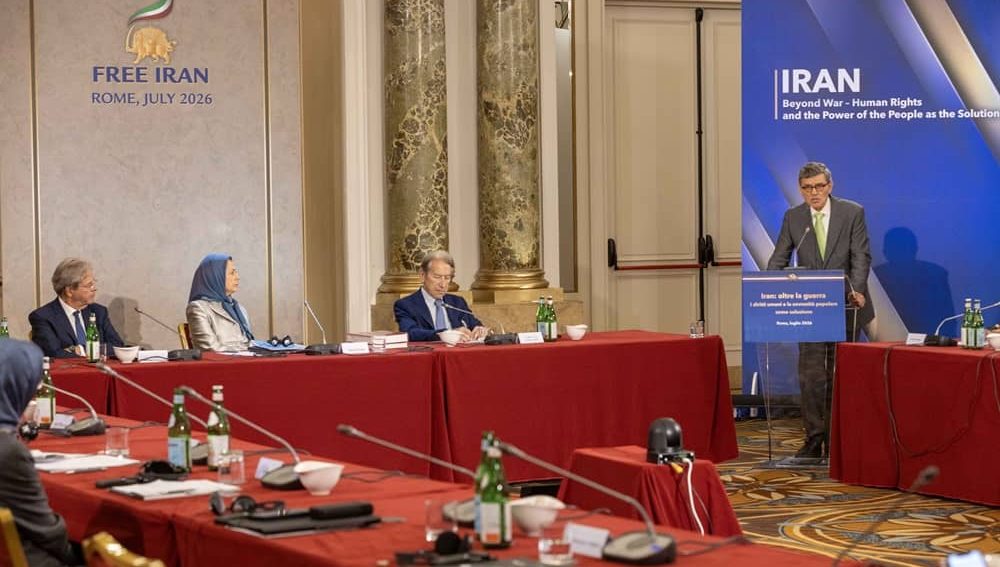
At an international conference in Rome on July 17, 2026, Ambassador Hans-Ulrich Seidt, former German Ambassador to Afghanistan and the Republic of Korea, addressed the escalating crisis in Iran, emphasizing that true political change cannot be achieved through foreign military action or economic collapse alone. Addressing the strategic realities across military, economic, and political domains, Amb. Seidt highlighted that despite ongoing conflict, the Iranian regime’s leadership is deeply fractured and vulnerable, while the Iranian people remain strongly opposed to foreign intervention.
Amb. Seidt asserted that the genuine path forward relies on the internal democratic movement led by the National Council of Resistance of Iran (NCRI). He explicitly rejected recent external efforts to promote Reza Pahlavi, calling such initiatives an obstacle to legitimate domestic democratic forces rather than a viable alternative.
Highlighting regional and global stability, Amb. Seidt explained that a democratic, secular Iran grounded in human rights and the rule of law directly aligns with Europe’s strategic interests. He endorsed Mrs. Maryam Rajavi’s Ten-Point Plan as a realistic, viable roadmap reflecting the Iranian public’s aspirations, pointing to its commitment to hold free and fair elections within six months of the regime’s fall. The former senior diplomat concluded by urging European Union member states to actively support this vision and engage constructively to secure lasting peace.
The full text of Ambassador Hans-Ulrich Seidt’s speech follows:

Madame Rajavi, ladies and gentlemen, it’s an honor and pleasure to participate in this conference in Rome. Roma is perhaps no longer the Caput Mundi, but it’s still one of the leading centers of the world of the 21st century. So, this conference also demonstrates the diplomatic role of Italy in today’s world.
Today, there is no doubt the foundations of the Iranian regime are shaking. What is to be expected? To answer the question, I would like to focus on three strategic domains.
The first is the military domain. Ten days ago, during the last NATO summit in Ankara, President Donald Trump called off the Memorandum of Understanding. Thank you very much, Mr. Verhofstadt, for this very important remark. The Memorandum of Understanding, the ceasefire ended, and the war continued. It continues today, and it escalates. However, the limits of air power are evident. They are evident, in particular, with regard to the geopolitical situation of Iran. So we have to be realistic. Political change in Iran will not be brought about by the American and Israeli air campaigns.
So, let us move to the second strategic domain: the economy. The economy remains for the regime the most urgent and serious challenge. Throughout the last year, Iran was already struggling with high inflation, currency depreciation, unemployment, electricity, water, and energy shortages, and the cumulative effect of international sanctions. The economic decline of the regime will continue, and as a result of the war, the economic decline will accelerate. It already triggered the outburst of domestic protest during the January uprising.
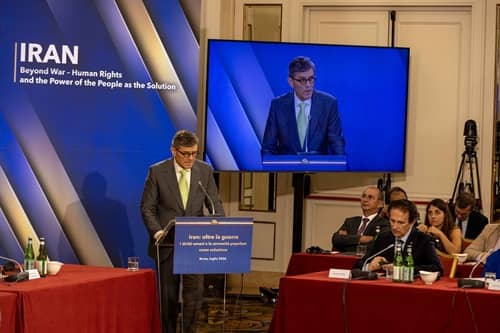
This leads me finally to the political domain. Analysts agree that it is very difficult to assess the psychological effects of the US and Israeli air attacks. How many Iranians are supporting the country’s national defense even if they oppose the mullah regime? Iranians are proud and patriotic. After their experience with 19th and 20th-century imperialism, they strongly resent foreign intervention.
However, it would be a serious misperception to assume that the regime’s leadership is today stronger and more cohesive than before the war. No, quite to the contrary, the leadership has been shaken by the war. If we analyze recent events, it’s clear that disagreements exist among the leadership about how to manage the regime’s survival. Tensions within the political elite became evident during the recent funeral of Ismail Haniyeh [sic]. Civilian political leaders, including President Masoud Pezeshkian and Foreign Minister Abbas Araghchi, were publicly criticized.
So, what can be, should be done? The successive nationwide uprisings of the last decade escalated and have shown a profound public rejection of the regime. The January uprising this year demonstrated the people’s willingness to challenge their repression and to end the regime. So, if we look beyond the current war, we will realize that the future of Iran will not depend on foreign intervention, but on the democratic opposition within the country—the opposition led by the NCRI. This opposition is genuine. It is ready to make sacrifices for freedom and democracy.
There is a saying in Latin: *Sanguis martyrum semen ecclesiae*. The blood of the martyrs are the seed of the church, of the community, of the ecclesia. But the Iranian opposition should not be misguided from the outside. Recent attempts to present Reza Pahlavi as a serious diplomatic leader were not a push, but if we analyze it correctly, it was an obstacle for the democratic forces inside the country. False hope and illusions stimulated by interested third parties from the outside are not helpful, to say the least.
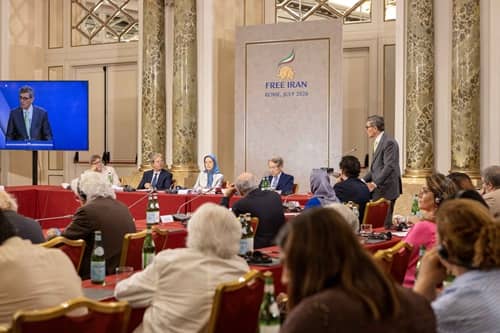
So, an Iran founded on secular government, respect for human rights, rule of law, is in the best interest of Europe. It will stabilize the entire region of Western Asia and contribute to a more stable and peaceful world. But as a conclusion, the impetus for fundamental change must come from the Iranian people, not from foreign powers.
Maryam Rajavi’s Ten-Point Plan reflects the aspirations of the Iranian people. Under this platform, or on this platform, free and fair elections would be held within six months after the end of the current regime. Today, such a scenario is no utopian idea. It is a realistic option for the future. Therefore, the member states of the European Union must support it. As Guy Verhofstadt said, we need constructive engagement by the European Union for the one solution that can solve the problem, not only of Iran but of a major problem that is shaking world peace.
Thank you very much.