

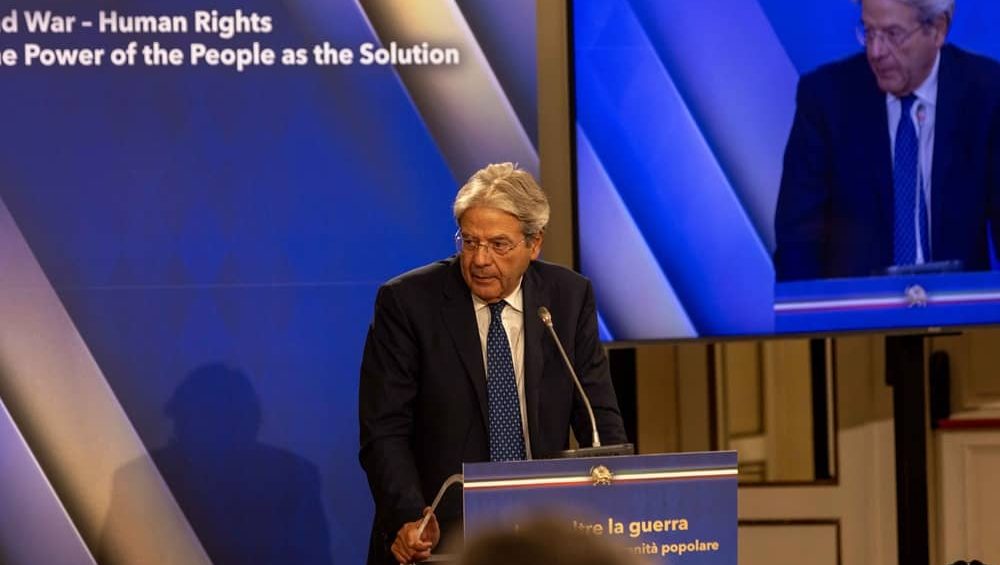
Speaking at an international conference in Rome on July 17, 2026, former Italian Prime Minister, Foreign Minister, and EU Commissioner Paolo Gentiloni emphasized that neither foreign military action, traditional diplomacy, nor international sanctions alone can resolve the crisis in Iran. Reflecting on past diplomatic attempts like the JCPOA, Gentiloni noted that past frameworks failed to deliver long-term change. Furthermore, while economic sanctions weaken the regime, they remain an incomplete tool on their own.
Addressing common misconceptions, Gentiloni firmly rejected the idea that recent foreign military strikes have consolidated public support around the ruling mullahs. Instead, he asserted that the regime’s foundation has been severely weakened, creating a distinct power vacuum and further destabilizing its leadership. He stressed that European public opinion must not allow disdain for foreign military interventions or external political figures to build sympathy for the repressive regime in Tehran.
Ultimately, Gentiloni argued that the true path forward lies beyond war and external interference, residing firmly in the hands of the Iranian people and their organized resistance. Endorsing the National Council of Resistance of Iran (NCRI), he called on the international community and European leaders to offer robust, active support to the democratic alternative. He concluded that empowering the domestic resistance and supporting the NCRI platform represents the only genuine route toward establishing a secular, democratic, and free Iran.
Excerpts of Paolo Gentiloni’s speech follow:

Well, thank you. Excellencies, dear colleagues, ladies and gentlemen.
Well, first of all, let me thank Madam Rajavi and the National Councils of Resistance for this invitation. I think this meeting today is very timely because we are living a moment where being here with some European and Italian friends is very important to stress the fact that what is happening now in Iran is something that leave the door open to an alternative, to a resistance, to the Iranian people, and not only to war and destruction.
So, it is very important that we meet today, in these days.
I think we should be very clear in assessing this situation. First of all, of course, I don’t think that the war and the decapitation are means to resolve the situation. But first of all, we are now facing in Iran a sort of vacuum of power. The power is weaker than it has been for years and years.
Probably, the regime is also changing towards what, is not clear. What is clear is that the military, the Revolutionary Guards are probably playing a stronger role than before, and probably that the regime will try to become even more autocratic, more oppressive, more dictatorial than before, which is not easy because since years there is an autocracy and a dictatorship.
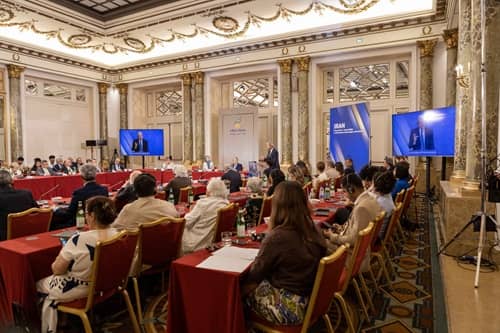
So, first message for the European public opinion, for the Italian public opinion, of course, the war had consequences, but don’t believe that the war gathered the Iranian people around the regime in support of the regime. This is not true.
Second point, where can the change come from? I have to say that even personally, I shared in a certain sense, hope and illusion on the diplomatic solutions that Europeans, Americans tried 10 years ago, JCPOA and all the agreements built by President Obama, my good friend John Kerry, 10 years ago.
I think it was a justified attempt, I’m not saying that this was crazy. I wouldn’t define it automatically as an appeasement, but for sure, it didn’t work. So, now, 10 years after, we should say first that this kind of diplomatic way is not working, and it will not work again.
But also, the war is not a solution. I heard some voices from Iran against the regime asking for the war and hoping that the war could have been a solution. I think that the reality proved that this is not true. The diplomatic way was not successful, but the war, the external war and intervention is not a solution for the European people, not at all.
And, sanctions. Sanctions are working. As Guy Verhofstadt just said, they should be strengthened in several domains. But as always, sanctions are not the decisive tool to solve this kind of solution.
We saw this with many, many countries and in many, many situations. We are seeing this now, we Europeans with Russia in the Ukrainian war, we know that sanctions are weakening countries that we are targeting with our sanctions, and that we are stronger, if we are stronger in the sanctions, they will be more effective.
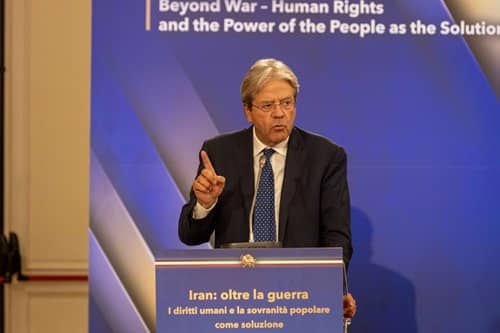
Because for sure, the economic malaise that the Iranian people are living, and that was also part of the uprising in in in last January, this economic malaise is also coming from sanctions. So, sanctions are working, they could work better, but they are not, in themselves, the solution.
The solution is, we could say, in your hands, in the hands of the Iranian people and on the support of the international community to the Iranian people. There is not another solution, not the diplomatic way, not the war, and not even the sanction.
I’m in favor of the sanction, but the solution will not come from the sanctions. We need to strengthen, to support, and I’m very happy that Senator Terzi has a leading role in the European Parliament to support your resistance and your activity.
This is the solution. We admire your country, your culture, your civilization. I think we will not forget Iranian fighting for freedom.
And so, freedom, democracy, the support to the National Council of Resistance, for people that, as is my case, do love Iran, its tradition, the country that I visited several times, I think this is the way. There is a way beyond war. The way beyond the war is freedom and democracy.
Thank you.