

THIS PAGE WILL BE UPDATED WITH THE LATEST NEWS
UPDATE: 9:30 AM CEST
Bessent Vows to ‘Asphyxiate’ Iran Economically, Warns Regime’s Offshore Assets Will Be Frozen

U.S. Treasury Secretary Scott Bessent detailed an aggressive campaign of economic “asphyxiation” against Iran, warning that the Trump administration could strip banks, firms or other entities that do business with the regime of access to the U.S. dollar-based financial system.
During a fireside chat with FOX Business’ Larry Kudlow on Tuesday at the G20 Finance Ministerial in Asheville, North Carolina, Bessent said the U.S. had identified the Islamic Revolutionary Guard Corps’ (IRGC’s) offshore accounts held by trust companies and luxury real estate holdings.
“Countries that go against this embargo, you’ll cut them off,” Kudlow prefaced, referencing the U.S. naval blockade of Iranian ports. “Secondary sanctions, you take them out of the U.S. dollar system, you’d take them out of the U.S. banking system, you take them out of the Federal Reserve wire, take them out of the SWIFT ledger?”
U.S. Strikes Iran as Tehran Retaliates, Raising Risk of Wider War

The U.S. and Iran traded a new round of attacks Tuesday, with American forces striking Iranian targets around the Strait of Hormuz and Tehran saying it had launched a retaliatory operation targeting U.S. interests across the region.
Explosions were seen over the southern Jordanian city of Aqaba as Iran said it was retaliating for the U.S. strikes, according to the Associated Press. It was not immediately clear what caused the explosions or whether Iranian missiles or drones struck targets there.
Aqaba is on the Red Sea, south of the U.S. bases targeted over the weekend and sits near Jordan’s borders with Israel and Egypt.
The strikes come after President Donald Trump had reportedly been considering a CENTCOM plan for limited attacks aimed at preventing Iran from rebuilding radar and missile capabilities that could be used to target ships in the strait.
UPDATE: 7:00 AM CEST
Forty Days After Mehdi Khanaki’s Martyrdom, Resistance Units Carry His Memory Forward
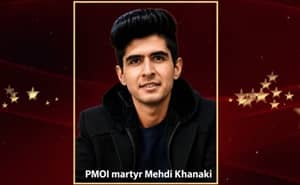
Forty days after the Iranian regime executed PMOI member Mehdi Khanaki, his name returned to the streets of Iran.
On August 31, 2026, Resistance activists in Tehran, Karaj, and Rasht placed wreaths and flower baskets bearing Khanaki’s photograph to commemorate him. The messages accompanying the flowers spoke not only of mourning, but also of remembrance and continuity.
In Tehran, one message said Khanaki would never be forgotten and that his name remained in the hearts of his comrades. Another described his name as a symbol of “kindness and courage.” In Karaj, where Khanaki had been arrested and imprisoned, a message read: “Your memory is honored, your name eternal, your path continues.” In Rasht, activists wrote that although he was gone, his kindness and memories would remain with them.
The tributes came as new accounts from Khanaki’s former cellmates shed further light on the months between his arrest and execution—months in which, according to those accounts, he endured solitary confinement and intense pressure while refusing to renounce the political convictions for which he had been arrested.
August 2026 Report: The Epic of Women Who Said ‘No’ to the Executioners!
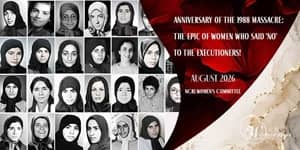
The August 2026 report is dedicated to the anniversary of the 1988 massacre, focusing on the women executed during this tragedy. Its purpose is to review one of the most significant events in contemporary Iranian history from the perspective of female political prisoners, the human toll of this disaster, and the imperative for justice. In this report, we have sought to present a coherent picture of the historical background, the sequence of events, the resistance of women, and the continuation of the movement for justice.
The summer 1988 massacre is not merely a historical event in the collective memory of the Iranian people. Due to its vast dimensions, systematic cover-ups, and the lack of accountability, it remains an active topic in the realm of human rights and justice seeking in Iran.
Among the 30,000 victims of this massacre, women hold a unique position—women who had endured years of imprisonment yet steadfastly refused to surrender their beliefs.
The overwhelming majority of the 1988 massacre victims were members and supporters of the People’s Mojahedin Organization of Iran (PMOI/MEK). However, in later stages, the execution decree was expanded to encompass resistant, militant prisoners from other political groups as well.
Iran’s Medicine Crisis: When Life-Saving Drugs Become a Luxury

Iran’s deepening economic crisis is now directly threatening access to life-saving medicine. With official annual inflation reaching 89 percent in August and food and beverage inflation climbing to 127 percent, the cost of essential goods has become increasingly unbearable for workers and wage earners. But medicine is becoming an even more devastating burden.
According to Hadi Ahmadi, spokesperson for the Iranian Association of Pharmacists, medicine prices have risen by an average of about 80 percent since the beginning of 2026, with increases reaching 300 percent for some products. In annualized terms, this represents an extraordinary escalation in the cost of medicines, with some drugs experiencing several-fold increases.
At the same time, shortages are becoming increasingly widespread. The Iranian Pharmacists Association and the regime’s parliamentary Health Commission have acknowledged shortages ranging from approximately 400 to 1,000 different medicines.
For patients suffering from cancer, chronic illnesses and other serious conditions, these are not merely economic statistics. They can determine whether treatment continues—or whether a patient survives.
Regime Infighting Deepens as Fear of a New Uprising Exposes Cracks at the Top

The Iranian regime’s repeated calls for “unity and cohesion” are increasingly revealing the opposite: deepening divisions at the highest levels of power. Recent statements by regime officials show that Mojtaba Khamenei’s attempts to impose discipline on rival factions have failed to silence disputes that are increasingly spilling into the open.
The central issue behind these divisions is not merely a struggle over political influence or economic interests. Increasingly, the dispute is over how the regime can survive mounting economic and social pressures—and the threat of another nationwide uprising.
On August 30, Mojtaba Khamenei called on the regime’s competing factions to preserve unity and warned against actions or statements that could undermine cohesion. Yet events immediately demonstrated the limits of his authority.
Ejei’s Threats Reveal Regime’s Fear of a New Uprising in Iran
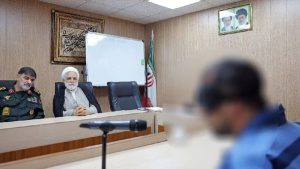
The latest remarks by regime Judiciary Chief Gholam-Hossein Mohseni Ejei reveal more than the regime’s familiar threats against its opponents. They expose growing anxiety at the highest levels of power over the possibility of renewed popular uprisings in Iran.
Speaking on Monday, August 31, 2026, during a meeting of the regime’s Judiciary High Council, Ejei devoted a significant portion of his remarks to what he described as efforts by the regime’s “enemies” and their alleged “mercenaries” inside Iran to create unrest.
His language was unusually direct. He warned that if such unrest occurred, the regime would respond with force, emphasizing that intelligence, security and police forces were supposedly at their “highest level of readiness,” while the judiciary would act “more decisively than ever” in prosecuting and punishing those deemed security threats.
Behind this aggressive rhetoric, however, lies a revealing fear: the regime is preparing for the possibility that widespread public anger could once again erupt into nationwide protests.
Iran’s Human Rights Crisis Deepens as Regime Escalates Executions and Suppresses Free Expression
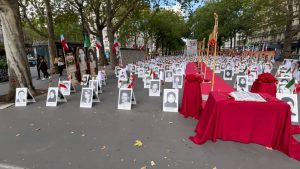
Iran’s human rights situation has sharply deteriorated in recent months, with a dramatic increase in executions, including those of political prisoners, alongside new restrictions targeting freedom of expression and access to information.
In an interview with INTV examining the latest developments, human rights commentator Sahar Sanaei pointed to executions as one of the clearest indicators of the regime’s worsening human rights record. She noted that while countries such as Lebanon have taken steps toward abolishing the death penalty, Iran has moved in the opposite direction.
Since March, executions have increased significantly. According to Sanaei, 56 political prisoners have been executed in the intervening months, representing the highest number in approximately 35 years.
The scale and speed of the executions have triggered growing international concern.
The Hidden Dimensions of Iran’s Gasoline Crisis
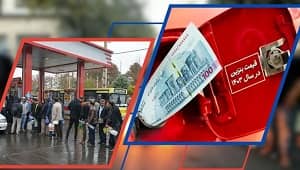
These days, Iran’s streets are witnessing long lines at gas stations. The crisis has spilled over into the public budget, inflation, fuel smuggling, the automotive industry, the environment, and citizens’ health.
Reports published in recent days indicate that daily gasoline consumption in Iran has exceeded domestic production capacity. Some estimates put the gap between production and consumption at tens of millions of liters per day. The roots of this crisis lie in the flawed structure of the energy economy.
To understand the hidden dimensions of the gasoline crisis, one must go back to 2004. At the time, the regime’s parliament halted the gradual process of adjusting energy prices by approving a price stabilization plan. The decision was promoted in the political climate of the time as an “Eid gifts to the people,” or a holiday gift to the public.
10 Protesters Sentenced to Death in Isfahan Shohada Square Case
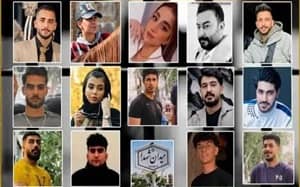
The First Branch of the Revolutionary Court in Isfahan has issued death sentences for 10 detainees arrested during the January protests in the case known as the “Isfahan Shohada Square” case. Six other defendants in the case have also been sentenced to lengthy prison terms. Human rights sources report restrictions on lawyers’ access to the case file, torture during interrogations, and the failure to properly investigate a complaint by one of the detained women concerning sexual assault while in custody.
According to a report by the Bazdashtshodegan website, the sentences were issued at the trial court level. The 10 defendants—Taraneh Rahimi, Navid Elyasi, Abolfazl Dadgostar, Mehdi Mansouri, Ahmadreza Saeedi, Mehrdad Boeri, Mohammadmehdi Asadi, Armin Gholami, Parsa Jafari, and Mehdi Jafari, also known as Mehdi Khosravi—have been sentenced to death.
Six other defendants in the case have also received lengthy prison sentences. According to reports, Romina Rahimi and Milad Boeri have each been sentenced to 25 years in prison, Hamed Mehralian to 15 years, and Setayesh Saedi, Sajjad Abedi, and Ali Boeri to five years each.