

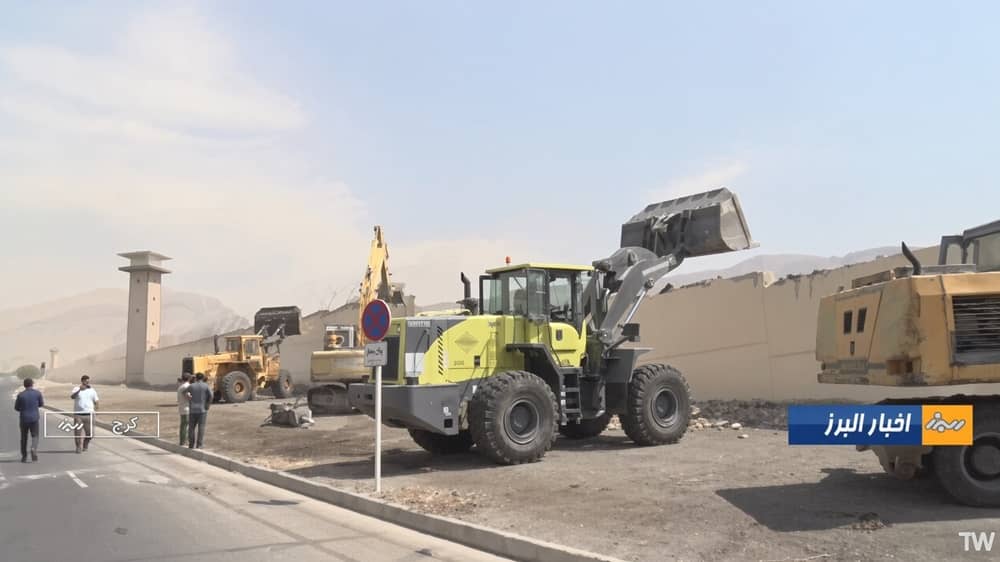
Iranian authorities have begun demolishing Gohardasht Prison in Karaj, one of the principal sites of the 1988 massacre of political prisoners, raising urgent concerns that evidence potentially relevant to future investigations and prosecutions could be permanently destroyed. The demolition began on September 13, with officials saying the former prison site would be cleared for development and its surrounding walls removed within a month.
Gohardasht occupies a central place in the documentary record of the 1988 killings. Survivors have described its cells, corridors, torture chambers and notorious “Death Hall,” while testimony and detailed reconstructions of the prison later became important evidence in Sweden’s prosecution of former Iranian prison official Hamid Noury. The prison’s destruction also follows allegations of interference with burial sites connected to political executions elsewhere in Iran, a pattern previously raised by a U.N. special rapporteur.
In the following commentary, J. Kenneth Blackwell, a former U.S. ambassador to the United Nations Human Rights Commission, argues that the United Nations must act before potentially significant physical and documentary evidence disappears. The article was originally published by the Washington Examiner on September 17, 2026, and is republished below.
Iran is bulldozing a crime scene — and the UN is standing by
2/4 | Prison Walls to Be Gone Within a Month
Prisons Organization chief Heydar Asiabi said the demolition was ordered by the judiciary chief and that all surrounding walls would be demolished within a month, clearing the site for residential and commercial development. pic.twitter.com/UwnX41jwIM
— SIMAY AZADI TV (@en_simayazadi) September 16, 2026
There are places whose importance cannot be measured in bricks and concrete. They are witnesses to history — and sometimes witnesses to crimes.
For Iran, Gohardasht Prison is such a place.
On Sept. 13, Iranian authorities began a new phase in the demolition of the notorious prison in Karaj, west of Tehran. State media showed the walls coming down as officials announced that the site would be cleared for residential or commercial development. The head of Iran’s prisons organization said the demolition was proceeding under direct instructions from the head of the judiciary and that all of the prison’s surrounding walls would be destroyed within a month.
But Gohardasht is not simply an obsolete prison occupying valuable urban land. It is a possible crime scene — one of the principal sites of the 1988 massacre of political prisoners in Iran.
Its destruction, therefore, raises an urgent question that should concern every government represented at the United Nations: Will Tehran be allowed to destroy physical evidence of one of the gravest chapters in Iran’s modern history before that evidence can be independently examined and preserved?
1/4 🚨 Iran Begins Demolishing Gohardasht Prison
Iranian state media aired footage on September 13 showing the demolition of Gohardasht Prison in Karaj, one of the principal sites of the 1988 mass executions of political prisoners.pic.twitter.com/rXcibjAD8n
— SIMAY AZADI TV (@en_simayazadi) September 16, 2026
The timing makes this especially urgent. As world leaders gather in New York for the U.N. General Assembly, thousands of Iranians will rally outside the U.N. against executions in Iran and call for accountability for those responsible for past and present atrocities. Their message connects two chapters of the same story: the impunity surrounding the mass executions of the past and the executions being carried out today.
Gohardasht was one of the principal killing grounds of 1988. Survivors have described its corridors, isolation cells, torture chambers, and the infamous “Death Hall,” where political prisoners were taken during the massacre.
The People’s Mojahedin Organization of Iran, or PMOI/MEK, documented the prison’s layout and survivor accounts decades ago. Those accounts later assumed extraordinary evidentiary importance during the Swedish prosecution of former Iranian prison official Hamid Noury. Witnesses provided testimony, sketches, and three-dimensional reconstructions detailing Gohardasht and what occurred inside it.
The Noury case demonstrated that even decades after an atrocity, evidence can survive, witnesses can testify, and those accused of responsibility can be brought before a court. That is precisely why the destruction of Gohardasht matters.
Architectural features can corroborate survivors’ accounts and help establish how prisoners were moved from their cells to interrogation rooms and execution sites. Documents or physical objects may also retain evidentiary importance. Once bulldozers reduce the site to rubble, such evidence may disappear forever.
And Gohardasht does not stand alone.
On August 5, the regime’s judiciary also announced that in addition to the closure of Gohardasht, the central prisons in the cities of Mashhad, Zanjan, Tabriz, Kermanshah, Yazd, and Bijar in Kurdistan province will also be transferred outside the cities.#1988Massacre pic.twitter.com/SDGM32wbPX
— Iran Freedom (@4FreedominIran) August 7, 2023
For years, Iranian authorities have faced accusations of interfering with burial sites associated with the mass executions of political prisoners, including sites in Khavaran, Tabriz, Mashhad, and Ahvaz. In August 2025, Plot 41 of Tehran’s Behesht-e Zahra cemetery, containing the graves of thousands of PMOI members executed in 1981, was destroyed and leveled with heavy machinery.
The international community has already been warned about this pattern. In his July 2024 report, then-U.N. special rapporteur on Iran Javaid Rehman stated that Iranian authorities had initiated what he described as a systematic campaign to destroy mass graves associated with thousands of political prisoners executed in 1988. He warned that this compounded the suffering of victims’ families while obstructing efforts to establish the truth and hold those responsible accountable.
More than three decades ago, I had the privilege of representing the U.S. on the U.N. Commission on Human Rights in Geneva and heading the American delegation there. During that period, the international community was already confronting the Iranian government’s human rights record.
That experience left me with an enduring lesson: International scrutiny matters, but scrutiny without accountability is not enough.
Resolutions, investigations, and survivor testimony matter. But so does preserving evidence that could establish individual responsibility. If evidence is permitted to disappear and perpetrators come to believe that the passage of time will shield them from justice, documentation alone cannot end impunity.
NCRI Statement: The Religious Fascism Seeks to Destroy Evidence of the #1988Massacre by Demolishing Gohardasht Prisonhttps://t.co/ZF8zZnj6K1
— NCRI-FAC (@iran_policy) September 15, 2026
Iranian authorities may say that the prison was closed years ago, that Karaj has expanded around it, and that redevelopment serves legitimate economic purposes. But none of those arguments answers the essential question: Why destroy a site associated with alleged crimes against humanity before independent investigators have been permitted to examine and document it?
The U.N. should urgently call on Tehran to halt any further demolition that could destroy historically or forensically significant evidence at Gohardasht until independent experts can document the site. Governments should demand the preservation of prison registers, architectural plans, execution records, photographs, personnel files, and other archives associated with the prison.
The same principle must apply to suspected mass graves throughout Iran. Such sites should be protected from interference until independent forensic examinations can be conducted.
This is not about preserving a prison as a monument.
It is about preserving a crime scene for justice.
The families of the victims of 1988 have already endured nearly four decades without accountability. Many were denied the bodies of their loved ones or even knowledge of where they were buried. They should not now be forced to watch the physical evidence disappear as well.
In recent years, Gohardasht Prison has come into focus again due to the transfer of political prisoners connected to the 2009 protests. For decades, the prison has hosted thousands of political prisoners and witnessed their torture and execution.#1988Massacre pic.twitter.com/CX5QthymEt
— Iran Freedom (@4FreedominIran) August 7, 2023
This is why the voices of thousands of Iranians gathering outside the United Nations this month carry particular significance. Their demand for an end to executions is inseparable from their demand for accountability. The absence of accountability for yesterday’s atrocities creates the conditions in which abuses can recur.
Having represented the U.S. at the U.N.’s principal human rights body, I believe this is precisely the moment when international human rights institutions must demonstrate their purpose. The international community should not wait until Gohardasht has disappeared and then lament the destruction of evidence.
Nearly four decades after the 1988 massacre, the families of its victims are still waiting for truth and justice.
Concrete can be pulverized. Prison walls can be torn down. Cemeteries can be bulldozed.
History cannot.
The U.N. must help preserve the evidence required to prosecute those responsible.
The bulldozers are already at Gohardasht. The time to act is now.
Ambassador J. Kenneth Blackwell is a senior fellow for human rights and constitutional governance at the Family Research Council and former U.S. ambassador to the United Nations Human Rights Commission. He is on X @kenblackwell