

Three-minute read
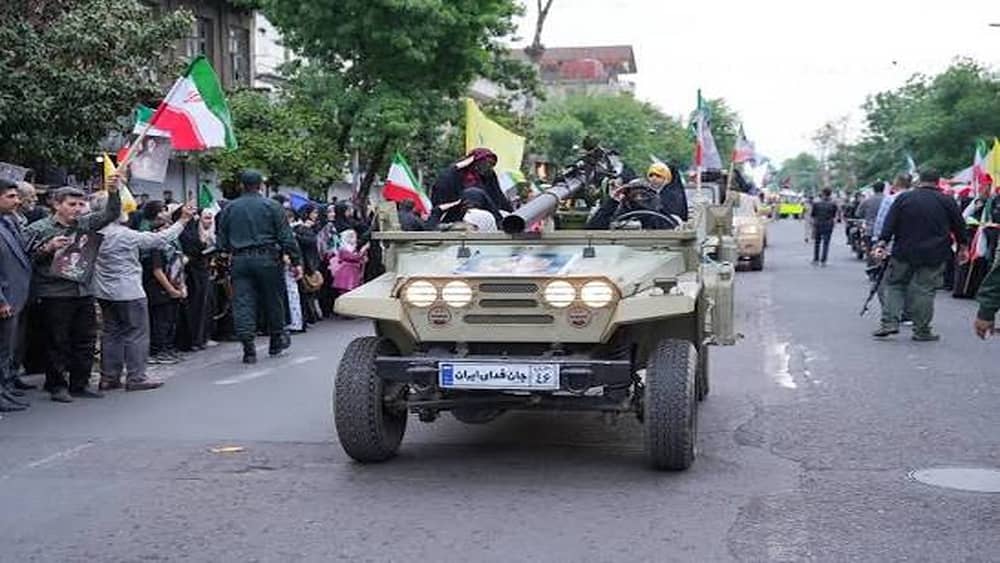
As Iran’s ruling establishment prepares to stage a massive street mobilization in Tehran under the banner of the “Jan-Fadayan-e Iran” (Devotees of Iran) exercise, officials are portraying the event as a demonstration of national unity and popular strength. Yet the scale, rhetoric and timing of the campaign suggest a deeper concern inside the clerical establishment: fear that the next major challenge to its survival will emerge not on distant battlefields, but in Iran’s own streets.
Scheduled for September 18, the anniversary of the start of the 2022 uprising, state media claimed the maneuver is expected to bring together 313,000 participants from the Basij militia, the Revolutionary Guards, law enforcement forces, and other regime-affiliated networks. Hassan Hassanzadeh, commander of the Tehran branch of the Revolutionary Guards, said registrations had already surpassed 400,000 and could eventually reach 500,000. He described the event as a display of national solidarity and declared that participants would march from Imam Hossein Square toward Enghelab Square in central Tehran.
But the official language surrounding the exercise reveals more than a routine display of loyalty. In the same remarks, Hassanzadeh repeatedly celebrated what he called the Iranian people’s “200 nights” of steadfast presence, claiming that this street mobilization had become “the most important component of national power.”
#Iran News: IRGC Stages Massive Drill in #Tehran Amid Fear of Uprisinghttps://t.co/Rd1fDhqcIR
— NCRI-FAC (@iran_policy) January 8, 2025
That emphasis is striking. For decades, the clerical dictatorship defined its strategic leverage through three pillars repeatedly cited by regime officials: its nuclear program, ballistic missile capabilities and regional proxy network extending through Lebanon, Syria, Iraq and Yemen. Today, however, senior figures increasingly speak about the “field” inside Iran itself. The shift reflects how dramatically the regime’s strategic environment has changed.
For years, Supreme Leader Ali Khamenei justified Iran’s regional interventions by arguing that Tehran had to confront threats beyond its borders in order to prevent instability at home. The doctrine was encapsulated in one of his most frequently cited statements: “If we do not fight in Syria or Lebanon, we will have to fight in Tehran and the provinces.” The implication was clear: the regime’s security perimeter extended far beyond Iran’s borders.
The Jan-Fada exercise reflects that reality. According to official announcements, participants will be organized into 72-member battalions and deployed across one of Tehran’s most politically symbolic corridors. Authorities insist the event is designed to demonstrate “readiness,” “cohesion” and “security.” Yet the language used by state media repeatedly references confronting “threats” and preserving order in the capital, terminology commonly associated with internal security operations.
#Iran's Regime Mobilizes Nationwide Basij Drills to Expand Surveillance and Prepare for Crackdownhttps://t.co/SwQodwwuE3
— NCRI-FAC (@iran_policy) August 23, 2025
Equally revealing is the political debate unfolding within the regime itself.
In recent months, competing factions have increasingly clashed over the extent to which security forces should maintain a visible and permanent presence in public spaces. Hardline elements argue that continuous street deployment is essential to deter unrest and maintain ideological control. Others warn that an excessive security footprint deepens public resentment, highlights the state’s insecurities and exposes the limits of its legitimacy.
That anxiety is increasingly visible in official messaging. Hassanzadeh framed the upcoming exercise as evidence that the nation remains united and that enemies have failed to weaken the regime. “The enemy intended to weaken cohesion and unity,” he said, arguing instead that society had become more unified. He further insisted that participants were prepared to stand “to the last drop of blood.”
Yet historically, governments confident in their social base rarely need to organize colossal demonstrations of loyalty on such a scale. The repeated emphasis on participation figures, whether 313,000 attendees, 400,000 registrations or projections of 500,000 volunteers, appears aimed as much at shaping perceptions as reporting facts.
#Iran’s Revolution Parade: Regime Flaunts #Nuclear-Capable #BallisticMissileshttps://t.co/CwzyugULoz pic.twitter.com/TJ7uC8c1Op
— NCRI-FAC (@iran_policy) February 14, 2018
The symbolism of the venue is also significant. Enghelab Street has long been associated with political activism, student movements and moments of social unrest. By filling that space with organized loyalist forces, authorities appear intent on sending a message not only to foreign adversaries but also to domestic audiences.
That evolution reflects a deeper reality confronting Tehran’s rulers. The debate is no longer simply about diplomacy versus military power, or even about missiles versus negotiations. Increasingly, the regime’s central strategic question is the “field” at home: the streets, the public mood and the possibility of another nationwide eruption of dissent.
In that sense, the planned mobilization is not merely a display of power. It is an acknowledgment that the front line the regime once claimed to keep far away has moved inside Iran itself.