

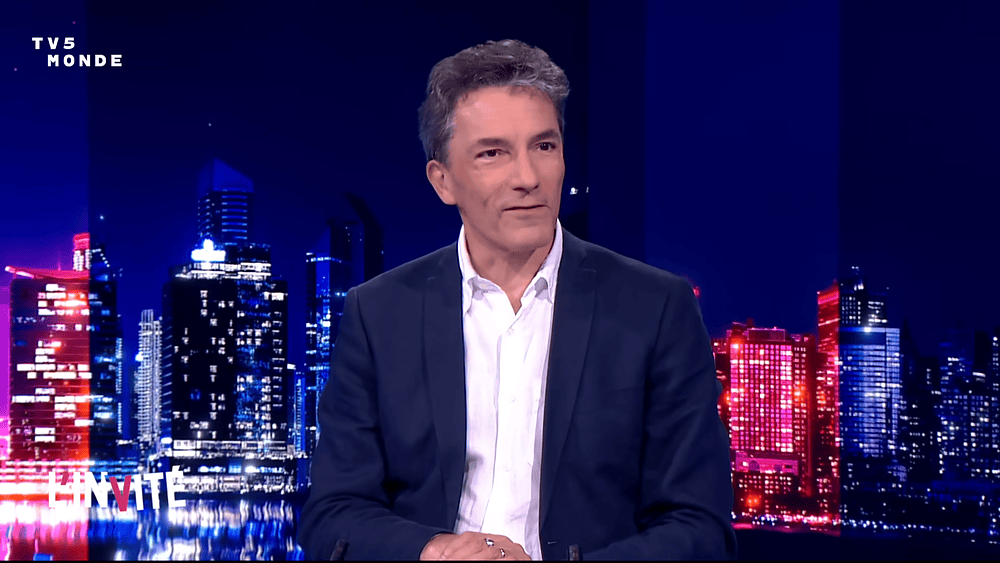
Former magistrate Marc Trévidic revisits the June 2003 raid against the Iranian Resistance and denounces what he describes as the political instrumentalization of anti-terror justice in France’s rapprochement with Tehran. The remarks were delivered on May 4, 2026, during the conference “Justice Facing the Challenge of Terrorism” in Nantes and were broadcast on September 10, 2026, on the program Grand Format on Radio Présence in Toulouse.
Marc Trévidic, one of France’s most prominent anti-terrorism magistrates, offered a rare insider account of the campaign that targeted the People’s Mojahedin Organization of Iran (PMOI/MEK) in the 2000s. His remarks revisit the events surrounding June 17, 2003, when French authorities launched a large-scale operation against PMOI members in Auvers-sur-Oise, arresting scores of Iranian dissidents, including NCRI President-elect Mrs. Maryam Rajavi. The operation involved more than a thousand police officers and became one of the most controversial counterterrorism actions ever undertaken on French soil. All detained individuals were later released, and the judicial proceedings eventually collapsed.
Trévidic’s remarks focus on what he views as the political motivations behind the case, the role of France’s efforts to improve relations with Tehran, and the broader problem of using terrorism designations as instruments of policy rather than law.
Full translation of Marc Trévidic’s remarks follow:
“I have also known cases where something was considered terrorism purely for political reasons.
Politically speaking, I took over the office of Jean-Louis Bruguière. As it happened, when I was working in the anti-terrorism prosecutor’s office in the early 2000s, I witnessed this strange rapprochement between France and Iran.
In 2001 and 2002, France wanted to sign several lucrative contracts with Iran. Oil, gas, everything we needed.
Iran set a condition: that we arrest its opponents. And in France, we had all the opponents. Many were in Germany, but above all we had the PMOI, the People’s Mojahedin Organization of Iran, in Auvers-sur-Oise with Maryam Rajavi.
The Resistance That Refused to Die — and Why Tehran Cannot Sleephttps://t.co/pEYM3Ro9j9
— NCRI-FAC (@iran_policy) July 4, 2026
These were people who were preparing to take power. They were also being assassinated by the Iranian regime.
At the anti-terrorism services, we were dealing with terrorism, and then suddenly we were told: ‘But they are terrorists too!’
So, everyone is a terrorist.
Iran was killing its opponents, and the opponents were terrorists as well. Try to make sense of that.
But because it was political, unfortunately the justice system agreed to play along. Fifteen hundred police officers descended on Auvers-sur-Oise and arrested PMOI members.
Bruguière put them in prison. Fifteen days later, the investigating chamber released them all.
Fortunately, something happened.
Later, when I took over the investigation after replacing Bruguière, I reviewed the case file.
Yes, the PMOI carried out attacks in Iran. Certainly. They targeted institutional figures. They would kill a general. They would target the director of Evin Prison, for example, someone responsible for torturing people.
So yes, they killed.
They also had significant military capabilities there that, in my opinion, would be very useful today in bringing down the regime.
But those capabilities no longer exist because we eliminated them. We did. The Americans did. The British did. Everyone participated in that process.
Yet the whole thing created a serious legal problem because they were all political refugees with official refugee status.
On This Day | July 3, 2003
On July 3, 2003, NCRI President-elect Mrs. Maryam Rajavi was released from prison after being arrested on June 17 during a raid on the NCRI's headquarters in Auvers-sur-Oise, France.Her release followed an international campaign that included hunger… pic.twitter.com/D2yK6JRj71
— SIMAY AZADI TV (@en_simayazadi) July 3, 2026
At that time, they were being debriefed every fifteen days by the DST so that French authorities could learn about the situation inside Iran and about various developments there.
In other words, there was no problem.
I believe Maryam Rajavi even had the Legion of Honour.
Then, overnight: ‘No, they’re terrorists. Let’s arrest them.’
What is that?
It is the instrumentalization of anti-terror justice for political purposes.
I ultimately closed my cases with dismissals.
I based my reasoning on something very simple: Article 2 of the Declaration of the Rights of Man and of the Citizen, the right to resist oppression.
That principle has a value higher than ordinary law.
At some point, we must ask whether these people were not resisting a form of oppression imposed by the Iranian regime.
And above all, are we supposed to serve the interests of the mullahs?
Seriously.
What’s interesting is that everyone talks about terrorist lists.
Those lists are created solely by political authorities.
The United States has its list of terrorist organizations. The European Union has one. The British have one. Everyone has one.
That’s politics.
As judges, we are not bound by whether an organization appears on a list or not.
July 3, 2003 – A Turning Point for Iran’s Democratic Resistance
Today marks the anniversary of a pivotal moment in the struggle for freedom and democracy in Iran. On July 3, 2003, @Maryam_Rajavi, the President-elect of the National Council of Resistance of #Iran (NCRI), was… pic.twitter.com/TD5OKoY0UZ— Javad Dabiran (@JavadDabiran) July 3, 2025
We examine the acts.
Has a particular organization committed a terrorist act?
That is what matters to us.
Not whether it appears on a political list.
Fortunately, because the PMOI was removed and reinserted several times depending on the state of relations with Iran.
One day it is terrorist; another day it is not.
Arafat was once considered a terrorist and later received the Nobel Peace Prize.
At a certain point, we need to be careful.
We cannot simply follow political fluctuations.
A while ago, Hezbollah was placed on the European Union’s list of terrorist organizations.
Of course, Hezbollah is a terrorist organization.
But why did you discover that only now?
Why put it on the list now?
Because it is political, linked to the crisis at the moment.
I have no other explanation.
When Carton, Fontaine and Kauffmann were being tortured in Lebanon, was that not enough?
When the French ambassador was killed, was that not enough?
Do you see what I mean?
Politics is not something stable.
The problem is that criminal law requires clear definitions.
It requires legal certainty.
People need to know what is prohibited and what is not prohibited.
They need to know what terrorism is and what terrorism is not.
That is why the issue is so complicated.”