

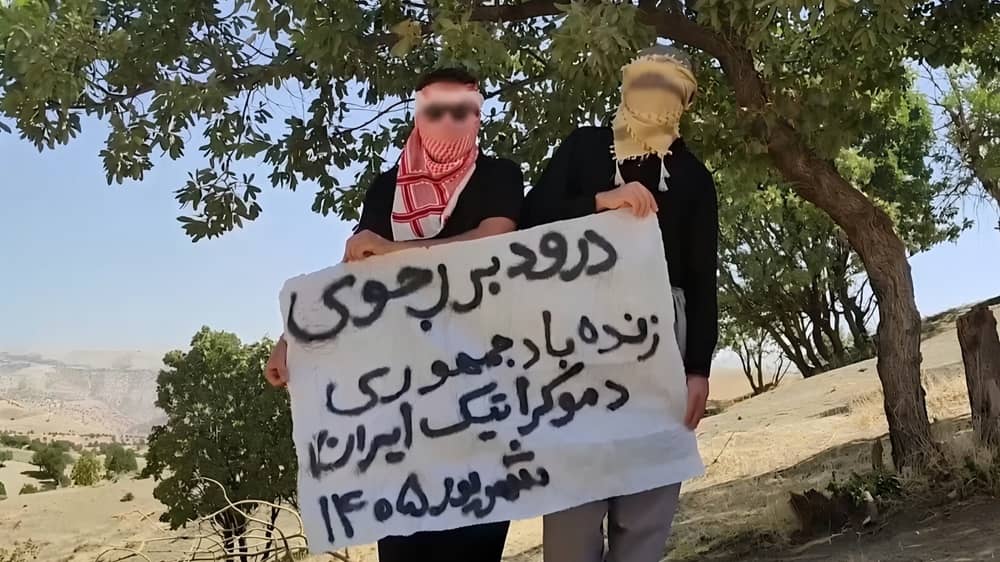
A coordinated surge of daring operations expanded across dozens of Iranian cities between September 13 and 19, 2026. Despite heightened security alerts and public threats from state authorities, the People’s Mojahedin Organization of Iran (PMOI/MEK) affiliated Resistance Units, executed targeted fire strikes against security centers and intelligence markers while coordinating anti-execution campaigns across major urban centers. This synchronized push underscores deepening domestic defiance and highlights the clerical regime’s increasing inability to suppress organized dissent through coercive measures.
September 18, 2026
In Zahedan, the Resistance Units executed a major public campaign across primary avenues to mark the anniversary of the 2022 nationwide uprising and honor its 750 martyrs. Displays featured banners rejecting both clerical and monarchical rule, demanding a democratic republic, and asserting that state repression and economic austerity will not halt the momentum toward regime change. Across multiple provinces, Resistance Units concluded a week of anti-repression operations, maintaining operational density despite widespread military readiness and State Security Chief Ahmad-Reza Radan’s announced crackdown on dissidents.
Resistance Units mark uprising anniversary with 40 operations across Iran https://t.co/VeCpRm90jO
— People's Mojahedin Organization of Iran (PMOI/MEK) (@Mojahedineng) September 18, 2026
September 16, 2026
Resistance Units carried out 40 direct incendiary strikes against government security, intelligence, and propaganda targets across 21 cities. In Mashhad, targeted fires struck two Islamic Revolutionary Guard Corps (IRGC) Basij bases and a state religious center. The units also launched fire strikes against student Basij command posts in Bam, an IRGC Basij center in Iranshahr, and a state facility in Kermanshah.
Resistance Units networks simultaneously disrupted state intelligence infrastructure by torching Ministry of Intelligence espionage markers and IRGC Basij informant guidance boards in Tehran, along with similar intelligence signage in Iranshahr and Bushehr. Concurrently, blazes destroyed billboards and posters depicting Ruhollah Khomeini, Supreme Leader Ali Khamenei, Mojtaba Khamenei, and Qasem Soleimani across Tehran, Karaj, Bandar Abbas, Nishapur, Yazd, Sari, Qom, Arak, Zanjan, Zahedan, Birjand, Sabzevar, Saveh, Babol, Kermanshah, Semnan, and Ahvaz.
🚨 EXCLUSIVE | 40 PMOI Resistance Unit Operations Across Iran
Exclusive footage received by Simay Azadi shows operations attributed to PMOI Resistance Units on September 16, marking the fourth anniversary of Iran’s 2022 uprising.
According to the PMOI, 40 operations were… pic.twitter.com/FBhuvL0Nud
— SIMAY AZADI TV (@en_simayazadi) September 19, 2026
September 15, 2026
The “No to Execution Tuesdays” movement mounted field demonstrations across 14 cities demanding the release of political prisoners and an immediate end to capital punishment. In Karaj, the Resistance Units members held a memorial for martyred dissident Mehdi Khanaki and staged photo displays to honor the executed political prisoners and PMOI members Vahid Bani-Amirian, Behrouz Ehsani, Mehdi Hasani, and Babak Alipour. In Rasht, audio broadcasts and flyers called for revoking death sentences for Arghavan Fallahi, Farshad Etemadifar, Zahra Tabari, Mohammad Javad Vafaei Sani, Isa Chari, and Manouchehr Fallah. In Tehran, the units broadcast resistance audio messages, staged photo displays for Fallahi, and distributed flyers demanding the release of executed martyrs’ remains.
Photo demonstrations in Tabriz featured death-row detainees Ehsan Faridi and Chari, while units in Mashhad demanded the immediate cancellation of death sentences for student Faridi, Fallahi, and boxing champion Vafaei Sani. Further photo displays and leaflet distributions targeted death sentences in Ahvaz (for Chari, Etemadifar, and Alireza Merdasi), Islamshahr (for Fallahi and Vafaei Sani), Isfahan, Shiraz (where stickers were affixed inside transit buses), Yazd, Varamin (demanding information on Ehsani and Ali Akbar Daneshvarkar), Najafabad (for Amir-Hassan Akberi, Masoud Jamei, Mansour Jamali, and Fallah), Lahijan, and Malayer. On the same day, resistance units projected light displays onto public structures in Kerman (“Monarchy and Velayat, 100 years of crime”), Hamedan (“Neither Shah nor bloodthirsty mullah”), and Kashan (“Hail to Rajavi”), while conducting 30 additional field actions and wall-writings across Tehran, Mashhad, Isfahan, Shiraz, Kermanshah, Hamedan, Saveh, and Karaj.
September 14—Iran
PMOI/MEK Resistance Units mark the 4th anniversary of Iran's 2022 nationwide uprising with 40 daring operations against regime targets across the country. pic.twitter.com/GS9iJAz7Iw— People's Mojahedin Organization of Iran (PMOI/MEK) (@Mojahedineng) September 18, 2026
The rapid execution of synchronized fire strikes and public campaigns across dozens of Iranian cities underscores the failure of state terror as a mechanism of control. Rather than pacifying the population, the regime’s reliance on executions and security sweeps has accelerated the tactical coordination of organized underground networks that directly target security and intelligence infrastructure. This nationwide operational footprint exposes a fundamental political deadlock, demonstrating that public intimidation no longer suffices to project stability or prevent coordinated resistance.