
THIS PAGE WILL BE UPDATED WITH THE LATEST NEWS
UPDATE: 7:30 AM CET
Zahedan Resistance Units Reject Shah and Mullah’s Dictatorships, Reaffirm Commitment to a Democratic Republic
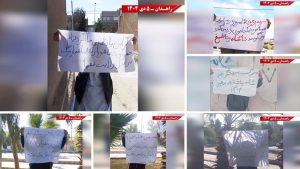
On October 23, 2026, PMOI/MEK Resistance Units resumed their weekly anti-regime activities in Zahedan, southeastern Iran, displaying placards in public places despite the regime’s security measures. Their messages rejected both the ruling clerical dictatorship and attempts to revive the deposed monarchy, while calling for freedom, equality, and a democratic republic.
“From Zahedan to Tehran, down with the oppressor, be it the shah or the supreme leader,” read one placard. The campaign emphasized that replacing one dictatorship with another would not fulfill the democratic aspirations of the Iranian people.
A central theme of the campaign was the rejection of both monarchical and religious dictatorship.
“A dictator is a dictator, whether with a turban or a crown,” declared one placard. Others stated, “No to monarchy, no to the rule of the supreme leader, yes to freedom and equality,” and “Monarchy and mullahs’ rule, 100 years of crime.”
These slogans reflect Iran’s experience of successive dictatorships. The 1979 revolution ended the Pahlavi monarchy, but the establishment of clerical rule under Ruhollah Khomeini replaced one authoritarian system with another.
Kalemeh Network Founder Exposes Pressure to Promote Reza Pahlavi and Silence Critics
The founder of Kalemeh Network, a broadcaster established to serve Iran’s Sunni Muslim community, has exposed a growing struggle over political loyalty and freedom of expression inside the network. In a public statement on October 8, 2026, Seyed Aqil Hashemi described how pressure to promote Reza Pahlavi had reached the point where a program on human rights and executions in Iran was prevented from going ahead because its planned participants had criticized Pahlavi. Hashemi directly named Abdol Fattah Khedmati, accusing him of pressuring the network’s control-room staff and employees and threatening their salaries through sponsorship funds if the program was broadcast.
The program, organized by Massoud Akhtarani, was to feature three experts discussing human rights and executions in Iran. Hashemi said he had given those involved ample time to resolve the dispute but could no longer accept the suppression of a program devoted to people facing execution.
“People are being executed. The blood of our compatriots is being shed in Iran,” he emphasized, questioning why defending human lives had become secondary to promoting a particular political figure.
The confrontation has exposed a fundamental issue: whether support for Reza Pahlavi is becoming an unwritten requirement for participation in parts of the Iranian opposition’s media environment, even when the subject under discussion is the defense of human rights.
Thousands of Fuel Tankers Smuggled Daily in Iran

Recent remarks by Masoud Pezeshkian, president of the Iranian regime, about the need to crack down on fuel smugglers and use measures such as canceling or blocking the fuel cards of violators have once again turned the smuggling of petroleum products and how to combat it into major economic issues in the country.
However, the main question is whether canceling fuel cards and restricting access to subsidized fuel quotas can address the extensive scale of smuggling, or whether the issue involves structures that go beyond individual violations and the illegal use of fuel quotas.
According to Hassan Moradi, an oil and energy expert, fuel smuggling is not limited to violations at fuel stations. To combat it effectively, the land and maritime routes used to transport petroleum products must also be placed under close surveillance.
In many cases, petroleum products are transported by trucks to border regions, where warehouses, garages, or large storage facilities are then used to facilitate their onward transportation to the coast. Under these circumstances, it must be determined how such large quantities of petroleum products are being moved and why these routes cannot be identified and blocked before the fuel leaves the country.
Unequal Distribution of Inflation in Iran: Rising Prices Hit the Poor Hardest

Rising prices in Iran do not affect the rich and the poor equally. Iran’s regime announces a single nationwide inflation rate each month, a figure intended to reflect changes in the cost of living for millions of Iranians. But behind this average are households with different incomes, different consumption patterns, and unequal resources to cope with rising prices. Inflation may appear to be a universal phenomenon in statistical terms, but when it comes to household budgets, the same bill cannot be applied to everyone.
September 2026 provides a clear example of this inequality. According to the figures, in a month when overall inflation reached 4.24%, the monthly inflation rate for the first income decile was 6.28%, compared with 7.52% for the tenth decile. In other words, the consumption basket of households in the highest expenditure decile became more expensive almost twice as fast as that of households in the lowest decile. At first glance, the 1.24-percentage-point gap between these rates presents an unexpected picture, suggesting that this time rising prices have hit the wealthy harder than the poor. Yet for a household that spends most of its income on rent, food, and healthcare before the month ends, even a smaller price increase can be more burdensome than increases in the prices of goods that wealthier households can afford to stop buying.
Iran Rebuilds Drone Production As 1,300 Chinese Air Shipments Deliver Dual-Use Components

Fresh images from an underground military facility, alongside customs data and sanctions documents, indicate that Tehran has resumed drone production after the 2026 strikes, while remaining dependent on foreign networks for engines, electronics and aerospace materials.
Iran is expanding its drone production centers and moving part of that capacity into underground facilities, while customs data, U.S. sanctions documents and intelligence assessments indicate that rebuilding the country’s drone arsenal remains dependent on a steady flow of imported components and materials, particularly from China and Hong Kong. Footage broadcast by Iranian state television on October 22 showed Army Commander-in-Chief Amir Hatami at a facility described as an underground drone factory.
Hatami said production had been expanded with the involvement of universities, knowledge-based companies and various institutions, adding: “We have expanded our production centers, and today we have very good reserves.” Reuters said it could not independently verify when or where the footage was filmed. Before the war, according to Reuters, Iran’s industry had the potential capacity to produce around 10,000 drones a month, although its actual current capacity has not been independently established.
Melbourne Exhibition Exposes Iran’s Human Rights Crisis, Executions
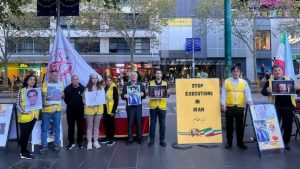
Melbourne, Australia – October 23, 2026 – Supporters of the People’s Mojahedin Organization of Iran (PMOI/MEK) gathered in Melbourne and held a book table and photo exhibition to highlight Iran’s deepening human rights crisis and the regime’s systematic executions of political prisoners and protesters detained during the nationwide uprisings.
The event also called for the immediate and unconditional release of all political prisoners in Iran. Participants denounced the death penalty, political repression, and the regime’s impunity, demanding justice and accountability for human rights violations.
Demonstrators described the executions as a blatant violation of human rights and called for regime change in Iran. They also urged the Australian government and the international community to adopt a firm policy toward the clerical regime, increase pressure to halt executions, and support the Iranian people’s struggle for freedom, democracy, and human rights.
Sydney Exhibition Exposes Iran’s Executions and Demands Freedom for Political Prisoners
Sydney, Australia – October 23, 2026 – Supporters of the People’s Mojahedin Organization of Iran (PMOI/MEK) gathered in Sydney and held a book table and photo exhibition to highlight Iran’s deepening human rights crisis and the regime’s systematic executions of political prisoners and protesters detained during the nationwide uprisings.

The event also called for the immediate and unconditional release of all political prisoners in Iran. Participants denounced the death penalty, political repression, and the regime’s impunity, demanding justice and accountability for human rights violations.
Demonstrators described the executions as a blatant violation of human rights and called for regime change in Iran. They also urged the Australian government and the international community to adopt a firm policy toward the ruling clerical regime, increase pressure to halt executions, and support the Iranian people’s struggle for freedom, democracy, and human rights.