
THIS PAGE WILL BE UPDATED WITH THE LATEST NEWS
UPDATE: 7:30 AM CET
Iran’s Regime Upholds Uprising Death Sentence
WASHINGTON — On Tuesday morning, November 3, 2026, the Iranian regime executed Amir-Hossein Maleki and Amir-Hossein Ebrahimi, two 20-year-old prisoners of the January uprising, at Dastgerd Prison in Isfahan. Along with other uprising prisoners, they had been sentenced to death in the case known as the “Ali-Khani Square” case in Isfahan, in which seven other political prisoners had already been executed in an effort to instill fear and prevent renewed uprisings.
Additionally, Iran’s ruling clerical regime has upheld the death sentence of a detainee arrested during the January 2026 uprising, while three other detainees reportedly face death sentences. The cases come amid a campaign to deter renewed resistance after the uprising.
Will growing pressure on Tehran bring consequences for officials directing domestic repression?
According to HRANA, Iran’s Supreme Court has upheld the death sentence of Arman Marefati, approximately 38, who was arrested in Tehran during the January uprising. He is held in Ghezel Hesar Prison in Karaj. The regime’s notorious judge, Abolghasem Salavati of Tehran’s Revolutionary Court, sentenced him on national-security-related charges. Two co-defendants, Mehrdad Mohammadinia and Ashkan Maleki, were executed in June.
A Simay-e Azadi report recorded at least 34 executions between October 21 and 28. Its figures included 15 executions on October 27 and seven on October 28—22 prisoners put to death in just two days.
Iran Executes 32 In Less Than a Week Amid Rise in Protests

The Iranian regime executed more than 30 people over three days in late October. The toll includes two brothers of a prisoner who was executed last year, according to the National Council of Resistance of Iran. Even as the executions intensify, the Europe-based resistance group reports that officials in Tehran are facing mounting dissent on multiple fronts. Confrontation between the state and an increasingly diverse cross-section of Iranian society is widening, NCRI said Tuesday.
“On Tuesday, Oct. 27, the clerical regime’s criminals ruthlessly hanged 15 prisoners,” NCRI officials said. “The executions are intended to intimidate society and deter another uprising.”
The crackdown on dissent by the Iranian regime has also been reported by the Norway-based Iran Human Rights and by exiled political activist Ebrahim Allahbakhshi.
The pressure extends beyond the political prisoners to their families. Women and workers are protesting economic hardship in Iran while a prison hunger strike campaign has drawn the participation of United Nations human rights experts.
Frankfurt Greens Criticize Reza Pahlavi Award, Say Freedom Prize Must Honor Iran’s People
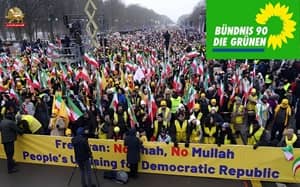
The Frankfurt chapter of Germany’s Green Party has criticized the Friedrich Naumann Foundation’s decision to entrust its 2026 Freedom Prize, dedicated to the people of Iran, to Reza Pahlavi, the son of Iran’s former shah. In a statement published on October 29, the party welcomed international recognition of the Iranian people’s struggle for freedom but argued that the award should have gone to representatives of the democratic movement inside Iran rather than to a figure associated with the former monarchy.
The award ceremony is scheduled for November 7 at Frankfurt’s historic Paulskirche, a landmark of Germany’s democratic tradition. The foundation has designated the Iranian people as the recipients of the 2026 prize, with Pahlavi accepting it in a representative capacity.
The Frankfurt Greens said the decision risks overshadowing the people whose courage and sacrifices the award is supposed to recognize, particularly women and those who have actively participated in successive protest movements.
Burkhard Schwetje, spokesperson for the Frankfurt Greens, praised the determination of Iranians fighting for democracy and freedom, highlighting the role of women and the significance of the Jin, Jiyan, Azadi (Woman, Life, Freedom) movement.
Frankfurt’s Die Linke Rejects Reza Pahlavi as Representative of Iranian People, Calls for Freedom Prize to Be Withheld
Elected representatives of Die Linke in Frankfurt have joined growing opposition to the Friedrich Naumann Foundation’s decision to let Reza Pahlavi receive its 2026 Freedom Prize on behalf of the Iranian people. In an open letter published on October 23, the party’s municipal parliamentary group rejected the invitation to the November 7 ceremony at Frankfurt’s historic Paulskirche, arguing that Pahlavi has no democratic mandate to represent Iran’s population.
The letter, addressed to the foundation’s leadership, makes a clear distinction between recognizing the Iranian people’s decades-long struggle for freedom, democracy, and self-determination and granting political representation to an individual whose role remains highly controversial within the Iranian opposition.
“We firmly reject your invitation to the presentation of the 2026 Freedom Prize on November 7 at Frankfurt’s Paulskirche. We protest your decision to have Reza Pahlavi accept the award on behalf of the Iranian people,” the representatives wrote.
They stressed that Pahlavi, as the son of Iran’s last shah, carries a particular historical responsibility for the record of his father’s monarchy. Under Mohammad Reza Shah Pahlavi, political opponents were persecuted, tortured, and murdered. The letter noted that Reza Pahlavi has yet to offer a clear repudiation of the human rights violations committed under his father’s rule.
Iran’s Economic Crisis Deepens as Regime Policies Protect Wealthy Elites at Public Expense
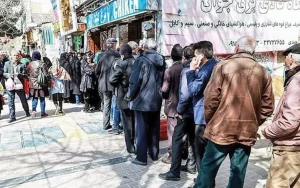
Iran’s deepening economic crisis is increasingly exposing the structure of an economy dominated by powerful political and security networks. Despite possessing the world’s second-largest oil and gas reserves, the country continues to experience declining production, accelerating inflation, currency depreciation, and deteriorating living standards.
The problem extends beyond the economic damage caused by the recent war. Decades of mismanagement, massive budget deficits, uncontrolled liquidity, and the concentration of wealth in the hands of regime-linked networks have created what economists describe as a mafia-style or oligarchic economy.
The principal beneficiaries are networks connected to the supreme leader’s office, the Islamic Revolutionary Guard Corps (IRGC), senior officials, and their families. Meanwhile, ordinary Iranians face mounting poverty and diminishing purchasing power.
The handling of oil revenues illustrates the problems facing Iran’s economy. Reports cited in discussions of the regime’s internal disputes indicate that approximately $11 billion in oil income has gone missing or failed to return to the country.
Several individuals have reportedly been implicated in the controversy, including former intelligence minister Ali Fallahian and other figures involved in oil transactions. Six additional individuals have also reportedly been identified, among them the son of former Supreme National Security Council secretary Ali Shamkhani, in connection with the regime’s oil sales and the failure to repatriate the proceeds.
Iran Regime Power Struggle Deepens as Mojtaba Khamenei Tightens Grip on Security Council
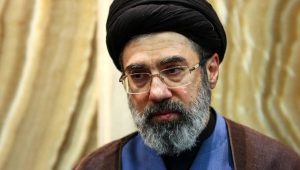
Iran’s regime is witnessing an increasingly bitter power struggle over control of negotiations with Washington, foreign policy, and the country’s security apparatus. Conflicting reports about the roles of Parliament Speaker Mohammad Bagher Ghalibaf and former Revolutionary Guards commander Mohsen Rezaei point to a widening struggle between rival factions at the highest levels of the regime. The dispute has intensified following reports that US Vice President JD Vance sent a letter to Rezaei, the reported dissolution of a media committee associated with Ghalibaf, and changes in the composition of the Supreme National Security Council (SNSC).
Although the precise extent of these developments remains unclear, their convergence highlights the instability within a leadership struggling to consolidate power under Mojtaba Khamenei.
Reports circulating in state-affiliated media suggest that responsibility for negotiations with the United States may be shifting from Ghalibaf to Rezaei, who serves as secretary of the Supreme National Security Council.
Urban Marginalization in Tehran: The Housing Crisis and Uneven Development
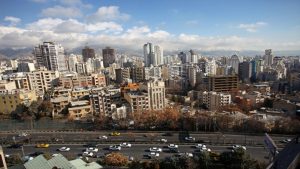
The housing crisis, social inequality, water shortages, land subsidence, and the consequences of uneven development, combined with the concentration of wealth and resources and the mismanagement of natural resources, have turned Tehran into a hub of social inequality and environmental hazards.
Tehran and Karaj, the country’s main centers of population, capital, economic activity, and administrative services, are now facing a series of interconnected crises, ranging from soaring housing prices and rents to traffic congestion, air pollution, urban marginalization, water shortages, and land subsidence.
The head of the Tehran Province Management and Planning Organization says the following about urban marginalization in Tehran: “Thirty-six percent of the province’s population live in marginalized areas and informal settlements. In Alborz Province, too, around one-third of the population faces conditions of urban marginalization.” These figures paint a troubling picture of expanding urban poverty and unequal access to housing and public services. They show that a significant portion of the population living around the capital, despite their proximity to the country’s economic center, does not benefit from urban development.
Iran Lawmakers Question Repeat Oil Allocations to Intermediaries Accused of Withholding Revenues

Iranian lawmakers are questioning why oil shipments were allegedly assigned to intermediaries with outstanding payments from earlier sales, reopening a dispute over who controls Iran’s opaque network of sanctions-era oil traders.
Mohammad Motamedi-Zadeh, a member of parliament’s Article 90 oversight commission, said on October 31 that another 80 million barrels had been allocated to intermediaries that had previously failed to return oil revenues. In an interview carried by ILNA, he blamed weak oversight and called for the publication of company and financial records.
The contracts and outstanding balances have not been independently established. His account raises a narrower but consequential question: what checks were applied before additional oil was entrusted to companies whose previous obligations were allegedly unresolved?
The warning follows an earlier effort in parliament to investigate oil sales. On September 22, lawmaker Ahmad Bigdeli said more than 40 members had signed a request for an inquiry into the National Iranian Oil Company and Naftiran Intertrade Company, or NICO, including the reported allocation of 80 million barrels to four traders or trustees.
Iranian Resistance Supporters Hold Rally in Malmö Against Executions in Iran
MALMÖ, Sweden – October 31, 2026 – Supporters of the Iranian Resistance (PMOI and NCRI) held a rally and photo exhibition in Malmö to protest the Iranian regime’s continued use of the death penalty and draw international attention to the plight of political prisoners and protesters at risk of execution.
The rally condemned the threatened executions of political prisoners and protesters arrested during recent nationwide uprisings, as well as the use of the death penalty in all its forms. Demonstrators called for an immediate halt to all executions.

Participants strongly denounced the actions of Iran’s ruling clerical regime, describing the executions as clear violations of fundamental human rights. They also paid tribute to the victims by displaying their photographs and called on the Swedish government to close the Iranian regime’s embassy in Sweden, which they described as a center for espionage and terrorism targeting freedom-seeking Iranians, particularly supporters of the Iranian Resistance.
Iranian Resistance Rally in Oslo Calls for End to Executions, Backs NCRI as Democratic Alternative
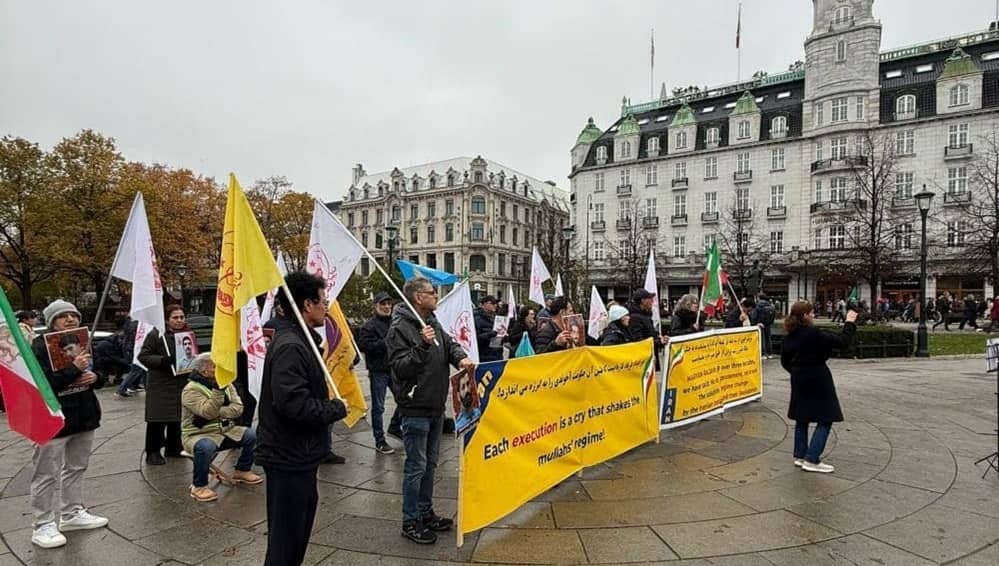
Oslo, Norway – October 31, 2026 – Supporters of the Iranian Resistance held a rally outside the Norwegian Parliament in Oslo, calling for an end to executions in Iran, the release of political prisoners, and the establishment of a democratic republic.
Mr. Ola Elvestuen, Norway’s former Minister of Climate and the Environment, addressed the participants and expressed his support for the Iranian Resistance’s cause, advocating a free, democratic, and secular Iran. He stressed the need for Norway and the international community to increase pressure on the Iranian regime to halt executions and underscored the importance of standing up for the rights of the Iranian people.
Mr. Parviz Khazaei, the representative of the National Council of Resistance of Iran (NCRI) in the Nordic countries, also attended the rally and addressed the demonstrators.

The protesters called for regime change and urged the Norwegian government to take a firm stance against the Iranian regime’s ongoing human rights violations. They also called for the closure of the Iranian regime’s embassy in Norway, describing it as a center for espionage and terrorism.