

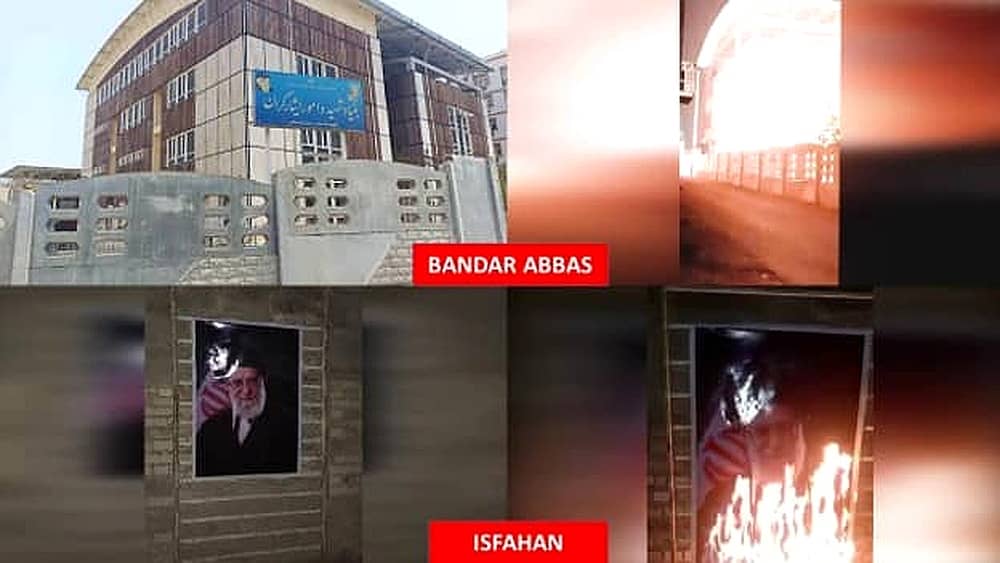
During the weekly reporting window of November 1–7, 2026, MEK Resistance Units across Iran launched a sweeping, highly synchronized wave of defiance to mark the anniversary of the Aban (November 2019) uprisings. Spanning dozens of cities from the capital to remote border provinces, they executed dozens of fiery sabotage operations against the infrastructure of clerical repression, alongside extensive anti-execution campaigns and mass graffiti actions. Despite the regime’s desperate escalation of political executions and state terror—exemplified by the hanging of protesters in Isfahan—this nationwide mobilization underscores an unyielding domestic resolve, demonstrating that underground resistance continues to dismantle the regime’s psychological monopoly and challenge its survival.
November 7, 2026
On November 7, 2026, Resistance Units expanded their nationwide footprint with a second major wave of sixty revolutionary practices under the Aban Uprising Campaign. In Tehran, operatives conducted coordinated group actions and disseminated direct calls for mass insurrection, declaring that the Iranian people are organized for upheaval. In Karaj, Resistance Units broadcast statements from opposition leadership emphasizing that the regime’s anniversary terror will be met with maximum offensive momentum. Similar high-visibility wall-writing, banner installations, and placard holdings reverberated across Mashhad, Shiraz, Isfahan, Qazvin, Kermanshah, Roudsar, Rafsanjan, and Saveh, featuring slogans proclaiming that the November uprising proved “fire answers fire” and demanding the total eradication of both clerical and monarchical despotism.
🚨 Iran | Defiant Youth Honor Two Recently Executed Protesters
On November 5, defiant youth and supporters of the Iranian Resistance commemorated Amirhossein Ebrahimi and Amirhossein Maleki, two recently executed protesters, in Isfahan, Tehran and other cities across Iran.… https://t.co/VGXvEPzJFo pic.twitter.com/iCfUBDcief
— SIMAY AZADI TV (@en_simayazadi) November 7, 2026
November 6, 2026
On November 6, 2026, youth and Resistance Units in Zahedan mounted defiant public activities condemning the regime’s accelerating wave of political executions and systematic repression. Displaying banners under the strategic “No Shah, No the mullahs” framework, protesters rejected both the ruling theocracy and any return to monarchical dictatorship, echoing leadership calls for an organized democratic republic. Activists stressed that true national salvation requires uncompromising struggle against both forms of tyranny, publishing widespread condemnations of the regime’s diversion of national wealth toward nuclear projects and domestic suppression while ordinary citizens face extreme poverty.
November 5, 2026
On November 5, 2026, solemn memorial gatherings and protest actions were held across Tehran, Isfahan, and Shahin Shahr to honor two newly executed protesters of the Isfahan uprising, Amirhossein Ebrahimi and Amirhossein Maleki. The units displayed photographs of the executed prisoners alongside statements from the Resistance leadership condemning the judiciary’s hasty gallows as a desperate, doomed attempt to preempt renewed uprisings. Demonstrators pledged that these state-sanctioned murders only steel the resolve of the Resistance Units to escalate their resistance against the clerical establishment.
November 6—Zahedan, southeast Iran
PMOI/MEK Resistance Units resume weekly anti-regime activities, defying the regime's growing wave of executions and reiterating the rejection of all forms of dictatorship, whether religious or monarchical. pic.twitter.com/eRNANqs2uc— People's Mojahedin Organization of Iran (PMOI/MEK) (@Mojahedineng) November 7, 2026
November 4, 2026
On November 4, 2026, Resistance Units delivered a synchronized wave of thirty fiery operations dedicated to the memory of the newly executed Isfahan rebels. Striking deep into the apparatus of state control, units in Tehran carried out an arson attack against a Khomeini Relief Committee facility. In Bandar Abbas, an incendiary strike hit a regime plunder foundation, while in Isfahan, units torched regime banners and incinerated a Ministry of Intelligence spy station signpost. Concurrently, coordinated arson attacks targeted Islamic Revolutionary Guard Corps (IRGC) Basij bases and leadership banners across Mashhad, Tabriz, Shiraz, Kermanshah, Zahedan, Dezful, Sabzevar, Mahshahr, Marand, Chabahar, Iranshahr, Bijar, Rask, and Noorabad (Fars), demonstrating the extensive operational reach of the underground network.
November 3, 2026
On November 3, 2026, Resistance Units and supporters of the “No to Execution Tuesdays” movement mounted widespread grassroots agitation across Isfahan, Tehran, Rasht, Shiraz, Karaj, Lahijan, and Sanandaj. Deploying targeted placards, tracts, and wall-writings, participants demanded the immediate cancellation of all death sentences and the unconditional release of political prisoners and uprising detainees. High-visibility campaigns specifically highlighted the grave danger facing political prisoner Manouchehr Fallah, warning that the regime’s reliance on the gallows will be met with the fiery fury of the people.
🚨 EXCLUSIVE | 30 PMOI Resistance Unit Operations Across Iran
Exclusive footage received by Simay Azadi shows highlights of 30 operations reported by PMOI Resistance Units across 17 Iranian cities, including Tehran, Isfahan, Mashhad, Tabriz, Shiraz, Kermanshah, Bandar Abbas,… https://t.co/NP9LVDx7Tt pic.twitter.com/ycnHubsUCc— SIMAY AZADI TV (@en_simayazadi) November 4, 2026
November 2, 2026
On November 2, 2026, the Aban Uprising Campaign officially commenced with a sweeping mobilization comprising thirty fiery actions and sixty revolutionary practices. Resistance Units networks in Tehran set fire to two IRGC Basij bases alongside propaganda banners of former president Ebrahim Raisi and Qasem Soleimani, while inscribing defiant graffiti warning the regime of armed resistance. In Tabriz, operatives hurled Molotov cocktails at centers of clerical training and suppression, torching Basij outposts and large banners depicting Ali Khamenei and Mojtaba Khamenei. Similar incendiary strikes and anti-regime propaganda destructions struck Mashhad, Isfahan, Ahvaz, Kermanshah, Abadan, Bojnord, Sabzevar, Dezful, Babil, Marand, Mahshahr, Chabahar, Iranshahr, and Rask. Widespread graffiti and tract installations bearing “Hail to Rajavi” echoed across Bushehr, Arak, Zahedan, Nahavand, Kordkuy, Roudsar, and Noorabad.
PMOI Resistance Units keep the flame of Iran’s November 2019 uprising alive with 30 operations nationwide https://t.co/IWneb7hJMQ
— People's Mojahedin Organization of Iran (PMOI/MEK) (@Mojahedineng) November 5, 2026
The intensive nationwide mobilization during the first week of November 2026 highlights the terminal vulnerability of a clerical establishment caught in an inescapable cycle of repression and crisis. By doubling down on political executions and state terror in a desperate effort to avert a resurgence of mass protests, the regime has merely catalyzed a more organized, decentralized domestic resistance. The systematic torching of IRGC infrastructure, intelligence outposts, and ideological monuments across dozens of cities demonstrates that the Resistance Units have penetrated the state’s security defenses, signaling that the clerical regime’s authoritarian grip is actively fracturing from within.