
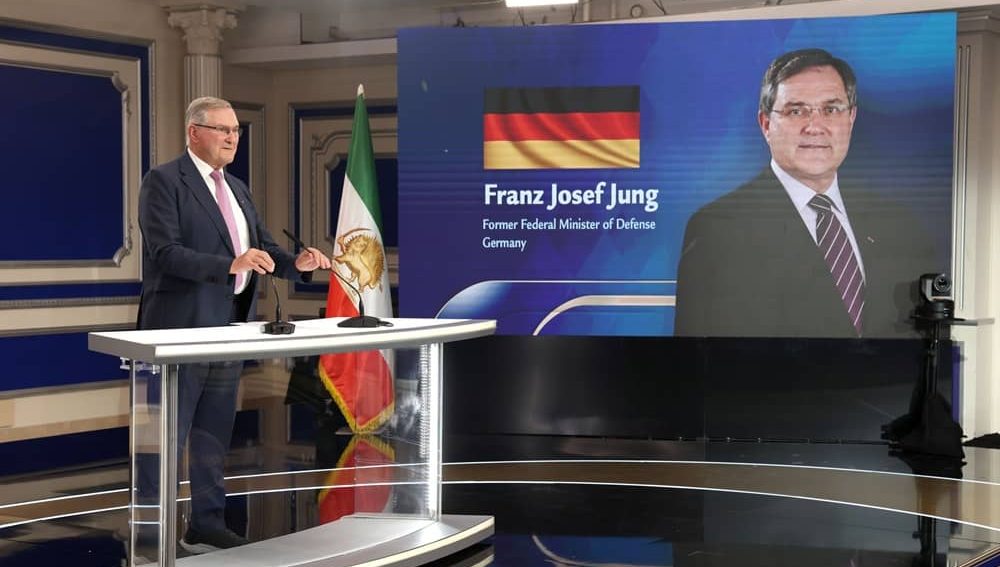
Addressing an international conference on Iran on November 21, 2026, former German Federal Minister of Defense Franz Josef Jung, President of the Association of Former Members of the German Bundestag and the European Parliament, urged the European Union to actively support democratic regime change in Tehran. Jung argued that the clerical regime poses a direct threat to European security through its nuclear ambitions, maritime disruptions, and backing of regional proxies, asserting that lasting peace depends on establishing democracy in Iran rather than merely curbing military capabilities.
Rejecting both the ruling dictatorship and a return to monarchy, he dismissed Reza Pahlavi as an uncredible alternative due to his refusal to distance himself from his father’s crimes or the Revolutionary Guards. Instead, Jung endorsed NCRI President-elect Maryam Rajavi’s Ten-Point Plan—calling for free elections, separation of religion and state, gender equality, and a non-nuclear republic—as the only viable roadmap out of the crisis.
The full text of Franz Josef Jung’s speech follows below.
Former German Minister @jungfj: The EU must actively back the Iranian people's push for freedom. Through its nuclear program, proxy terror groups, and threats to maritime shipping, Tehran endangers Europe—proving lasting security depends on democracy in a future Iran.…
— NCRI-FAC (@iran_policy) November 21, 2026
Dear President Rajavi, Excellencies, distinguished ladies and gentlemen, dear friends of the Iranian Resistance.
This conference is held under the motto: “Ways Out of the Crisis and Europe’s Responsibility.”
The best way out of the Iran crisis is the replacement of the current regime and the introduction of democratic principles in Iran.
The Iranian people want an end to the present regime. They want freedom, they want democracy, they want equality, they want the rule of law. The people are fed up with oppression.
It is therefore time for the European Union to more actively support the Iranian people’s desire for freedom.
The current regime is also a threat to Europe’s security. Both the nuclear program and the support for terrorist activities by proxy groups such as the Houthis, Hamas, and so on, as well as the threat to maritime shipping—all of this shows how Europe’s security is also threatened by this regime.
Therefore, lasting security is not achieved solely by limiting military capabilities; rather, it depends on democracy in a future Iran.
Like other dictatorships, the Iranian regime stokes existential crises in order to distract from domestic political problems.
The Iranian regime’s policy of exporting terrorism and fundamentalism is a sign of weakness, not of strength.
Another sign of the regime’s weakness is its fear of the opposition, both inside and outside Iran. That is also the reason why the regime executes peaceful people.
It is therefore time for the European Union to raise its voice more clearly against the inhumane actions of this regime. Regime change toward freedom, democracy, the rule of law, and human rights must be urgently supported.
A democratic Iran is thus also an essential prerequisite for peace, security, and stability in the region and in Europe.
Through their nationwide protests, the people in Iran have made it clear that they reject every dictatorship: both the ruling mullahs’ dictatorship and a return to the monarchic dictatorship of the shah’s era.
The “Reza Pahlavi” alternative—as we just heard once again—is simply not credible. He neither distances himself from the crimes of his father nor clearly from the Revolutionary Guards. He is not an alternative for a free Iran.
The way out of the crisis is the support for and implementation of Mrs. Rajavi’s Ten-Point Plan.
The ten points make it clear: this is about free and secret elections, freedom of speech, freedom of political parties, freedom of assembly, freedom of the press, the dissolution of the Revolutionary Guards, the prohibition of torture and the abolition of the death penalty, the separation of religion and state, gender equality, the independence of the judiciary, and a non-nuclear Iran that possesses no weapons of mass destruction.
Only those who implement these points can truly lead Iran out of the crisis.
And, ladies and gentlemen, that is why these points must also be clearly supported by the European Union.
The goal must be to free Iran from the yoke of tyranny and to guarantee freedom, the rule of law, democracy, and human rights.
Long live the Iranian Resistance! All the best to you!