
THIS PAGE WILL BE UPDATED WITH THE LATEST NEWS
UPDATE: 7:00 AM CET
Fardis Prison: Women Political Prisoners Segregated as Restrictions Intensify
New restrictions have been imposed on women political prisoners in Fardis Prison (a.k.a. Kachouii Prison) in Karaj. Prison authorities have separated the hall housing these prisoners from the rest of the women’s ward, restricting their contact with other inmates.
Authorities have also established separate social work offices in each hall, subjecting prisoners’ movement to tighter control. As a result, political prisoners are no longer allowed to enter other sections of the women’s ward.
By implementing these measures, prison authorities have effectively isolated different sections of the women’s ward and reduced communication among prisoners to a minimum, creating conditions that resemble a permanent internal quarantine.
Officials at Fardis Prison have increased control over women political prisoners by setting up separate social work offices in each hall. Rather than facilitating prisoners’ affairs, this policy has resulted in stricter restrictions on communication and interaction within the prison.
Operation Economic Outcast Disrupts Iran’s Global Shadow Banking Networks
WASHINGTON—Today, as part of Operation Economic Outcast, the U.S. Department of the Treasury sanctioned over two dozen Iranian exchange houses, front companies, and key personnel in a sweeping effort to disrupt Iran’s global shadow banking networks. As Iran’s economy remains battered by punishing economic sanctions and its oil revenues continue to decline, the regime’s shadow banking facilitators have increasingly failed to repatriate dwindling export earnings while simultaneously enriching themselves by stealing state resources that rightfully belong to the Iranian people.
“Iran’s economy is underwater, and its leaders are panicking,” said Secretary of the Treasury Scott Bessent. “Iran’s shadow banking system is the last financial lifeline of a bankrupt regime. Treasury will continue dismantling these illicit networks until we have buried the head of the snake.”
Today’s action targets the financial infrastructure that underpins much of Iran’s remaining foreign trade, disrupting the exchange houses, front companies, and facilitators that move billions of dollars through the international financial system to provide the regime access to foreign currency despite comprehensive sanctions.
Iran Regime’s Internal Crisis Deepens as Factional Infighting Becomes More Open
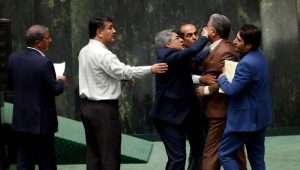
Iran’s regime is increasingly exposing its internal divisions as economic deterioration, mounting public discontent, and strategic deadlock intensify the struggle between competing factions. Attacks by Khamenei-aligned Friday prayer leaders against President Masoud Pezeshkian’s government have become more explicit, revealing disagreements that extend beyond economic policy to fundamental questions about the regime’s identity, priorities, and survival.
The latest exchanges show that appeals for unity from the highest levels of the establishment have done little to contain the infighting. Instead, officials and clerics are increasingly confronting one another publicly over responsibility for the country’s deteriorating conditions, the treatment of neighboring countries, and the growing threat of popular unrest.
Ahmad Alamolhoda, Khamenei’s representative in Mashhad and Friday prayer leader, has sharply criticized the government’s plans to eliminate preferential foreign-exchange rates and implement what officials describe as economic restructuring.
Questioning the government’s approach, Alamolhoda argued that ordinary people should not bear the cost of economic reforms through higher prices, reduced access to food, and declining living standards. He also criticized decisions affecting gasoline distribution cards, questioning how an adviser could influence such policies without parliamentary oversight.
Iran’s War Economy: How IRGC-Linked Networks Profit From Sanctions and Restricted Trade

War and economic restrictions have sharply increased operating costs for Iranian businesses and disrupted the country’s foreign trade. Yet the impact is far from equal across the economy. While ordinary companies face difficulties accessing foreign currency, banking services, and international transportation, networks connected to the Islamic Revolutionary Guard Corps (IRGC) and other military institutions continue operating through alternative financial and commercial channels.
This disparity has renewed questions about the economic interests tied to the continuation of war and the persistence of sanctions. The IRGC is not merely a military organization. Through affiliated companies, commercial intermediaries, and economic conglomerates, it maintains a substantial presence in sectors ranging from energy and foreign trade to construction and industrial infrastructure.
As conventional trade becomes more difficult, the relative importance of networks capable of circumventing restrictions increases. Companies with access to unofficial financial channels, overseas intermediaries, and state-backed logistical infrastructure can continue conducting transactions under conditions that increasingly constrain independent businesses.
Iran’s Cost-of-Living Crisis Deepens as Food Prices Surge and Producer Inflation Exceeds 120%
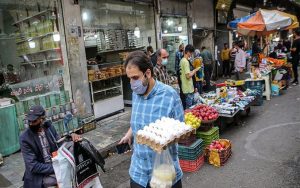
December is approaching, but there is little relief in sight for Iranian households struggling with the combined effects of rising prices, economic mismanagement, and the consequences of the regime’s policies. Food prices continue to climb, further eroding purchasing power, with low-income families bearing the heaviest burden.
Reports in Iranian media at the beginning of December describe another wave of increases in essential food products. Eggs, milk, and chicken have all become more expensive, while higher prices for industrial food products are also expected. At the same time, official statistics reveal the scale of inflationary pressure building throughout the economy, with producer-price inflation exceeding 120 percent year-on-year.
Egg prices have recorded one of the sharpest increases. On Sunday, November 22, Didar News reported that a carton of 30 eggs had reached 714,000 tomans, describing the latest increase as another record.
The outlet noted that the same quantity had sold for approximately 315,000 tomans in March 2026. This means the price has more than doubled in just eight months, increasing by approximately 127 percent.
Iran Resumes Power Cuts as Energy Crisis Threatens More Than One Million Jobs

Iran is preparing to resume scheduled electricity cuts for residential and commercial consumers from December 1, as the country’s worsening energy crisis exposes the growing consequences of shortages in natural gas and electricity. While households face renewed power disruptions at the beginning of winter, industrial production has already suffered substantial losses, with a parliamentary official warning that more than one million workers could eventually lose their jobs if the situation continues.
Mohammadollahdad, chief executive of Iran’s state electricity company Tavanir, announced on Saturday, November 21, that electricity restrictions would begin on December 1 because of difficulties securing sufficient fuel for power plants. Under the initial schedule, households and businesses could face power cuts lasting up to two hours every other day.
He added that if temperatures fall further, electricity cuts could increase to two hours every day.
The return of scheduled blackouts, barely two months after the end of summer, highlights the structural problems behind Iran’s energy shortages. With the onset of colder weather, household gas consumption rises sharply for heating, leaving less fuel available for thermal power plants that depend heavily on natural gas to generate electricity.
Retirees Take to the Streets in Isfahan and Shush as Labor and Livelihood Protests Expand in Iran
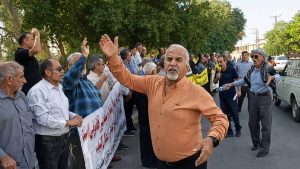
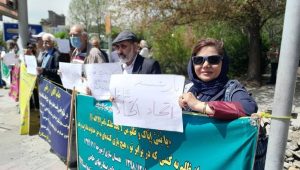
Labor and livelihood protests continued across several Iranian cities, educational institutions, and economic centers on Saturday and Sunday, November 21 and 22. On Sunday, retirees from the steel industry in Isfahan and Social Security retirees in Shush held rallies and marches to protest their living conditions and rising prices. Earlier, truck drivers at Tehran’s wholesale produce market, students at Tarbiat Modares University, and car buyers from the state-owned Saipa automaker had also voiced their demands through strikes and protest gatherings.
On Sunday, November 22, retirees from the steel industry in Isfahan held a march from Dowlat Gate toward the provincial governor’s office, protesting their living conditions and demanding that their labor-related grievances be addressed.
At the same time, Social Security retirees in Shush held a protest gathering outside the local Social Security Organization building. The demonstration brought together retirees and people demanding improvements in living conditions. Protesters chanted slogans expressing their dissatisfaction with the economic situation and the living conditions of workers and retirees.
The protesting retirees in Shush stressed that they would continue their street protests, chanting slogans including “Our rights can only be won in the streets” and “The streets, the streets, are the stronghold of the toiling people.”
Iran’s Garment Industry on the Verge of Complete Shutdown
As winter approaches, Iran’s garment industry is facing an unfamiliar scene. A workshop that recently employed more than 100 people now has most of its machines shut down. Workers are being laid off one after another.
The secretary of the Union of Textile and Garment Production and Export says production has fallen by around 30% compared with last year. According to him, this decline could have a similar impact on employment in the garment industry. The rise in foreign exchange rates, reduced liquidity for purchasing raw materials, and conditions following the outbreak of war have been cited as among the causes of this decline. Viscose, a raw material, is entirely imported for environmental reasons; therefore, exchange rates directly affect production costs.
The secretary of the Iranian Textile Industries Association reports a severe slump in the garment market during the cold season. In his view, demand and orders decline first, followed by production. The problem gradually spreads throughout the entire supply chain. Retail businesses and distribution-sector operators are also struggling to generate liquidity from sales. Even well-known brands have introduced substantial discounts to boost sales.
The secretary of the Iranian Textile Industries Association says statistics point to rising producer-price inflation and higher unit production costs in the garment industry. Raw material prices have also increased compared with last year. He says this year’s production is facing difficulties involving raw material supplies, liquidity, and energy costs. Indicators of product inventories and industry operators’ expectations for a market recovery show no significant change.
Imminent Execution of Milad Armoun and Navid Najjaran, Two Defendants in Iran’s Ekbatan Case

Iran Human Rights warned of the imminent risk of execution facing Milad Armoun and Navid Najjaran, two defendants in Iran’s Ekbatan case. The transfer of the two prisoners to solitary confinement at Qezel Hesar Prison, following the Supreme Court’s confirmation of their death sentences, has heightened concerns that the executions may soon be carried out.
Iran Human Rights, a Norway-based human rights organization, announced on Saturday, November 21, that Milad Armoun and Navid Najjaran, both protesters who took part in the 2022 uprising, had been transferred to solitary confinement and were at serious risk of execution.
The organization stated in its announcement: “Milad Armoun and Navid Najjaran, two protesters who took part in the 2022 uprising and defendants in the Ekbatan case, were transferred to solitary confinement at Qezel Hesar Prison on Saturday. Given the recent confirmation of their death sentences, there are serious concerns that this transfer may be a prelude to carrying out the executions.”
According to the human rights organization’s report, Iran’s Supreme Court recently upheld the death sentences of 27-year-old Milad Armoun and 34-year-old Navid Najjaran. In the same case, the death sentences of Mohammad Mehdi Hosseini and Mehdi Imani were overturned, and their cases were referred to a court of equal jurisdiction for retrial.
Iran: Alireza Merdasi, an Ahvaz Teacher Sentenced to Death Twice, at Risk of Execution
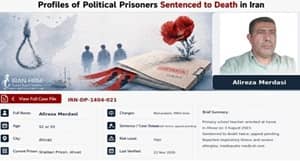
According to the case information, Ministry of Intelligence agents violently arrested Alireza Merdasi at his home in Ahvaz on 3 August 2023, in the presence of his wife and children. His initial place of detention and the dates of subsequent transfers have not been established. Reportedly, he spent a prolonged period in solitary confinement between arrest and trial.
Judicial authorities charged him with “moharebeh” (enmity against God), “assembly and collusion against national security”, “membership of the People’s Mojahedin Organisation of Iran” and “propaganda against the system”. Merdasi rejects the allegations. On 11 July 2025, Branch One of the Revolutionary Court of Ahvaz, presided over by Judge Adibi-Mehr, sentenced him to death twice and to one year’s imprisonment. He was personally informed of the judgment in court. The exact hearing date is unknown. According to the primary case information, he had no lawyer and was unable to mount an effective defence.
Merdasi appealed the ruling. Following the information provider’s latest direct check on 22 November 2026, his situation was reported as unchanged and the appeal as still awaiting consideration. The official appeal record and written judgment are not available.
According to the case information, Ministry of Intelligence officers carried out the arrest. Reports describe prolonged solitary confinement and the failure of officials at Sheiban Prison in Ahvaz to provide necessary medical care. No official response addressing these matters is included in the available information.
Gothenburg Rally Supports Iran’s Democratic Alternative and Abdanan Uprising
Gothenburg, Sweden – November 21, 2026 – Supporters of the People’s Mojahedin Organization of Iran (PMOI/MEK) held a rally in Gothenburg, reaffirming their support for the National Council of Resistance of Iran (NCRI) as a democratic alternative to Iran’s ruling religious dictatorship. The gathering also expressed solidarity with the uprising of the people of Abdanan, in Ilam Province, against the regime, where protesters chanted “Death to the Dictator.” Participants voiced their support for the nationwide uprising in Iran and renewed their commitment to continuing the campaign in support of the Iranian people’s struggle and ensuring that their voices are heard around the world.

Under the proposed transition, the provisional government would have a six-month mandate to prepare for elections to a Constituent Assembly, paving the way for the transfer of sovereignty to the Iranian people.
Toronto Rally Condemns Executions in Iran and Supports Nationwide Uprising
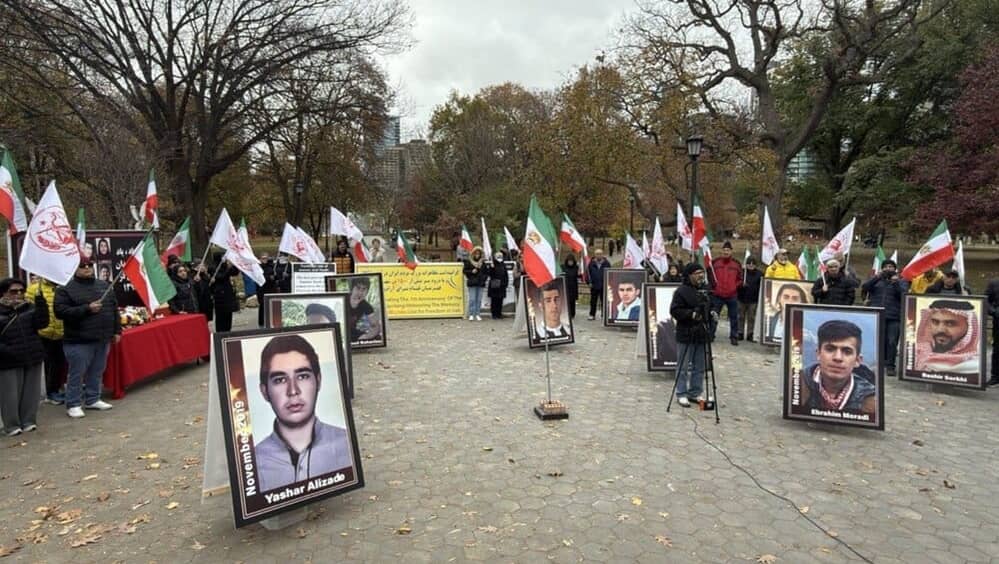
Toronto, Canada – November 21, 2026: Supporters of the People’s Mojahedin Organization of Iran (PMOI/MEK) held a rally in Toronto to condemn executions in Iran, demand the release of political prisoners, and pay tribute to victims of the nationwide uprising. Participants also expressed support for the 2026 Magnitsky International Human Rights Award presented to imprisoned Iranian boxing champion and political prisoner Mohammad Javad Vafaei Sani, calling for the immediate annulment of his death sentence and his release. The gathering also marked the seventh anniversary of Iran’s nationwide November 2019 uprising. Participants expressed solidarity with the ongoing uprising in Iran and renewed their commitment to continuing the campaign in support of the Iranian people’s struggle and ensuring that their voices are heard around the world.

Demonstrators strongly denounced the Iranian regime’s continued use of the death penalty as a flagrant violation of human rights.
Participants displayed photographs of executed prisoners and individuals killed during the nationwide uprising. Through this tribute, they honored the victims and highlighted the plight of political prisoners in Iran.