
Between November 22 and November 28, 2026, Resistance Units carried out dozens of daring anti-repression operations, direct strikes on regime security centers, and nationwide protest campaigns across more than twenty Iranian cities and districts. Marking the International Day for the Elimination of Violence against Women, the “No to Executions Tuesdays” movement, and public outrage over inflation, housing demolitions, and state executions, these coordinated actions struck Islamic Revolutionary Guard Corps (IRGC) Basij bases, regime foundations, and propaganda symbols. Despite heavy security measures and mounting repression, the persistence and reach of these underground operations underscore a deepening political crisis and internal paralysis within the ruling theocracy.
November 27, 2026
In Zahedan, Resistance Units displayed placards and handwritten messages conveying statements from Iranian Resistance leaders Massoud Rajavi and Maryam Rajavi alongside slogans rejecting both monarchical and clerical dictatorship, including “Death to the oppressor, be it the Shah or the Leader” and “Monarchy and Velayat, one hundred years of crime”. The messaging emphasized the overthrow of the clerical regime, support for the Resistance Units and the National Liberation Army of Iran, and the realization of a democratic republic founded on the separation of religion and state, gender equality, autonomy for oppressed nationalities, and the abolition of the death penalty.
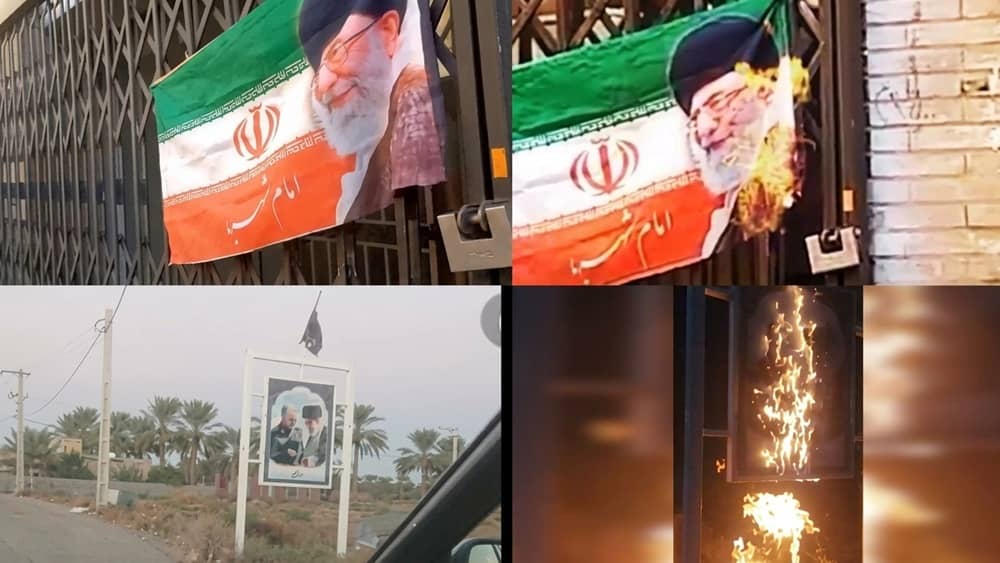
On the same date, the second series of the “Clusters of People’s Wrath” campaign recorded fifteen fiery actions and strikes across multiple cities. In Tehran, Resistance Units set off a blaze at an IRGC Basij base; in Khorramabad, a blaze struck a regime center dedicated to the suppression of women. Units also attacked an IRGC Basij base with gunfire in Sheyban near Ahvaz, set fire to a banner of Ali Khamenei using incendiary devices in Zahedan, and ignited blazes at IRGC Basij bases in Chabahar and Mehrestan as well as an anti-student Basij unit in Iranshahr. Additional fires destroyed banners of Ruhollah Khomeini, Ali Khamenei, and slain commander Qasem Soleimani in Isfahan, Zahedan, Sirjan, and Marivan, while a regime Basij intelligence guidepost was torched in Qazvin.
PMOI Resistance Units mark seventh anniversary of November 2019 uprising with operations across Iran https://t.co/49PpCmI5kS
— People's Mojahedin Organization of Iran (PMOI/MEK) (@Mojahedineng) November 23, 2026
November 25, 2026
Marking November 25 as the International Day for the Elimination of Violence against Women under the banner of standing with Maryam Rajavi against the regime’s misogynistic rule, Resistance Units staged coordinated public displays, slogans, and wall inscriptions across several cities. In Tehran, Karaj, Isfahan, Mashhad, Hamadan, Bandar Abbas, and Rasht, units highlighted Maryam Rajavi’s Ten-Point Plan, denounced forced hijab, forced religion, and forced government, called for accountability for crimes against women, and affirmed that women will play a decisive role in overthrowing the clerical dictatorship and establishing a democratic republic.
November 24, 2026
Coinciding with Masoud Pezeshkian’s visit to Mashhad and Khorasan Razavi province, Resistance Units distributed printed and handwritten leaflets denouncing his presence and the ruling structure with slogans such as “Pezeshkian, get lost from Mashhad,” “Pezeshkian, get lost from Khorasan Razavi,” and “Death to the oppressor, be it the Shah or the Leader”.
In the third series of the “Clusters of People’s Wrath” campaign, fifteen fiery warnings and strikes addressed crushing inflation, soaring prices, and widening class inequality alongside a statement from Massoud Rajavi. Blazes struck an IRGC Basij district headquarters and the Torqabeh municipality in Mashhad, while units opened fire on an IRGC Basij base in Ahvaz, used incendiary devices to set fire to IRGC Basij bases in Zahedan and Iranshahr, and torched a Basij unit in Khorramabad. Additional fires hit IRGC Basij bases in Ilam and Chabahar, burned banners of Ruhollah Khomeini, Ali Khamenei, and Mojtaba Khamenei in Isfahan, Gorgan, and Zahedan, and destroyed a symbol of Qasem Soleimani in Sirjan.
PMOI Resistance Units in Zahedan reject shah and mullahs, reaffirm commitment to a democratic republic https://t.co/B71DO7UN7G
— People's Mojahedin Organization of Iran (PMOI/MEK) (@Mojahedineng) November 28, 2026
Meanwhile, as part of the “No to Executions Tuesdays” campaign, Resistance Units conducted placard-holding actions, leafleting, and audio broadcasts across Hamadan, Ardabil, Rasht, Isfahan, Lahijan, Haraz Road, and Mashhad. These actions demanded the annulment of death sentences for political prisoners including Farshad Etemadifar, Amirhossein Akbari Monfared, Ehsan Faridi, Masoud Jamei, Karim Khojasteh, Manouchehr Fallah, and Alireza Mardasi, while celebrating Mohammad Javad Vafaei Sani’s 2026 Magnitsky Award and urging nationwide solidarity against executions.
November 22, 2026
In the first series of the “Clusters of People’s Wrath” campaign—saluting the martyrs of the Mahshahr reedbeds from the November 2019 uprising and responding to the demolition of impoverished citizens’ homes—Resistance Units executed fifteen fiery strikes across multiple cities. A blaze hit a municipal office in District 2 of Region 18 in Tehran, blazes struck an IRGC Basij district office in Mashhad and an IRGC Basij base in Kermanshah, and units attacked an enemy patrol vehicle in Ahvaz. Incendiary devices and fire also hit IRGC Basij bases in Saravan, Iranshahr, Chabahar, and Dezful, while banners of Ali Khamenei, Ebrahim Raisi, and Qasem Soleimani were torched in Isfahan, Kermanshah, Qazvin, Iranshahr, Khash, and Sirjan.
PMOI Resistance Units carried out 20 more daring operations across Iran as part of the nationwide campaign marking the 7th anniversary of the November 2019 uprising, targeting the regime's centers and symbols of repression, corruption, and propaganda. pic.twitter.com/4z9vrpBILR
— People's Mojahedin Organization of Iran (PMOI/MEK) (@Mojahedineng) November 26, 2026
The operations recorded during this weekly cycle demonstrate that the clerical regime’s reliance on executions, mass arrests, and economic coercion has failed to extinguish organized resistance inside Iran. Instead of intimidating society into submission, state repression and worsening living conditions have fueled determined strikes against Basij compounds, municipal centers, and regime symbols across urban and border regions alike. By confronting the ruling establishment with sustained street and operational defiance while rejecting both clerical and monarchical rule, Resistance Units expose a regime trapped in deep political deadlock behind its facade of authority.