
THIS PAGE WILL BE UPDATED WITH THE LATEST NEWS
UPDATE: 10:00 AM CET
PMOI Resistance Units in Zahedan Reject Shah and Mullahs, Reaffirm Commitment to a Democratic Republic
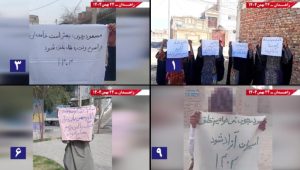
On November 27, 2026, Resistance Units affiliated with the People’s Mojahedin Organization of Iran (PMOI/MEK) continued their weekly activities in Zahedan, southeast Iran, reiterating their commitment to the struggle for freedom and the establishment of a democratic republic.
Holding placards in public places, members of the Resistance Units condemned the regime’s escalating repression, expressed solidarity with political prisoners facing execution, and reiterated their rejection of both clerical and monarchical dictatorship.
“The regime is weaker than ever and has no solution and is on the verge of being overthrown,” read one of the placards.
The activities continued a series of weekly campaigns in Zahedan in which Resistance Units have challenged the ruling regime and articulated their vision for Iran’s political future.
A prominent theme of the November 27 activities was the resistance of political prisoners who continue to stand by their convictions despite the threat of execution.
Pro-Pahlavi Monarchists Disrupt Iranian Women’s Rights Event in Paris
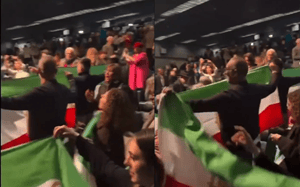
The incident exposed a troubling contradiction within a political current that presents itself as an alternative to Iran’s ruling regime while displaying intolerance toward those who reject its preferred leadership. The Iranian people have endured decades of authoritarian rule. Their struggle for freedom cannot be served by a movement that seeks to silence political opponents rather than defend their right to speak.
The IMA event was held at the initiative of France’s Foreign Ministry, in the presence of Foreign Minister Jean-Noël Barrot. It marked the fourth anniversary of the Woman, Life, Freedom movement and brought together artists and members of Iranian civil society for an evening of testimonies, music, poetry, and film.
In his opening remarks, Barrot reaffirmed that Iranian voices would always find refuge and a platform in France where they could express themselves freely. The gathering was intended to honour the courage of Iranian women and the wider civil society confronting repression.
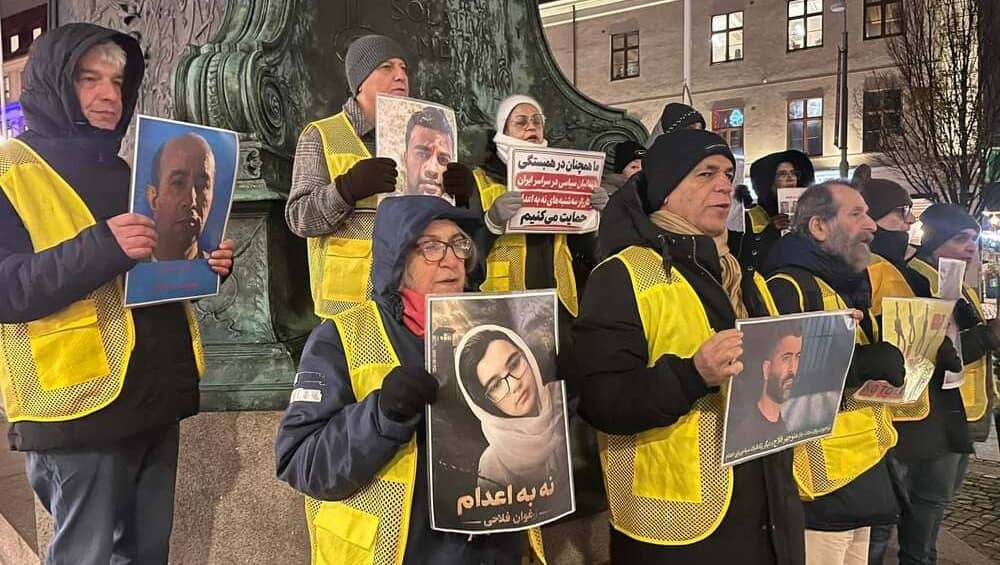
French Mayors Express Solidarity With Iranian Political Prisoners Facing Execution, Urge Action to Save Arghavan Fallahi
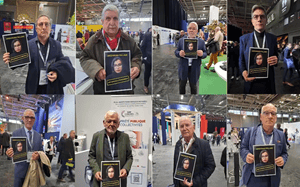
During the Congress of Mayors of France, several mayors photographed themselves holding portraits of Iranian political prisoners sentenced to death. Through this public gesture, they called for the prisoners’ lives to be saved and their death sentences immediately annulled.
The initiative underscored the growing international concern over the use of capital punishment against political prisoners in Iran and the importance of sustained public pressure to prevent further executions.
Among the prisoners whose cases have drawn international attention is Arghavan Fallahi, a 24-year-old political prisoner and supporter of the People’s Mojahedin Organization of Iran (PMOI/MEK).
Fallahi was arrested in February 2025 and held in solitary confinement, where she was subjected to prolonged interrogation and reported physical and psychological torture. In July 2026, Branch 15 of Tehran’s Revolutionary Court, presided over by Judge Abolghassem Salavati, sentenced her to death on charges of baghi (armed rebellion). Her sentence was subsequently upheld by the Supreme Court, and her request for a retrial was rejected.
Iran’s Winter Gas Crisis Exposes Years of Neglect, Waste, and Mismanagement

This recurring crisis is not simply a consequence of seasonal demand. It reflects years of underinvestment, wasted resources, deteriorating infrastructure, and the failure to develop the country’s energy capacity. The contradiction is particularly striking: while millions of cubic meters of natural gas are burned or lost before reaching consumers, industries and power plants face shortages that disrupt production and deepen economic pressures.
One of the clearest examples of the mismanagement of Iran’s energy resources is the enormous volume of associated natural gas burned during oil production instead of being captured and put to productive use.
According to the World Bank’s satellite-based Global Gas Flaring Tracker, Iran burned approximately 20.2 billion cubic meters of gas in 2023, equivalent to an average of around 55.5 million cubic meters per day. This represented a substantial increase from the 17 billion cubic meters recorded in 2022.
Iran’s Gas Exports to Turkey and the Shutdown of Factories in Iran

As cold weather sets in, two reports about Iran’s gas supply have emerged side by side. One concerns supply restrictions in several provinces, while the other announces an extension of gas exports to Turkey until April 2032.
Officials of the National Iranian Gas Company have forecast that approximately 11 provinces will face supply problems during the winter of 2027. According to them, restrictions on facilities and industries lasting one to two months were also imposed in previous years. This chronic problem in Iran’s gas network existed even before the war and has now become more severe. The likelihood of further restrictions is considered higher in the northern provinces.
The managing director of the National Iranian Gas Company says that more than 25% of the country’s production capacity was recently taken offline. According to him, nearly half of this lost capacity has been restored. Nevertheless, gas supplies to industries remain restricted due to the pre-existing supply deficit. He has also urged the public to observe consumption guidelines, as the residential sector accounts for a large share of gas consumption.
Iran’s Annual Death Toll from Air Pollution and Road Accidents Reaches 90,000

Mohammad Reza Zafarghandi, the Iranian regime’s Minister of Health, admitted that 20,000 people die annually in road accidents and another 70,000 lose their lives due to air pollution.
The Iranian regime’s health minister’s admission that 20,000 people die annually in traffic accidents and 70,000 from air pollution exposes a catastrophe rooted in incompetence, neglect of vital infrastructure, and anti-people policies. In a country rich in wealth and natural resources, young lives are being sacrificed on unsafe roads under a regime that has failed to prioritize the people’s welfare and security.
On November 24, Mohammad Reza Zafarghandi, the Iranian regime’s Minister of Health, announced that 20,000 people die annually in road accidents and 70,000 due to air pollution.
Road accidents in Iran cannot be attributed solely to human error or chance occurrences. Deteriorating infrastructure, inadequate vehicle safety, regulatory failures, insufficient emergency response facilities, and disregard for essential standards are structural factors that can contribute to rising road fatalities.
Death Penalty for Damage to Public Property: Ilya Ben-Rashid’s Life Is at Risk
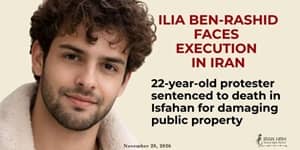
Ilya Ben-Rashid, a 22-year-old native of Ahvaz and resident of Shahin Shahr, Isfahan Province, was arrested in connection with the nationwide protests of January 2026. Branch 5 of the Isfahan Revolutionary Court sentenced him to death on the charge of moharebeh (enmity against God) through participation in the destruction of public property. He was notified of the sentence on 20 October 2026 at Dastgerd Prison in Isfahan. Ilya has lost both parents and lived with his elderly grandparents before his arrest. He also has a younger sister. His grandparents’ advanced age and physical limitations have severely hindered their ability to pursue his case. He now faces a death sentence following judicial proceedings during which, according to available information, he was denied access to a lawyer of his own choosing.
According to reports received, during the initial days of his detention, he was held in solitary confinement, subjected to severe physical and psychological pressure, and deprived of food and water.
On 21 February 2026, Ilya was formally charged at Branch 2 of the Public and Revolutionary Prosecutor’s Office in Shahin Shahr. His trial before Branch 5 of the Isfahan Revolutionary Court took place via videoconference in early April 2026.
According to available information, Ilya presented his own defence during the hearing while being denied access to a lawyer of his own choosing. The details of his defence, the evidence presented against him and the manner in which the court assessed that evidence remain unclear.
Iran Borrows More and Invests Less as Budget Pressures Threaten Economic Recovery
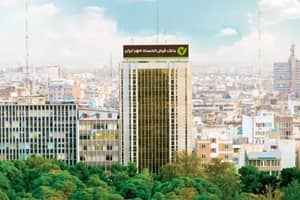
Iran’s government has become increasingly dependent on borrowing while spending less on infrastructure, a structural shift in public finances that threatens to constrain the country’s economic recovery and deepen its fiscal difficulties in the years ahead.
An analysis published by Donya-e Eqtesad on November 25 found that government development expenditure fell by approximately 33 percent in inflation-adjusted terms between the fiscal years beginning in March 2011 and March 2024, even as total budget resources increased by 37 percent.
Over the same period, current expenditure rose by 48 percent, driven in part by the growing dependence of pension funds on government support and interest payments on government bonds.
The findings expose a widening imbalance in Iran’s public finances that predates the latest war. The government is accumulating financial obligations while committing fewer resources to the infrastructure needed to expand economic output and generate future tax revenues.
With damage to industrial facilities, energy infrastructure and transport networks adding to the country’s investment needs, that imbalance risks becoming a major obstacle to reconstruction.
PMOI Supporters in Bern Hold Exhibition for Human Rights and “No to Executions” in Iran
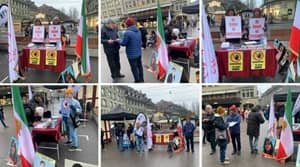
Bern, Switzerland – November 26, 2026 – Supporters of the People’s Mojahedin Organization of Iran (PMOI/MEK) held a book stall and photo exhibition in Bern to draw attention to Iran’s deteriorating human rights situation. The event focused particularly on the execution of political prisoners and protesters detained during nationwide uprisings. It also expressed solidarity with the “No to Execution” campaign. The exhibition supported NCRI President-elect Maryam Rajavi’s “No to Executions” campaign and called for its expansion worldwide. It also reaffirmed the call for a secular, democratic republic in Iran—one that rejects both theocracy and monarchy.
Echoing the Iranian Resistance’s message, participants called for: no to war, no to appeasement, and yes to peace and freedom through the overthrow of the regime by the Iranian people and their organized resistance. They also called for the establishment of a provisional democratic republic in Iran.
Swiss citizens who visited the photo exhibition of martyrs and images of political prisoners sentenced to death signed petitions condemning the executions and human rights violations committed by the mullahs’ regime in Iran. Through their signatures, they expressed solidarity with the Iranian people’s struggle for freedom and democracy.