
The Iranian regime’s parliament approved the general framework of a major restructuring of the Ministry of Intelligence on Sunday, as the IRGC announced coordinated preparations ahead of the first anniversary of the January 2026 uprising. Meanwhile, the dollar broke through the 300,000-toman threshold, truckers expanded their strike, and pensioners took to the streets with slogans targeting the regime’s domestic and regional policies.
Khamenei tightens control over intelligence apparatus
Parliament approved the general framework of amendments to the Intelligence Ministry’s founding legislation by 165 votes to 70, with eight abstentions.
The proposed restructuring introduces a representative of the supreme leader within the ministry and strengthens Khamenei’s authority over internal intelligence protection. Parliament also approved provisions allowing individuals without advanced Islamic jurisprudential qualifications to become intelligence minister.
Parliament Speaker Mohammad Bagher Ghalibaf disclosed that the restructuring originated with Mojtaba Khamenei himself and that parliament had taken the initiative following delays by the government. The ministry has operated under an acting head for eight months. The proposed changes represent its most substantial institutional restructuring since its establishment.
On the same day, IRGC spokesperson Hossein Mohebbi announced the formation of a special headquarters coordinating propaganda and loyalist mobilization ahead of the anniversary of the January uprising and its bloody suppression. According to Tasnim, preparations include public ceremonies, field activities and propaganda campaigns. Mohebbi’s insistence that the nationwide coordination of last January’s protests needs preparations more than a month in advance, betrays the regime’s apprehension that the anniversary could reignite an already explosive society.
As Iran’s economic crisis deepens, ruling factions clash over decision-making authority, Khamenei’s directives and the use of military confrontation and armed proxies as strategic leverage. Today’s state-aligned press exposes the widening divisions.
By @MehdiOghbai…— NCRI-FAC (@iran_policy) November 28, 2026
Dollar breaches 300,000 tomans despite market intervention
The dollar reached a reported 304,500 tomans on Sunday, despite the Central Bank’s restrictions on nine cryptocurrency exchanges. Less than 24 hours after suspending Tether trading, major platforms reopened their markets within prescribed price ranges.
Meanwhile, the Central Bank announced that companies holding commercial licenses would be permitted to purchase up to $20,000 through selected banks beginning Monday.
MP Ebrahim Najafi cited an Audit Court report indicating that more than $80 billion in export proceeds had not returned to the economy since 2018. He also disclosed that more than 4,500 product categories could lose access to official currency allocations, warning of another wave of price increases.
According to the Central Bank’s latest official figures, year-on-year urban inflation reached 85.8 percent, with goods inflation standing at 118.3 percent. The successive emergency interventions have thus far failed to arrest the currency’s depreciation.
Iran’s dollar nears 300,000 tomans, financial restrictions widen, labor unrest spreads, and factional disputes expose decision-making paralysis. Emergency measures offer little relief as #economic grievances accumulate across an increasingly volatile society.
By Farid Mahoutchi…— NCRI-FAC (@iran_policy) November 28, 2026
Pensioners turn economic protests into political demands
Pensioners demonstrated in at least five cities on Sunday, including Rasht, Ahvaz, Kermanshah, Shush and Isfahan. Their slogans increasingly targeted the regime’s political priorities rather than merely demanding higher pensions.
“Enough warmongering; our tables are empty,” protesters chanted in Ahvaz, while pensioners in Isfahan demanded, “Neither Lebanon nor Gaza—pensioners’ rights.” In Kermanshah, demonstrators declared that the exchange rate was not simply a number but the destruction of their livelihoods.
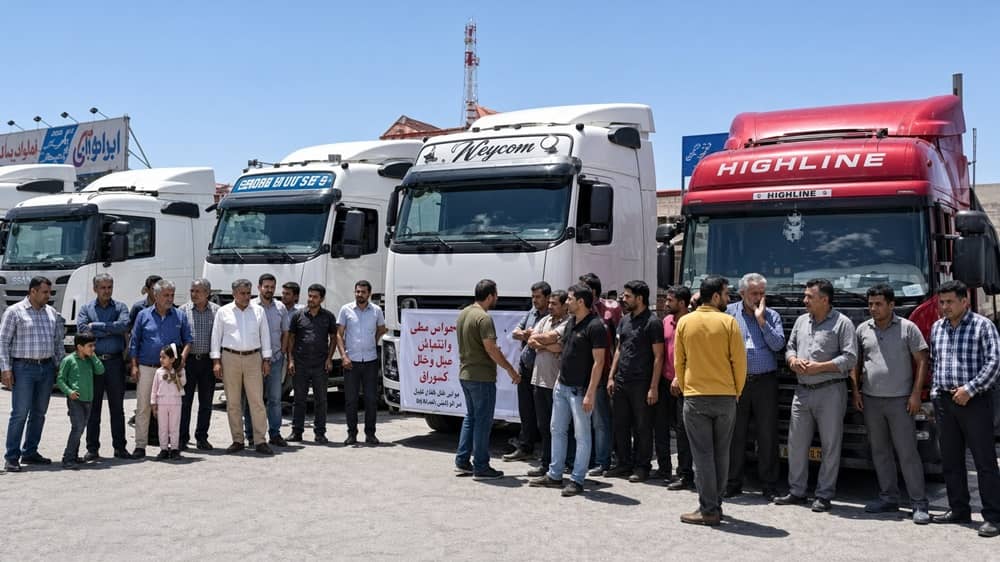
Meanwhile, the truckers’ strike entered its eighth consecutive day, with new stoppages reported across Kurdistan and Ilam provinces. Workers at the Calcimin company in Zanjan also demonstrated over inadequate wages.
The convergence of these protests reflects mounting grievances over the distribution of national resources, state spending priorities and declining purchasing power.
Iran’s truckers extend their strike, the dollar approaches 300,000 tomans, and gas shortages threaten industrial shutdowns. Amid widening factional disputes, the regime relies on emergency price controls and Basij mobilization to contain mounting domestic pressures. By…
— NCRI-FAC (@iran_policy) November 27, 2026
Pezeshkian warns of unrest as Ghalibaf prioritizes military salaries
The regime’s president Masoud Pezeshkian met bazaar representatives and trade associations on Sunday in the presence of senior economic officials. According to Tasnim, he warned that the regime’s adversaries were seeking to generate public dissatisfaction and unrest, urging merchants to help prevent that objective.
His remarks follow warnings by Friday prayer leaders about the political consequences of worsening economic conditions. In Qom, Hashem Hosseini Bushehri cautioned officials against making decisions that provoke social backlash and subsequently force the government to retreat.
Meanwhile, Ghalibaf emphasized the need to increase salaries before the end of the financial year, particularly for armed forces personnel. His emphasis on military salaries is noteworthy as pensioners and workers struggle to secure payments commensurate with inflation.
Iran’s Regime Expands Basij Mobilization as Labor Protests Spread and Political Tensions Intensify https://t.co/4nD1Sm0G8L
— NCRI-FAC (@iran_policy) November 26, 2026
Influenza crisis exposes healthcare deficiencies
Influenza has exceeded the high-alert threshold in 28 provinces, according to Health Ministry figures reported by state media. Approximately 33 percent of respiratory samples tested positive last week, with children under 15 accounting for 48 percent of identified infections.
The outbreak comes amid delays in vaccine procurement and the suspension of domestic influenza vaccine production this year. Previously disclosed official figures indicated that only 700,000 of the planned 2.8 million vaccine doses had entered the country by late September.
The simultaneous restructuring of the intelligence apparatus, preparations for the uprising’s anniversary and official warnings about social unrest reveal how prominently domestic stability figures in the establishment’s current calculations. As emergency economic interventions fail to halt currency depreciation, grievances expressed in the streets increasingly extend beyond living costs to the regime’s political and strategic priorities.