

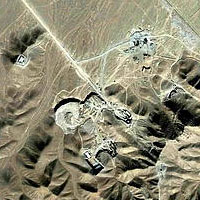
 NCRI – A recent inspection of the Iranian regime’s underground nuclear facility near the city of Qom by the International Atomic Energy Agency (IAEA) has reinforced suspicions that it could have been planned as part of a secret military nuclear program, diplomats in Vienna told The Associated Press on Thursday.
One of the diplomats – a senior official from a European nation – says the hall is too small to be able to house the tens of thousands of centrifuges needed for peaceful industrial nuclear enrichment but the right size for the few thousand advanced machines that could generate the amount of weapons grade uranium needed for a military nuclear program.
The diplomats said Thursday that Iranian regime started building the plant near Qom in 2002, and then paused for two years in 2004 before resuming construction in 2006.
The underground nuclear facilities near Qom were first unveiled in a press conference in Paris by the Iranian Resistance on December 20, 2005. Mr. Mohammad Mohaddessin, Chair of the Foreign Affairs Committee of the National Council of Resistance of Iran disclosed information about four underground complexes comprised of tunnels and installations serving the regime’s nuclear programs. He said: “The first complex is located near Qom close to the salt lake. This is comprised of several tunnels and underground buildings. Construction of the complex started in year 2,000.”
It was revealed in this conference that these tunnels are used to hide the nuclear facilities, laboratories and workshops, and to conceal various sub-sections of the regime’s nuclear and missile programs, in particular nuclear and missile research and command centers.
The Iranian Resistance informed the IAEA of the details of the site and called for inspection of the site and probe into its details, but regrettably, in the framework of the policy pursued by the Secretary General of the IAEA at the time, it received no attention.