

Three-minute read
The finalization of the latest memorandum of understanding (MoU) has torn away the Iranian regime’s veneer of stability, exposing an establishment trapped in an existential deadlock. As internal factions wage intense political warfare over tactical concessions and hereditary succession, the fundamental crises driving the historic wave of popular uprisings since 2017 remain entirely unaddressed. Far from being solved, the regime’s systemic economic devastation, structural decay, and intense public rage have only compounded, leaving the theocracy increasingly vulnerable to a restive nation poised to strike at every opportunity.
The state’s deep anxiety over this vulnerability is vividly illustrated by its bizarre, hyper-engineered propaganda campaign surrounding the delayed burial of Ali Khamenei. In a calculated act of psychological projection, the regime’s funeral committee released astronomical attendance figures—claiming 15 million in Tehran, 5 million in Qom, and 10 million in Mashhad—long before the ceremonies had even occurred. These figures are not projections or assessments; they are state-manufactured artifacts of deception, designed to engineer public perception and force a narrative of ‘unity’ upon a fractured and defiant society.
However, the timing of this elaborate dynastic pageant exposes a profound and agonizing deception within the regime’s demoralized core. The clerical dictatorship is staging this grand burial pomp at the exact moment its so-called diplomats are finalizing a deal with the very Western powers the hardline base considers the “killers of its leaders.” Suspicions are mounting that this protracted, politically charged spectacle—deliberately timed to coincide with the emotional peak of Muharram in Mashhad—is being deployed as a massive psychological smoke-screen. By engineering this artificial environment of mourning, the leadership appears desperate to dampen hardline outrage, distract from its strategic retreats, and normalize a humiliating status quo under the guise of sacred necessity.
"A brewing #diplomatic settlement between Tehran and Washington has ignited an unprecedented domestic crisis within the Iranian regime, exposing severe structural fractures at the highest levels of the clerical establishment," @HakamianMahmoud writes.https://t.co/FNT4uPeG5t
— NCRI-FAC (@iran_policy) June 15, 2026
A Fractured Base Rebels Against the Succession
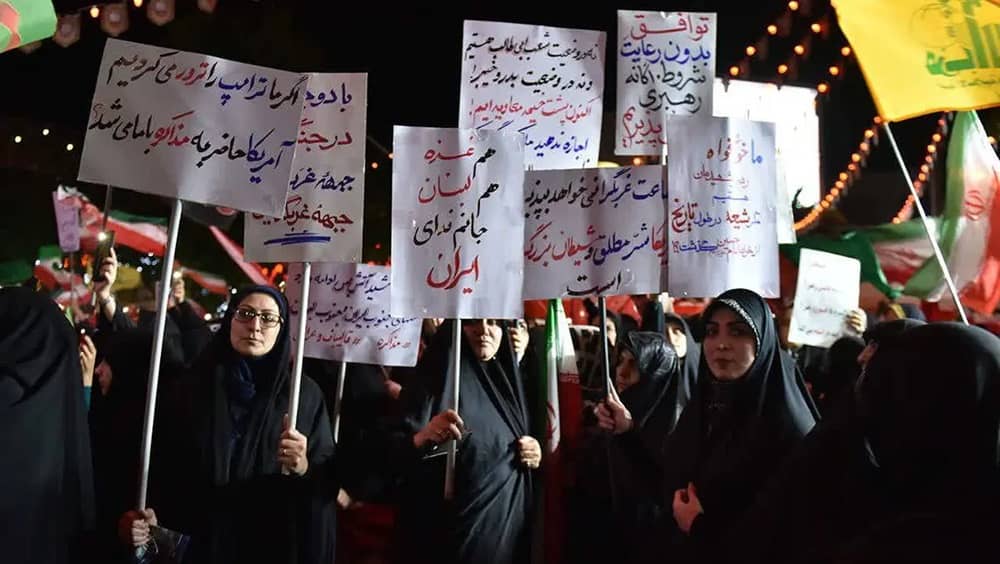
This desperate manipulation has failed to suppress an aggressive, unprecedented domestic mutiny from within the regime’s own ranks. On June 13, 2026, highly organized hardline groups took to the streets of Tehran, directing explicit vitriol at Foreign Minister Abbas Araghchi and Parliament Speaker Mohammad Bagher Ghalibaf. Shroud-clad protesters outside the Ministry of Foreign Affairs directly challenged the system’s new trajectory, shouting, “Ghalibaf, Araghchi, what about my Leader’s blood?” and branding the state’s top diplomats as “dishonorable infiltrators”.
The rebellion has directly compromised the authority of the newly elevated Mojtaba Khamenei, whose absolute silence underscores a deeply precarious and weak position. Ultraconservative parliamentarians have completely dropped historical protocol to openly lambast the regime’s strategic retreats. Member of Parliament Amirhossein Sabeti publicly warned on June 13, 2026, that the administration was executing “a weaker agreement than the JCPOA” that directly violates the established red lines of the leadership, while explicitly declaring that making maritime concessions in the Strait of Hormuz constitutes absolute “treason”.
The regime’s internal paralysis is now defined by the desperate weaponization of Mojtaba Khamenei’s name, with competing factions turning his directives into tools for mutual delegitimization. While the administration exploits his May 28, 2026, directive as a shield to frame the MoU as a state-mandated necessity, hardline insurgents are invoking the exact same “leadership red lines” to brand the negotiation as an act of high treason. This recursive cycle of factional warfare confirms that the newly designated leadership lacks the stature to serve as a neutral arbiter, forcing the theocracy to cannibalize its own foundations while desperately attempting to project a hollow facade of unity.
Power Dynamics in Iran and #MojtabaKhamenei’s Inner Circlehttps://t.co/eTfcnFH14Z
— NCRI-FAC (@iran_policy) June 3, 2026
Socioeconomic Realities Fueling the Inevitable Explosion
While the ruling cliques fight over the terms of their survival, the economic foundations of the state are undergoing a terminal collapse. Official Central Bank figures from February 2026 reveal that national liquidity skyrocketed to an unmanageable 14,640 trillion tomans—a devastating 47.3 percent annual surge. Driven by a 54.7 percent expansion of the hyper-inflationary monetary base, the economy is trapped in a spiral that international financial institutions predict will push consumer inflation close to 69 percent, systematically dismantling the purchasing power of ordinary families.
This economic ruin has triggered an irreversible flight of vital human capital, leaving the domestic social infrastructure entirely defenseless. Deputy Health Minister Abbas Ebadi recently admitted to a catastrophic brain drain in the healthcare sector, revealing that within a single year, 1,800 nurses abandoned their professions, 800 resigned completely, and 380 emigrated abroad due to systematically depressed wages and an “unrealistic valuation of services”. The human cost of this decay became acute during the recent 40-day war, where state-mandated internet blackouts, chronic power outages, and a lack of imported medicines left thousands of rare-disease patients facing immediate, life-threatening conditions.
Ultimately, no amount of fabricated funeral statistics, factional maneuvering, or geopolitical posturing can alter the underlying reality on the ground. The ongoing protests across the country—such as the June 14, 2026 rallies by retirees in Shush, Karkheh, and Haft Tappeh chanting “No war, no killing, we want lasting welfare”—prove that the core grievances driving the Iranian people’s revolt since 2017 have only multiplied in intensity. By treating a vital ceasefire as a poison and its own base with deception, the clerical regime has failed to solve a single structural crisis. As the cosmetic illusion of the absolute velayat-e faqih completely shatters, it leaves behind a hollowed-out, defenseless apparatus facing a highly conscious, restive nation determined to achieve total systemic overthrow.