

Three-minute read
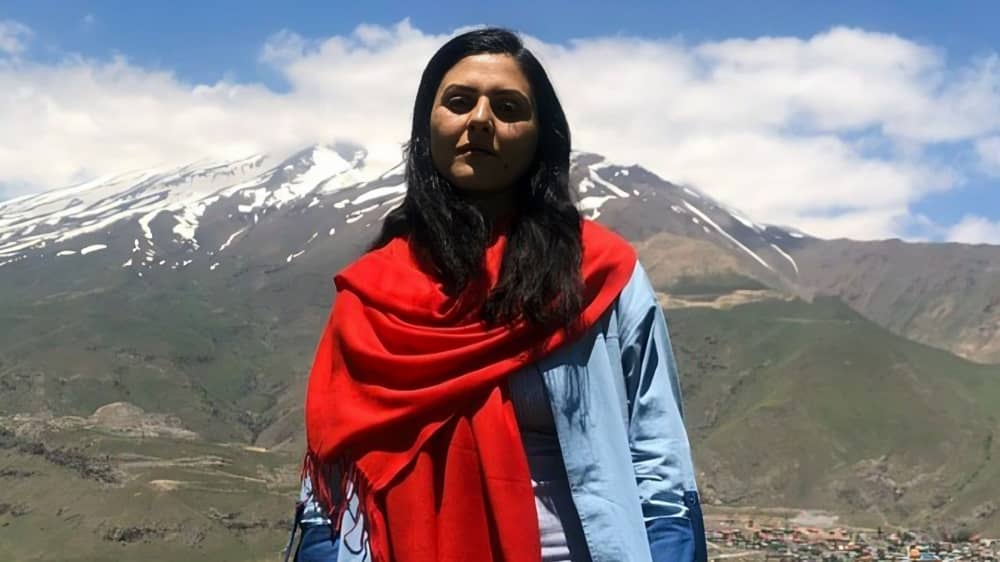
Golrokh Iraee, a political prisoner currently held in Evin Prison, has penned a sharp letter condemning what she describes as a calculated alliance between reformists and monarchists aimed at preserving Iran’s ruling power structure.
Writing from within the confines of Evin, Iraee criticized figures like Bahareh Hedayat for aligning with monarchists. Bahareh Hedayat, a well-known student activist and former political prisoner, recently appeared on a regime-linked media platform claiming to be a pro-republican activist but simultaneously praising the deposed Pahlavi monarchy. She also claimed that the new generation of Iranians longs for a return to the monarchy—a narrative frequently pushed by regime-backed media.
Iraee views Hedayat’s stance as emblematic of a broader pattern of opportunism and political expediency. According to Iraee, Hedayat’s recent public statements reflect a deliberate attempt to diminish genuine revolutionary forces by “reducing the opposition to the monarchist current.”
She accused the so-called “reformists” of attempting to salvage the regime, arguing that their role has always been to create “an atmosphere of fear to deter all who want to fight for righteous demands.” Highlighting how they have aligned with monarchists to maintain the current power structure, Iraee wrote: “Discussion of survival or collapse of the system is at hand. It is all about preserving the power structure.”
Reza Pahlavi, in a meeting broadcasted on Iran International on May 12th said,
"The last point I want to address is the highly sensitive importance of a paradigm shift in the thinking of forces that have traditionally been referred to as reformists (inside Iran). They, too,… pic.twitter.com/5pamQmbkG7
— Facts on Iran (@FactsOnIran) May 17, 2024
According to Iraee, the clerical dictatorship now seeks to unite with monarchists to maintain its grip on power. She argued that both factions share a fundamental desire for authoritarianism. “We experienced the authority of reformists in the 1980s. Their security, judicial, and military forces served their agenda. Their cultural policies sought to preserve the regime,” she stated.
Criticizing monarchists, Iraee dismissed their efforts to revive the old regime’s security apparatus and their promotion of reactionary slogans. She described their vision as a single-voice society that aligns with the regime’s authoritarian ambitions. “One cannot without explanation flee from this cursed regime to seek refuge in the arms of that rejected one,” she wrote, drawing parallels between theocracy’s “guardianship of the Faghih” and the monarchy’s “absolute rule.”
Iraee warned against uniting with monarchists, describing such a coalition as a misguided effort that only serves to reinforce authoritarianism. “Forming an alliance with such forces—whether knowingly or not—comes with heavy responsibility,” she cautioned. “If done knowingly, it is nothing but opportunism and exploitation of the people’s suppressed nationalism.”
One of these “activists” was Reza Pahlavi, the son of the ousted monarchial dictator, joined by Masih Alinejad, who had a background of cheering for factions inside the Iranian regime that stimulated a mirage of reform and moderation. #No2ShahNo2Mullahshttps://t.co/s6np8eaV6m
— NCRI-FAC (@iran_policy) February 24, 2023
Tracing the roots of the regime’s survival, Iraee argued that the clerical dictatorship continues to leverage past alliances with reactionary forces to consolidate its power. She was citing the fact that the Shah’s regime, while crushing progressive and revolutionary forces through imprisonment, execution, and censorship, ironically turned a blind eye to the clerics and their aligned extremist forces. The Shah even released many of them from prison. This deliberate policy laid the groundwork for the 1979 revolution to be hijacked by the clerics, who exploited the elimination of genuine revolutionary forces to seize power.
“People remember,” Iraee wrote pointedly. “Reformists lost their social base after December 2017. Khatami’s twenty-year effort failed. Reformist parties dissolved, their offices abandoned or reduced to ruins, and their ability to convince the people vanished.”
Iraee criticized Hedayat’s engagement in “a virtual studio provided by the Islamic Republic” as an act that “only serves the regime’s agenda of confusing the public and dividing the opposition.”
Golrokh Iraee’s statement adds a critical voice to the broader opposition narrative, particularly in the face of coordinated efforts by Tehran to manipulate or absorb various opposition currents. It underscores a deep-seated awareness that the struggle for freedom must remain independent from those seeking to exploit the nation’s suffering for their own political ends.
.@STRUANSTEVENSON: Reza Pahlavi admitted in an interview on Iran International TV back in 2018: “I am in communication with the IRGC." The IRGC is the equivalent of the Gestapo#No2ShahNo2Mullahs #مرگ_بر_ستمگر_چه_شاه_باشه_چه_رهبر https://t.co/hoIpu7UFSm
— NCRI-FAC (@iran_policy) February 28, 2023
In recent years, many officials and activists who previously rooted for the so-called reformist movement inside Iran have either been dispatched or have immigrated to Western countries. Curiously, many of these individuals have now turned into zealous monarchists, openly supporting the son of the ousted Shah, Reza Pahlavi.
According to a 2012 report by the Federal Research Division of the Library of Congress, the Iranian regime’s Ministry of Intelligence and Security (MOIS) has systematically infiltrated Iranian communities abroad. The report notes how MOIS sends individuals abroad under the guise of dissidents, aiming to infiltrate and destabilize opposition groups. It details how some are temporarily imprisoned to build false credibility before being dispatched to infiltrate exile communities.
The report reads, “MOIS infiltrates Iranian communities outside of Iran using a variety of methods. For instance, a society called “Supporting Iranian Refugees” in Paris is used to recruit Iranian asylum seekers to spy on Iranians in France. MOIS also has agents who abduct individuals abroad, return them to Iran, and then imprison or kill them. MOIS’s tactics of penetrating and sowing discord within the opposition abroad are discussed in an article on a website affiliated with the current Iranian government. The article (“How Do Iranian Intelligence Forces Operate Outside of the Country?”) discusses how Iran uses different mechanisms to penetrate the foreign-based opposition. MOIS uses its former members and/or people willing to cooperate with the ministry. They are sent to prison temporarily and become known as activists opposed to the Islamic Republic. After some time, no one questions their previous political activities; being a political prisoner is enough to be acknowledged as an opposition figure. Activists abroad may help get such a prisoner out of the country with the assistance of an international organization, or MOIS may send the prisoner abroad, calling him/her an “escaped dissenter.” This mechanism of releasing political prisoners to go abroad sows mistrust within the opposition in exile.”