

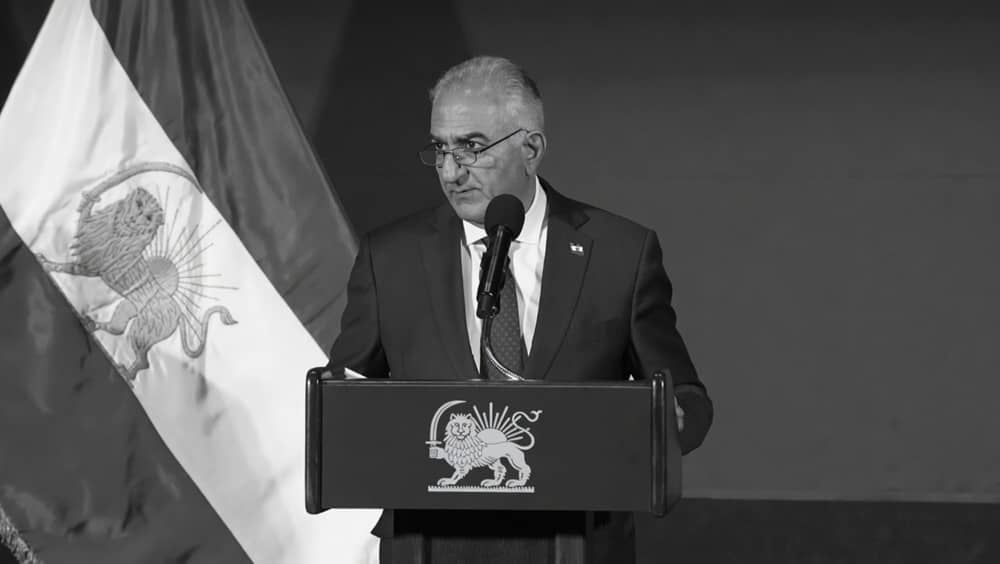
In a sharply critical investigation, the French magazine Le Nouvel Obs argues that Reza Pahlavi’s emergence as a face in the Iranian opposition was not an organic political phenomenon, but the product of coordinated media campaigns, lobbying networks, foreign influence operations, and increasingly radical monarchist activism.
The article by journalist Marie Vaton traces how the exiled son of Iran’s ousted shah transformed, within three years, from a marginal figure into a globally promoted individual after the 2022 protests and the January 2026 massacres in Iran. According to the report, this transformation was fueled by networks stretching across the Atlantic.
The investigation mentions how a Persian-language channel, accused by former staff members of systematically promoting a pro-intervention, pro-Pahlavi narrative while portraying foreign countries as a necessary ally against the regime in Iran. It also references allegations of Israeli-linked online influence operations designed to artificially amplify monarchist support on social media.
The article further describes a growing overlap between segments of the monarchist movement and far-right, ultranationalist, and openly supremacist rhetoric. Several dissidents interviewed accuse radical pro-Pahlavi activists of harassment, intimidation, blacklisting campaigns, and even threats against rival Iranian opposition voices. Former supporters warn that the movement around Pahlavi is increasingly taking on “fascistic” characteristics.
A full translated version of the article follows:
Main edition
Le Nouvel Obs
Pages 26–31
Thursday, May 14 to Thursday, May 21, 2026
3,216 words – 12 min
REZA PAHLAVI: The Making of a King
How did the exiled son of the deposed Shah of Iran manage, in just three years, to establish himself as a symbol of the Iranian opposition? From Washington to the cobblestones of the Trocadéro, the rise of this exiled heir is in fact the product of multifaceted and aggressive networks, sometimes close to certain far-right figures.
The figure
Almost every Sunday, they gather at Place du Trocadéro. It is there, in front of the Eiffel Tower, that the spectacle begins. Music first—Persian, of course—followed by a chant echoed by a few hundred demonstrators: “Javid Shah” (“Long live the Shah”), then “Marg bar se M.” (“Death to the three M.s: the mullahs, the leftists, and the People’s Mojahedin”). Their rallying cry.
Seen from above, the square appears covered in red and green, the colors of the Iranian flag—except that here they are adorned with a lion and sun, emblems of Iran before the 1979 revolution. The image is striking. The message is clear: down with Islamic darkness, bring back the light and progress of the Shah’s golden age.
How many are they, these exiled “monarchists” dreaming of placing Reza Pahlavi, the son of the late king, on the throne? Since the massacres committed by the Iranian regime on January 8–9, 2026, hundreds have rallied—from Brussels to Munich, via Paris, a city symbolic in many ways. It is here, in Passy cemetery, that Leila Pahlavi, one of the Shah’s daughters, was buried after an overdose in 2001. It is also here that Farah Pahlavi, the widow of the deposed sovereign, lives.
“Thank you ‘Bibi’, thank you Trump”
France, historically a land of refuge for Iranians exiled, wounded, and tortured by the Islamic Republic, has nonetheless ended up disappointing them. Among placards reading “Thank you ‘Bibi’, thank you Trump,” a man in camouflage cuts through the crowd, draped in an Israeli flag.
He is Samuel Davoud, vice-president of the association Homa, which officially works for the defense of women in Iran but in practice organizes mobilizations in favor of Reza Pahlavi. He appears on the podium holding up Le Point magazine featuring the prince on its cover. Hand on heart, Davoud pays tribute to Israel, which he says is working to eradicate “Islamic terrorism and all its proxies.” Unlike “Macron’s France,” which he accuses of failing to take a stance since the start of the American-Israeli strikes on February 28.
Chief warrant officer Arnaud Frion, killed in an attack by a pro-Iranian militia in Iraqi Kurdistan in March, is honored with a minute of silence. Not so for the 175 schoolgirls who died that same month in the bombing of their school in Minab, Iran.
Davoud repeats his pro-interventionist narrative in friendly media, such as the morning show of Frontières, a far-right outlet, or on the Israeli channel i24News, which is pro-Netanyahu. On January 11, he brought three members of the far-right collective Némésis onto the stage, including Alice Cordier, who was applauded after holding up a sign reading “F… Khamenei.”
Then there is Mona Jafarian, the most visible Franco-Iranian monarchist. Three years ago, she was mainly active on Instagram, posting family photos and promoting honey creams or high heels. Since the “Woman, Life, Freedom” movement in 2022, her profile has changed.
Now she promotes Reza Pahlavi through her collective Femme Azadi, with tireless activism: by day at the Trocadéro or outside the Iranian embassy in Paris calling for its closure, and on TV channels such as LCI, France Info, RTL, and Europe 1, where she is presented alternately as a “journalist,” an “essayist,” or the “voice of the people.” By night, she attends dinners and gala events.
Organizations such as the CRIF Friends group, Agir Ensemble (linked to the pro-Israel lobby Elnet), and the European Jewish Organization roll out the red carpet for her. She was even awarded the “Righteous of October 7” trophy at a pro-Israel evening organized by the Diaspora Defense Forces in May 2025.
On social media, she relentlessly denounces the “Iranian far left,” insulting them extensively. Among her targets: Nobel Peace Prize laureate Narges Mohammadi, imprisoned in Iran and recently hospitalized, whom she accuses of “acting,” Franco-Iranian researcher Kevan Gafaïti, and journalists such as Quentin Müller, whom she calls a “little supremacist turd.” All, in her view, are complicit with the Islamic regime.
Her blacklist also includes La France Insoumise, “feminists,” pro-Palestinians, the UN, UNICEF…
She describes herself as “Islamophobic” and claims a “pre-Islamic Aryan identity.” She has been under police protection for two years, claiming she has received death and rape threats, “often from Lebanese Hezbollah supporters,” she said on CNews.
She represents the visible face of a broader, multifaceted, proselytizing, and aggressive network—activists, lawyers, political and media figures—operating with powerful influence groups from the corridors of the European Parliament to the streets of Paris, aiming to establish the Shah’s heir as an unavoidable political figure.
“Make Iran Great Again”
The story begins in February 2023 at Georgetown University in Washington, at the heart of American diplomatic networks where researchers, politicians, and diaspora figures intersect.
A few months earlier, Mahsa Jina Amini had been arrested in Tehran for “improper dress” and beaten to death in prison. The world was shaken by the fate of the 22-year-old Kurdish student and ignited by the “Woman, Life, Freedom” uprising.
It is in this context that Reza Pahlavi re-emerges. Living in the United States since the 1979 Islamic Revolution that overthrew his father Mohammad Reza Shah, he attempts to gather a small group of figures: Nobel Peace Prize laureate Shirin Ebadi, former footballer Ali Karimi, actress Golshifteh Farahani, and writer Hamed Esmaeilion, whose wife and daughter were killed when Ukraine International Airlines Flight PS752 was shot down by the Iranian Revolutionary Guard in January 2020.
“Almost no one knew him, neither in Iran nor on the international stage.” — Azadeh Kian, sociologist
The “Georgetown committee” is quickly dissolved. Reza Pahlavi wants unity… but only around himself. He was born a prince and intends to remain one. But at the time, his influence is minimal.
Yet on February 14, 2026, on the sidelines of the Munich Security Conference, he is cheered by 250,000 supporters after a speech urging Donald Trump to “keep his promises” and “help” the Iranian people following the “bloodbath” of January 8–9.
Munich becomes a kind of coronation of a future king…
How can a once secondary symbolic figure—advocating a secular Iran, a moderate constitutional monarchy, and admiring Martin Luther King Jr.—become, in just three years, the natural leader of the Iranian opposition, greeted by crowds wearing “MIGA” caps (“Make Iran Great Again”) and chanting slogans such as “One homeland, one flag, one leader”?
“Reza Pahlavi is the making of a political phenomenon,” says Azadeh Kian. At the center of this mechanism is Iran International, a Persian-language channel broadcast from London, which she compares to a kind of Iranian Fox News.
Launched in 2017 with $250 million in Saudi funding, according to The Guardian, it has long promoted a narrative of pre-1979 Iran as a lost paradise, modern and Westernized, where women walked in miniskirts.
In 2023, in the wake of “Woman, Life, Freedom,” the channel hardened its line. “Everything converged toward the same message,” recalls Armin Khameh, a former editor who left in October 2025. “The Islamic Republic is absolute evil, Israel must help the Iranian people, and Pahlavi is the best candidate—as if the channel were gradually preparing minds for military intervention.”
“Everything converged toward the same message: the Islamic Republic is absolute evil, and Pahlavi is the best candidate.” — Armin Khameh
“Opaque financing”
At the height of the “twelve-day war” in June 2025, and during the January protests, the channel continued broadcasting Reza Pahlavi’s statements, including calls for people to take to the streets, claiming 70,000 soldiers and officials would defect.
What followed is known: on January 8–9, regime militias opened fire with live ammunition, causing at least 7,600 identified deaths, according to Hengaw, a Norway-based human rights organization.
“This is when Reza Pahlavi truly emerged on the international stage,” says lawyer Ehsan Hosseinzadeh, a political refugee in France since 2019. He also notes a shift toward a more aggressive strategy against other Iranian opposition figures.
At the same time, a quieter campaign unfolds behind the scenes, powered by algorithms. In autumn 2025, an investigation by Haaretz, based on research by Citizen Lab (University of Toronto), revealed “Operation Prisonbreak,” allegedly led by elements of the Israeli state apparatus under Intelligence Minister Gila Gamliel—who had previously hosted Reza Pahlavi in Israel in April 2023.
Its goal: to promote regime change in Iran by flooding social media with thousands of pro-monarchy bots, simulating broad popular support.
Who pays for all this? “Not the prince himself—he doesn’t have such resources,” says his entourage, pointing to an “opaque ecosystem of funding involving lobbying and political networks.”
His advisor Saeed Ghasseminejad is a member of the Foundation for Defense of Democracies, a US neoconservative think tank with a $13 million annual budget, partly funded by billionaire Sheldon Adelson, a major Trump and Netanyahu supporter.
In Brussels, a “Woman, Life, Freedom” figure says she was approached by a pro-Israel organization offering payment to mobilize for Reza Pahlavi—an offer she refused.
In Paris, lawyer Sahand Saber acknowledges helping to promote the prince in France. Another close associate, Alexandre Fatemi, recruited communications strategist Jean-Baptiste Doat, formerly in Bruno Retailleau’s Interior Ministry team. The prince’s interview on TF1’s evening news in early February? He handled it. The Le Point cover a week later? Also him. France Inter? That was rejected.
“FASCIZING TURN”
Behind the scenes, some describe him as a “scout” recruiting charismatic figures for the future Shah’s message: young, attractive women, preferably seen as victims of the regime.
Journalist Nazila Maroufian, imprisoned after interviewing Mahsa Amini’s father, says she was offered housing and publishing deals upon arriving in France in 2023, which she refused.
Since then, model Negzzia has become one of the visible monarchist voices across major French media outlets.
Sahand Saber insists everything is done out of “pure humanism,” while regretting the dominance of the “Iranian leftist opposition” in French media.
He also claims Reza Pahlavi seeks only democracy, like his “natural ally” Netanyahu.
Yet over time, the initial soft power has faded. Mona Jafarian is now described by critics as a “harpy” who intimidates opponents. A list of “leftists to eliminate” circulated online, including lawyers, researchers, and bookstores in Paris.
In Canada, this climate has already turned deadly: Massoud Masjoody, a former professor and opponent of both the regime and monarchists, was killed by radical Iranians in March.
Online, some extremists even call for the return of SAVAK, the Shah’s feared secret police.
Some early supporters have since distanced themselves, describing a “fascistic turn.”
In the end, whose cause is Reza Pahlavi serving? What does he represent? asks journalist Kambiz Ghafouri, suggesting that this hard line may aim to weaken the opposition and keep Iran divided.
In his view, external powers risk replicating the same authoritarian logic as the Islamic Republic: imposing a symbolic authority without real legitimacy.
On April 27 in London, at a pro-Pahlavi rally, a group dressed in black staged a disturbing military-style performance honoring the ancient Persian “Immortals”—a symbolic vision of replacing one repressive force with another.
Or simply becoming it?
By Marie Vaton