

Five-minute read
On May 10, 2026, monarchist gatherings in Germany once again provided Tehran with one of its most useful propaganda tools. Some participants displayed SAVAK symbols and Shah-era imagery — scenes that allow the Islamic Republic to reinforce a carefully cultivated narrative: that Iran’s only alternatives are the current dictatorship or the return of the old one.
The significance of these displays lies less in the gatherings themselves than in how similar symbolism has increasingly appeared inside Iran’s protest movements — particularly on university campuses. For years, Iranian security networks and affiliated actors have sought to inject monarchist slogans into demonstrations, reframing democratic uprisings as calls for the restoration of the monarchy. During and after the January 2026 uprising, this pattern became especially visible as slogans such as “Javid Shah” and “Pahlavi will return” were aggressively amplified through selective clips and coordinated media ecosystems.
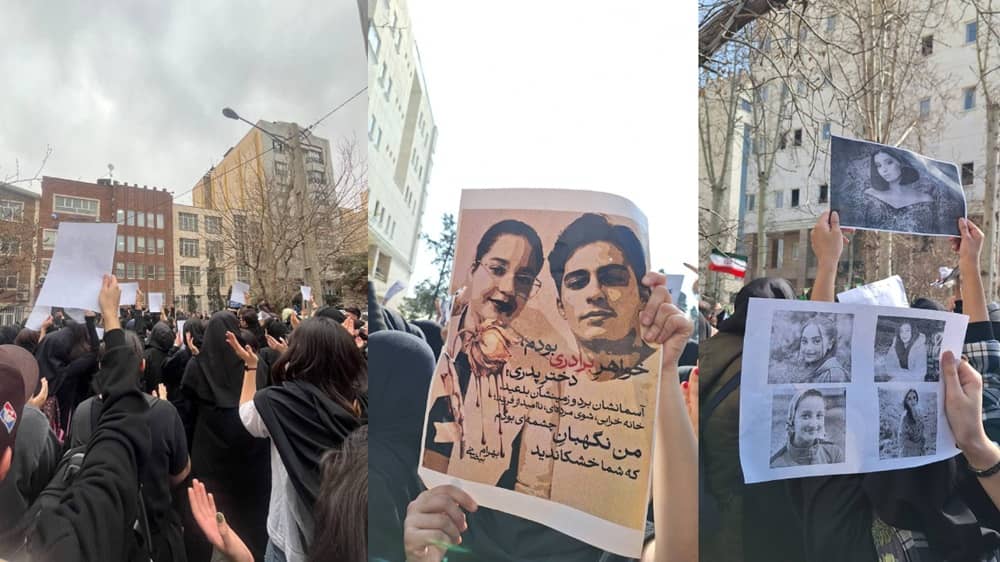
The March 2026 Student Protests
After the January 2026 uprising was suppressed, universities reopened on February 21, 2026. Within days, new student protests broke out across campuses, largely connected to the fortieth-day commemorations for those killed during the uprising. These protests lasted several days and were quickly met with pressure and repression.
But a new phenomenon appeared alongside them: the sudden emergence of “Lion and Sun Associations” on university campuses.
The #Iranian Regime’s Calculated Use of Monarchists: A Political Decoyhttps://t.co/yBZ1QJSnHd
— NCRI-FAC (@iran_policy) February 2, 2025
In some universities, groups were pushing monarchist slogans, including “Javid Shah” and ironically chanting death to leftist, and MEK. The central question became: who was behind this sudden coordinated monarchist presence in some of the campuses that had traditionally been centers of republican, democratic, and organized anti-regime activism?
According to accounts from student activists who discussed the matter in a Clubhouse room on March 5, around seventy active students and organizers debated the issue directly. One student, identified as Arash, said that as the campus protests were intensifying, a network calling itself the “Lion and Sun Associations” had suddenly announced its existence and claimed it would join the protests. He described the network as deeply suspicious, argued that its conduct was anti-protest in practice, and said that it operated under a student label while collaborating with university security.
Another student, Sima, said she had spoken with students from Tehran University, Iran University of Science and Technology, and Shahid Beheshti University. According to her account, students on those campuses also believed there was a deliberate effort to prevent republican and democratic student voices from becoming dominant. She stated that the Lion and Sun groups presented themselves as monarchists but worked with university security, pressured students to chant pro-Pahlavi slogans, and passed the names of active students to security bodies.
"For years, polite analysts have pleaded for #OppositionUnity, arguing that differences could be settled at the ballot box once the dictatorship falls. That framing misses the point," Farid Mahoutchi writes.https://t.co/WRXiCCDJGr
— NCRI-FAC (@iran_policy) May 11, 2026
A Sudden Network, Not an Organic Campus Movement
The timing is crucial. Universities reopened on February 21. Almost immediately, between February 21 and February 23, statements began appearing from newly formed Lion and Sun Associations in different universities. Within only a few days, a number of university-branded Telegram channels, statements, and declarations appeared.
One Telegram page for the “Lion and Sun Association of National University of Iran” describes the group as having been founded by students at that university in response to the “Lion and Sun Revolution” and links itself to a central channel. The same channel later published a statement declaring support for a transition under “Prince Reza Pahlavi.” Another Telegram preview for the Gilan University branch openly identifies itself as a “student Lion and Sun Association” and ends its profile text with “Javid Shah.” In reality many of them did not exist beyond the statement that had been issued.
However, the sudden scale, coordination, and function of these associations, under a dictatorship was very suspicious.
What makes everything even more suspicious is that the security forces not only refrained from harassing them but also allowed them to protest and even harass other students.
In an assessment, Col. Wesley Martin, former Senior Antiterrorism Officer for all Coalition Force – Iraq, portrays Reza Pahlavi’s Iran Prosperity Project (IPP) as an authoritarian scheme wrapped in the language of #democratic change.https://t.co/7YeC1vSGCq
— NCRI-FAC (@iran_policy) March 22, 2026
The Political Function of the Lion and Sun Associations
The apparent purpose of the Lion and Sun Associations was not to strengthen student protest. It was to hijack it.
Their apparent function was to push every campus protest into a monarchist frame, marginalize republican and democratic voices, and present Reza Pahlavi as the inevitable alternative. But the hidden agenda was to disrupt unity among students and thus in practice, this served the regime’s own strategic interest: to make protest appear authoritarian, divisive, and threatening to large sections of society.
The associations’ language shows the method clearly. They appropriated the emotional and moral vocabulary of revolution: “We neither forgive nor forget,” “We stand until the end,” “By the blood of the innocent,” “Universities must be the stronghold of awareness and demands,” “Tuesday is not a day of remembrance; it is a day of standing,” and then mix it with a few chants in support of the son of the shah. By this tactic not only do they divert the objective of the protests and create discord among them but create confusion among the students not to take part in protests in future.
But the Lion and Sun network then publicize it as support for Reza Pahlavi. The revolutionary language of sacrifice, blood, freedom, and dignity was redirected into a monarchist narrative. The result was a political contamination of the protest message: the courage of students was packaged as support for the Shah’s son.
This is exactly what the regime needed. The regime therefore benefits when the symbols of protest are stolen and placed in the hands of a politically sterile monarchy project abroad.
"While the ruling regime in Tehran continues to hijack the nation’s resources and enable foreign forces to further destroy Iran’s infrastructure and endanger the lives of millions of citizens, the thuggish actions of these monarchist hardliners are proving to be a strategic…
— NCRI-FAC (@iran_policy) March 30, 2026
From the First Announcement to Open Intimidation
These Telegram channels did not emerge as neutral student platforms. From the very beginning of their declared launch — on the second day of the student protests — they began by promoting slogans attacking rival opposition currents and pushing the “Lion and Sun Revolution” line as the supposed framework for the uprising.
During the uprising, these Telegram channels reportedly amplified slogans such as death to the MEK,” while also promoting the creation of “imperial Guards” on university campuses. More seriously, it published several aggressive posts warning and threatening students against supporting other political groups or currents. The message was clear: students were not merely being invited to join a pro-Pahlavi line; they were being pressured and intimidated not to stand anywhere else.
On February 23, it reportedly published a statement announcing the creation of “SAVAK” at Iran University of Science and Technology, claiming that its purpose was to identify “mercenaries and Basijis” on campus. The real objective was to identify the active student opposed to the regime.
This is perhaps the most revealing point. A student movement that names its internal security project after SAVAK is not building democracy. It is normalizing intimidation. It is also handing the regime exactly the propaganda it wants.

Why the Regime Benefits
The regime’s objective is:
First, it discourages ordinary Iranians who reject both theocracy and monarchy. Many Iranians despise the regime but also remember or know the history of Shah-era repression. When they see SAVAK symbols, threats against critics, and slogans demanding royal restoration, they hesitate to join protests that appear captured by another authoritarian project.
Second, by pushing slogans against the MEK and other democratic forces, the Lion and Sun network attempts to change the objective of the protests from targeting the regime to undermining the principal opposition to the regime, thus justifying its suppression.
Third, it changes the image of the uprising in Western media. Instead of being seen as a nationwide revolt for a democratic republic, the uprising can be misrepresented as a campaign to restore another authoritarian regime. This helps foreign governments and media outlets simplify Iran’s political future into a false binary of dictators: mullahs or monarchy.
Fourth, it gives the regime an excuse for repression. If student protests can be portrayed as associated with SAVAK nostalgia, the regime can more easily justify crackdowns of the students to its own base and to fearful sections of society.
Finally, it fractures the protest itself. The protest is no longer a broad front against dictatorship. It becomes a battlefield over imposed loyalty to the Shah’s son.
The Lion and Sun Associations should not be analyzed merely as monarchist student groups. Their importance lies in the service they are providing to the regime.
Taken together, the pattern points to a larger strategy. The clerical dictatorship does not only repress uprisings with bullets, prisons, and executions. It also tries to poison them politically. It injects false alternatives, manufactures fake leadership, and promotes the most divisive symbols available.