

Two-minute read
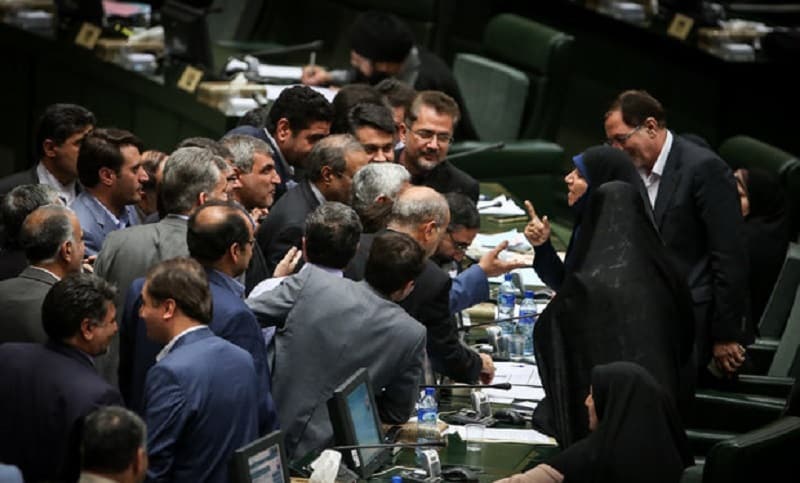
The Iranian regime is engulfed in a deepening internal crisis as fierce infighting escalates over the controversial mandatory hijab law and broader power struggles within the ruling establishment. Tensions between Masoud Pezeshkian’s administration and parliamentary factions that associate themselves with the regime’s Supreme Leader Ali Khamenei and security apparatus have reached new heights, exposing deep fractures within the clerical regime.
The regime’s internal strife has intensified over the enforcement of the oppressive hijab law. Morteza Agha-Tehrani, the head of the Parliamentary Cultural Commission, appeared at a gathering of pro-hijab law supporters and declared that “the hijab and chastity law will be officially implemented by March 20.” His remarks were a direct challenge to Pezeshkian’s government, which has so far stalled its enforcement in an attempt to prevent further public backlash.
On the other side, Pezeshkian’s legal deputy, Majid Ensari, admitted that “some sections of the hijab law are unenforceable” and revealed that a higher legal authority had temporarily suspended its implementation. Pezeshkian is attempting to delay the law’s enforcement, fearing that its rigid implementation could act as a spark for a broader social explosion reminiscent of the 2022 uprisings. However, mounting pressure from the parliament and security forces has left him with little room to maneuver. The outcome of this battle will serve as a barometer for the escalating factional conflicts within the regime.
#Iran's Regime Infighting Escalates as Rival Factions Clash Over Power, Corruption, and Policy Failureshttps://t.co/tlsz80vGAA
— NCRI-FAC (@iran_policy) March 8, 2025
Meanwhile, state-controlled media have reported that 209 members of parliament have sent a letter to Speaker Mohammad Bagher Ghalibaf demanding the immediate implementation of the hijab law. Gholamreza Goudarzi, spokesperson for the parliamentary presidium, reinforced this pressure, stating, “The hijab and chastity law will be enforced; it cannot be ignored.” Similarly, hardline MP Amirhossein Bankipour-Fard warned that further delays would create “social tensions,” arguing that enforcing the law would prevent future unrest.
Tensions have escalated to the point where extremist factions in parliament have openly threatened Pezeshkian with procedural maneuvers to bypass his administration. Amirhossein Bankipour-Fard emphasized that if the president fails to sign the hijab law into effect within two weeks, “the Speaker of Parliament will implement it instead.” He pointed out that such a precedent existed under former presidents Hassan Rouhani and Mahmoud Ahmadinejad, both of whom resisted enforcing hardline measures only to be overridden by parliament.
Beyond the hijab law dispute, broader cracks within the regime’s leadership are widening. Ahmad Qaempanah, Pezeshkian’s executive deputy, confirmed that the presidential deputy for Strategic Affairs Javad Zarif has effectively resigned, regardless of whether Pezeshkian formally accepts his departure. According to Qaempanah, “Zarif is gone, and there has been no further discussion about his role in the government.”
After Hemmati and Zarif's Ouster, Hijab Law Reignites #Iran’s Political Crisishttps://t.co/MVr3qVAl8M
— NCRI-FAC (@iran_policy) March 8, 2025
Additionally, Ali Tayebnia, who was appointed as Pezeshkian’s senior economic advisor in August 2024, has also ceased participating in government activities, further highlighting the internal fragmentation.
These fractures within the regime reflect a broader existential crisis. Internal factionalism, deep economic distress, and widespread public dissatisfaction are converging to weaken the clerical dictatorship from within. Factions aligned with Khamenei fear that failure to enforce oppressive measures will embolden resistance movements, while Pezeshkian’s camp fears that unchecked repression could ignite another wave of mass protests.
This internal struggle is a telltale sign of a system unraveling under the weight of its own contradictions. As the ruling elite turns against itself, history suggests that the end of the regime will not come solely from external pressures or economic collapse but from the escalating internal conflicts that are consuming it from within.