

Two-minute read
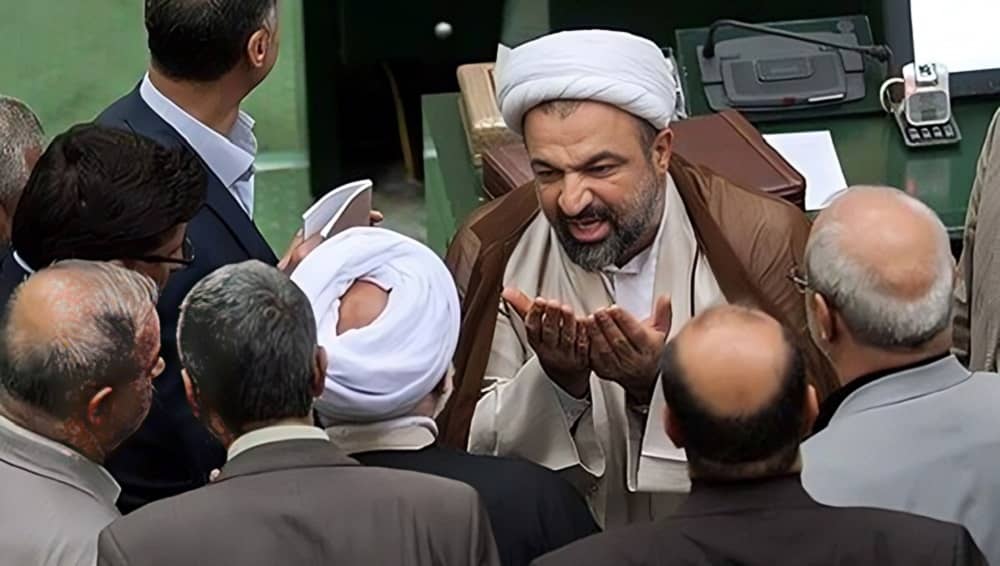
Amidst mounting domestic and international crises, factional infighting within Iran’s clerical regime has intensified, revealing deepening rifts among the ruling elite. Economic challenges, diplomatic failures, and ideological disagreements are converging to exacerbate internal discord.
The controversy surrounding Shahram Dabiri, the parliamentary deputy under Masoud Pezeshkian, perfectly illustrates the intensity of factional strife. Dabiri’s luxurious trip to Antarctica during the Nowruz holidays—while millions of Iranians endure crushing economic hardship—has sparked public outrage and intensified infighting within the regime. Dabiri’s absence from key government meetings, including Khamenei’s Eid al-Fitr speech, has prompted calls for his resignation from Pezeshkian’s own circle. His response, that only Pezeshkian himself has the authority to dismiss him, reflects his belief that his close ties to the president will protect him.
Ahmad Zaidabadi, a state-affiliated political analyst, painted a grim picture of the regime’s stability. Speaking in a roundtable discussion, he warned: “The crises have grown exponentially and reached a dangerous point. If the system has realized this, it is trying to moderate the situation through Pezeshkian, finding a middle ground or bringing new forces into participation.” However, he concluded that “the mechanism of reconciliation proposed by Pezeshkian has failed… because they [the rival factions] do not accept each other and cannot convince one another.”
#Iran’s Ruling Factions Descend into Confusion and Infighting Amid Mounting Criseshttps://t.co/Ph4mFLOHK4
— NCRI-FAC (@iran_policy) March 12, 2025
Zaidabadi noted, “The mechanism of reconciliation in part of the ruling establishment… has reached a dead end. It is evident that they do not want to resolve the problem through dialogue and negotiation.”
Meanwhile, Hamid Rasaee, an influential cleric closely aligned with the faction loyal to Khamenei, recently launched a scathing attack on Speaker of Parliament Mohammad Bagher Ghalibaf. Rasaee accused Ghalibaf of selectively silencing critical voices while favoring allies. “He quickly cuts off those who raise criticisms by saying, ‘What does this have to do with the agenda?’ Yet, he ignores similar issues raised by his friends, who coordinate their points beforehand,” Rasaee charged.
The escalating crisis is evident not only in political disputes but also in ideological rhetoric. The IRGC’s statement, published by ISNA on March 31, acknowledged the “critical and perilous situation” facing Iran. The IRGC stressed that “social cohesion is the most powerful asset of Islamic Iran, like an impenetrable fortress that shields the nation against foreign threats and internal sedition.” The statement warned that without unity, the regime would be vulnerable to internal and external challenges, describing the current circumstances as “fraught with threats and dangers.”
#Iran's Regime Infighting Escalates as Rival Factions Clash Over Power, Corruption, and Policy Failureshttps://t.co/tlsz80vGAA
— NCRI-FAC (@iran_policy) March 8, 2025
The emphasis on the urgent need for unity reveals the regime’s acute awareness of the mounting crises and the increasing difficulty in maintaining control amid intensifying factional disputes. The IRGC’s declaration underscores the regime’s fear that its fragmented state may invite further instability or even outright collapse.
With Iran’s economic collapse accelerating and its international isolation growing ever more severe, the clerical regime finds itself trapped in a deadlock from which it has no escape. The regime’s attempts to reconcile its warring factions are failing, and with no viable solutions in sight, the internal power struggles are certain to escalate, accelerating the regime’s decay.