

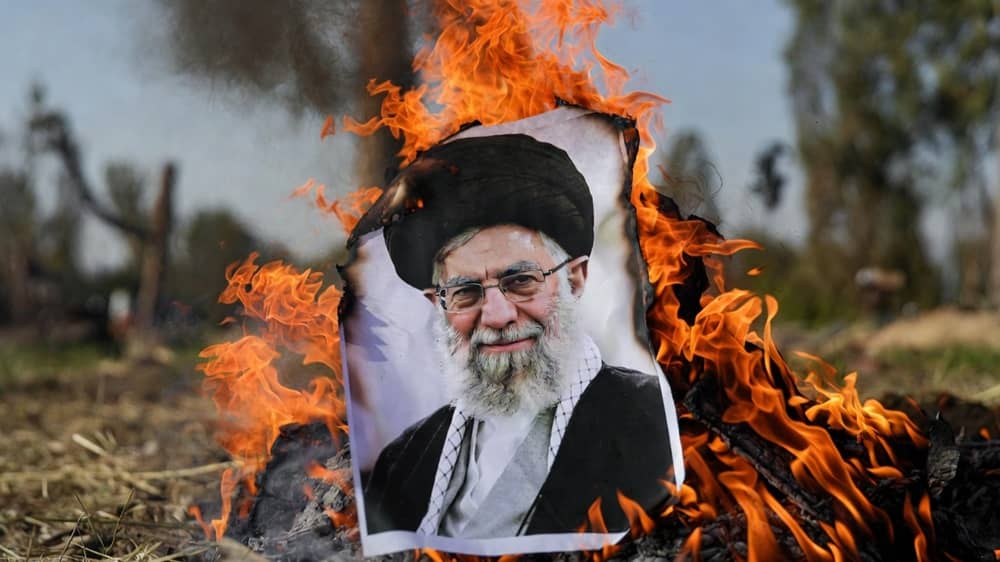
Following the bloody massacre of Iran’s 2026 uprising, Ali Khamenei’s recent public intervention was framed by state media as a moment of confidence: the “people” had defeated the “rioters,” and now, he declared, it was the turn of the khawas—the regime’s political and clerical elites—to take a stand. The supreme leader’s affiliated weekly Khat-e Hezbollah elevated the message into doctrine, arguing that after the street battle ends, the decisive arena becomes “positioning,” “narrative,” and elite responsibility.
But this was not a victory speech. It was a distress signal.
Authoritarian leaders do not normally beg their elites to speak. They assume compliance. Khamenei’s insistence that influential figures must now declare themselves reveals a deeper anxiety: after a bloody suppression of a nationwide uprising, the regime’s inner consensus has fractured, and silence inside the system has become as dangerous as slogans in the street.
The language matters. Khamenei did not ask elites to remain quiet; he demanded that they take a stance.
The result has been striking. Aside from former president Mohammad Khatami, who repeated the state line by portraying the uprising as a foreign conspiracy and praising the authorities’ conduct, almost no top-tier regime figure rushed to Khamenei’s defense. The absence is the story. In a system built on ritualized loyalty, this level of elite hesitation suggests fear—not of Khamenei, but of society.
A System That Can No Longer Close Its Rankshttps://t.co/HLZzsWenvs
— NCRI-FAC (@iran_policy) November 4, 2025
That fear helps explain the regime’s second, even more revealing move: the deliberate plunge into digital darkness.
Since early January, Iran has been subjected to an almost total internet blackout. Unlike previous shutdowns, this one has no defined security endpoint. The government spokesperson Fatemeh Mohajerani told media activists that international internet access would remain unavailable at least until before Nowruz 1405—late March 2026.
A state that expects unrest to fade does not plan censorship by the season.
The message is unmistakable: the regime anticipates prolonged confrontation with society and is preparing to manage it without witnesses. Activists and digital-rights groups warn that Tehran is moving toward a semi-permanent severance from the global internet, confining most citizens to a tightly monitored national network while granting limited external access to vetted institutions and individuals.
Khamenei’s Insistence on A “Propaganda War” Exposes That His Battlefield Is Inside #Iran https://t.co/yQa1E2qcx9
— Javad Dabiran (@JavadDabiran) December 12, 2025
The clerical dictatorship understands that violence is most dangerous to power when it is recorded, shared, and remembered collectively. In 1988, Ruhollah Khomeini, the regime’s founder and former supreme leader, cut prisons across Iran off from the outside world before overseeing the mass execution of political prisoners. The objective was not secrecy in the moment, but silence afterward. Khamenei, Khomeini’s successor, is applying the same logic to an entire society.
At the same time, the judiciary, under Gholamhossein Mohseni Ejei, has intensified threats of expedited trials and severe punishment. What emerges is not the image of a regime in control, but of one cornered by its own crimes.
What makes this moment especially dangerous for Khamenei is that it comes at the end of a clear trajectory, not as an isolated revolt. Since 2017, Iran has experienced repeated nationwide uprisings, each more radical, more organized, and more confrontational than the last. Protesters have moved from economic grievances to openly challenging the regime itself, striking at symbols of authority and absorbing brutal repression without retreat.
Clerical Regime in #Iran Sees Uprising Everywherehttps://t.co/r1zaUJf2pV
— NCRI-FAC (@iran_policy) November 30, 2025
In the latest uprising, this evolution reached a new stage. Entire towns and urban districts were temporarily wrested from state control, as citizens confronted the regime’s security forces directly and endured overwhelming military force. That threshold cannot be undone.
This uprising is far from over; it has entered a more dangerous phase. The regime has failed to restore fear or legitimacy. Each round of repression has only expanded the boundaries of resistance and hardened a society that has crossed key thresholds of defiance. Khamenei’s dependence on elite pressure, digital darkness, and brute force signals not consolidation, but exhaustion—and a struggle moving beyond his ability to rule through terror alone.