

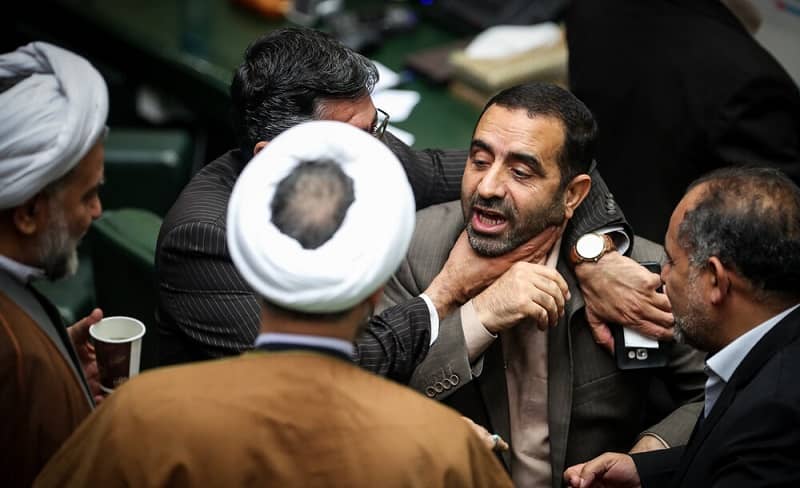
The power struggle within the Iranian regime has escalated following the removal of Mohammad Javad Zarif and Abdolnaser Hemmati, revealing deep divisions among its factions. While factions who associate themselves with the regime’s Supreme Leader Ali Khamenei celebrated the dismissals as victories for the rule of law, revisionist-aligned figures decried them as signs of a collapsing government. The upheaval has triggered accusations of corruption, economic mismanagement, and political purges, exposing the increasing fragility of Masoud Pezeshkian’s presidency.
A Scapegoat for a Shifting Strategy
Mohammad Javad Zarif, who was serving as deputy to Pezeshkian, was forced to resign following sustained pressure from parliament and the judiciary. MP Hamid Rasaee said, “There are still officials in the government who must either revoke their children’s dual nationality or step down. After months of persistent warnings from parliament to the heads of the three branches, Mohammad Javad Zarif, the illegal deputy to the president, was finally forced to resign.”
However, Sasan Karimi, Zarif’s deputy, refuted claims that the former foreign minister had resigned voluntarily. He stated on March 4: “Zarif will not be returning to the Strategic Deputy role. As they have written, Zarif did not ‘resign’; rather, the perception is that he was ‘removed’ from his position.”
Khamenei’s Removal of Zarif and Hemmati Marks a New Phase in #Iranhttps://t.co/QROYkyFVYK
— NCRI-FAC (@iran_policy) March 3, 2025
Blaming Economic Failures on a Fall Guy
On March 2, 2025, Finance Minister Abdolnaser Hemmati was impeached and dismissed in a parliament session that underscored the growing tensions between the Pezeshkian administration and Khamenei’s loyalists. His removal, approved by 182 votes, was widely interpreted as a coordinated effort to sideline figures seen as obstacles to regime loyalist control over economic policy.
MP Ebrahim Sabeti accused Hemmati of economic mismanagement and called for legal action against him: “We impeached Hemmati in parliament; now, the judiciary must investigate his dereliction of duty and misconduct. If the value of the dollar surged by 38,000 tomans in just six months, he was one of the main reasons. The judiciary must take action.”
Morteza Mahmoudi, another MP, demanded broader prosecutions, stating: “Mr. Ejei, please prosecute the veterans of corruption, negligence, and misconduct—figures like Zangeneh, Akhoundi, Nematzadeh, and Hemmati. Their records of wrongdoing stretch far beyond this latest scandal.”
#Iran News: Hemmati’s Impeachment Exposes Deep Fractures Within Regime as Factions Scramble to Shield Khameneihttps://t.co/UL3GcDsvRH
— NCRI-FAC (@iran_policy) March 2, 2025
Meanwhile, MP Babak Rezazadeh, clearly alarmed by the growing risk of a popular uprising, called for unity as a means to suppress dissent. He cautioned: “Now is the time for unity, not division. Now is the time to stand against the U.S. and Israel, not each other. The water crisis in Meshgin Shahr is becoming a security issue—how long will people have to suffer before action is taken?”
A Regime Struggling to Keep Control
Prominent revisionist figure Morteza Alviri expressed doubts about Pezeshkian’s ability to navigate the crisis, stating: “If I were in his place, I would not hesitate to resign. March 2 was one of the darkest days for this administration—the morning began with Hemmati’s impeachment, and by nightfall, Zarif was gone.”
Similarly, Abbas Abdi, a former intelligence interrogator turned a “reformist” journalist, warned that the administration was losing control: “National unity has failed. If this situation continues, the government will collapse. Pezeshkian is now facing a harsh reality he never anticipated.”
#Iran's Regime Infighting Escalates Amid #Economic Crisis and International Tensionshttps://t.co/QaeyKbnTc7
— NCRI-FAC (@iran_policy) February 19, 2025
Even state media acknowledged the disarray, with Entekhab sarcastically comparing Pezeshkian’s approach to governing with someone mistaking a fish for a frog: “It seems Pezeshkian’s vision of unity suffers from a cognitive error—mistaking a fish for a frog. If the government continues to rely on ethical individualism rather than political pragmatism, it will not survive.”
Judiciary Weaponized for Political Purges
Beyond political disputes, the judiciary has played an increasingly aggressive role in targeting figures associated with Pezeshkian’s administration. Calls for further investigations and legal action have intensified, particularly regarding corruption allegations.
MP Sabeti accused the judiciary of selective justice: “A disreputable official with family ties to the Mojahedin-e-Khalq was given a post in Persian Gulf Petrochemical Industries, despite negative security clearance. Thankfully, he resigned after pressure. But why has the judiciary not prosecuted any of Rouhani’s ministers for similar offenses?”
#Iran’s Ruling Factions Turn on Each Other Amid Deepening Economic Crisishttps://t.co/sA8jhOo0nY
— NCRI-FAC (@iran_policy) February 28, 2025
Meanwhile, criticism of economic mismanagement has mounted, with MP Jafar Qaderi asking, “How is it acceptable that we sit atop a sea of oil and gas, yet the nation faces energy shortages every summer and winter?” His remarks underscored the wider economic grievances fueling the regime’s internal conflicts.
The regime’s president himself has remained largely silent amid the turmoil, leading to speculation about whether he retains any real authority. According to Ali Qolhaki, a regime-linked journalist, Pezeshkian was reluctant to confront Zarif about his removal, instead delegating the task to a subordinate: “A senior official told Pezeshkian to inform Zarif that he was dismissed. Pezeshkian replied, ‘You tell him.’”
The same journalist suggested that further purges are imminent, stating: “At least five senior officials must now say goodbye to their posts.”
#Iran’s Ruling Clerics Descend into Hysteria as Fear of Collapse Growshttps://t.co/QDmQRIOSAn
— NCRI-FAC (@iran_policy) February 21, 2025
A Fractured Regime Facing Internal and External Pressure
The intensifying power struggles within the Iranian regime reflect its deepening internal instability. While regime loyalists seek to consolidate power by purging their rivals, the broader economic and political crises remain unresolved.
Public discontent continues to rise as Iranians face worsening living conditions, energy shortages, and soaring inflation. MP Hosseini Kia warned of the deteriorating quality of life: “Every day, the people’s table gets smaller. Car and housing prices are now just dreams for most. Inflation has skyrocketed, the exchange rate has risen by 60%, and monthly inflation has jumped from 1.5% to over 4%.”
As economic mismanagement, factional disputes, and repression intensify, the regime faces mounting pressure from within and without. The removal of Zarif and Hemmati may be only the beginning of a larger purge as Khamenei’s regime loyalists tighten their grip—at the cost of further fracturing an already fragile system.