

Three-minute read
The internal landscape of the Iranian regime has reached a state of terminal fracture, masked only by a thinning veil of “iron unity” and the calculated narratives of its foreign soft-power assets. While the state’s executive and legislative heads issue coordinated social media decrees of obedience to a wounded and invisible Supreme Leader, the material reality tells a story of a regime reeling from a “survival paradox.” In its frantic bid to avoid a total overthrow, the leadership has retreated into a bunker of military blackmail, choosing to bankrupt the nation rather than risk the demoralization of its last remaining pillar: the security apparatus.
The most striking evidence of this decay is the glaring strategic schism at the very summit of the regime’s hierarchy. While the executive apparatus desperately signals a willingness for dialogue to stop the economic bleeding, military commanders and their legislative allies double down on regional blackmail, explicitly tying the crisis to the blockade of the Strait of Hormuz. This stark divide over whether to negotiate or escalate definitively shatters Tehran’s manufactured optics of “iron unity.” Rather than a consolidated leadership moving in lockstep, these conflicting postures expose a paralyzing internal power struggle. A regime that cannot even maintain a cohesive strategic front at the height of a devastating war is not projecting strength; it is hemorrhaging control.
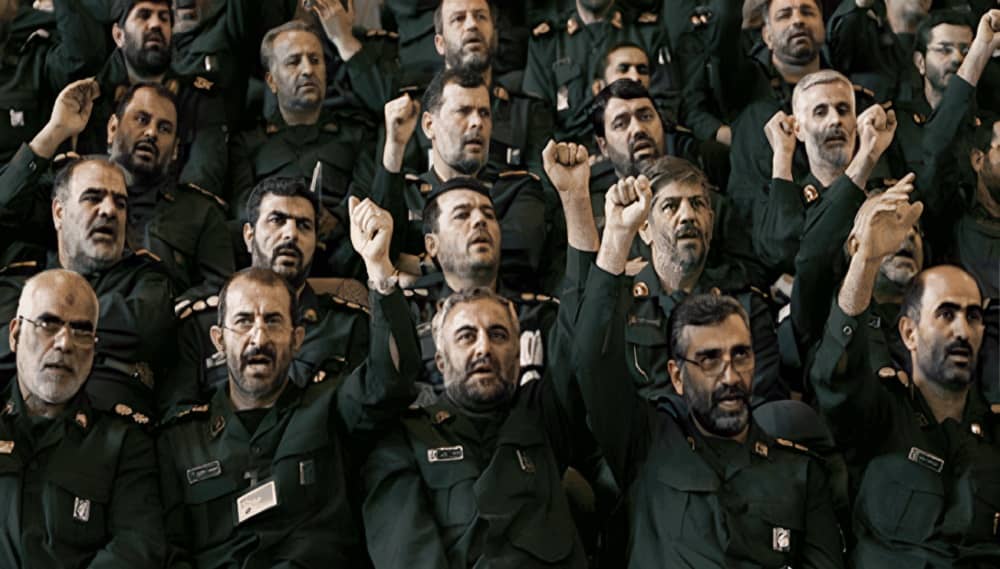
This hardening of the regime’s stance is being deliberately framed as “consolidation” by its soft-power soldiers in the West. A recent New York Times report from April 23, 2026, titled “A New Era and New Leadership: The Generals Who Are Running Iran,” serves as a textbook example of this narrative laundering. The article portrays the Islamic Revolutionary Guard Corps (IRGC) as a “battle-hardened collective” that has successfully “contained” external threats and is now “managing the country” like a corporate board of directors. By depicting the IRGC as an entrenched, unified force that has effectively sidelined political rivals, the piece plays directly into Tehran’s psychological strategy. The goal is to convince world leaders that the regime is an immovable monolith—a “fait accompli” that the West must accept and negotiate with, rather than a system on the brink of collapse.
#Iranian Officials Sound Alarm Over “Psychological War” Amid Fears of Collapsing Morale Among Forceshttps://t.co/FMtAdSTToT
— NCRI-FAC (@iran_policy) January 10, 2025
The War of Leaks
The infighting moved from the shadows to the public sphere through a campaign of “intentional leaks” and unprecedented warnings within state-aligned media. Factions within the regime, terrified of a total social explosion, are now weaponizing the state’s own catastrophic data to force a retreat. State-linked economists in outlets like Donya-e-Eqtesad and Shargh are now publicly debating “meltdown scenarios,” warning of a shift from chronic inflation to triple-digit hyperinflation reaching 123%. These reports, coupled with the Ministry of Labor’s admission that the conflict has already vaporized one million jobs, are not intended to inform the public. Instead, they act as a calculated pressure point against the regime’s leadership, serving as a warning that the state is approaching a “meltdown point” that even the most loyal Basij forces cannot contain.
For the core decision-makers, however, any step back is viewed as “committing suicide to avoid death.” The regime understands that its base—a tiny percentage of the population comprised of state bureaucracy, the IRGC, the paramilitary Basij, and regime-tied families—is only loyal as long as the state appears invulnerable. To concede to Western demands or to reopen the Strait of Hormuz under pressure would be a public admission of defeat. This would instantly demoralize the regime’s base. The leadership believes that if they lose the “fear factor” within their own ranks, its security apparatus will collapse from within before the first protester reaches the gates of the Bayt.
#Khamenei’s Speech Reflects Iranian Regime’s Morale Crisis After Strategic Loss in #Syriahttps://t.co/9EwLTl0Ydv
— NCRI-FAC (@iran_policy) January 1, 2025
This parasitic existence—where the regime siphons the last of the nation’s resources to feed its base while the entire nation faces a crushing economic emergency—is reaching its expiration date. The regime’s attempt to project strength through threatening regional neighbors and blocking international shipping is a desperate bluff. They are weaponizing the global oil market not from a position of power, but as a last-ditch effort to force a “no-war-no-peace” status that preserves their internal structure.
Why Soft-Power Illusions Cannot Save the Clerical Dictatorship
The current paralysis confirms that the clerical dictatorship has no “moderate” or “reformable” path left. The infighting over negotiations is merely a debate over which form of suicide to choose.
Ultimately, no amount of soft-power narrative spinning or IRGC bravado can resolve the fundamental weakness of a regime that has lost its domestic legitimacy. The resolution will not come from foreign think tanks or even the mightiest air armada, but from the organized Resistance and the people of Iran, who recognize that the regime’s current “strength” is nothing more than a house of cards waiting for the wind.