

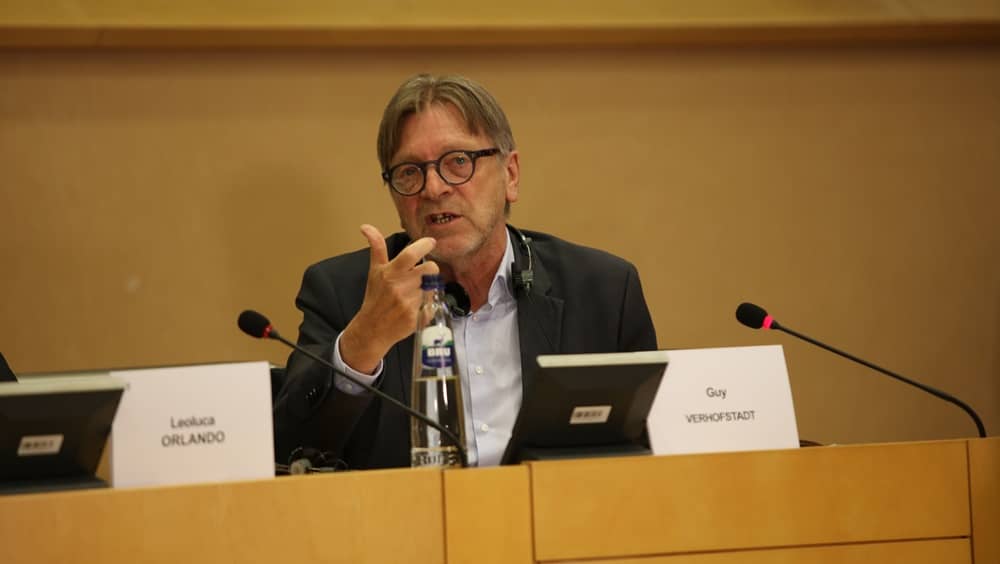
Speaking at a conference in the European Parliament in Brussels on April 22, 2026, former Belgian Prime Minister and ex-MEP Guy Verhofstadt sharply criticized the Western appeasement policy towards Iran, arguing that it has failed to deliver results.
Verhofstadt described the situation as the consequence of a “lack of serious strategy” by Europe and called for a new approach centered on what he termed “active engagement.” This would include formally recognizing the Iranian opposition and Resistance as legitimate representatives of the Iranian people, expanding sanctions against all members and supporters of the Islamic Revolutionary Guard Corps, and setting clear limits on Iran’s nuclear program.
He also urged the European Union to take a more assertive role, including securing maritime routes such as the Strait of Hormuz and breaking what he described as a “criminal silence” on executions in Iran. Verhofstadt called on lawmakers to draft a new parliamentary resolution to push member states toward a unified and decisive Iran policy.
Excerpts of Guy Verhofstadt’s speech follow:
Former Prime Minster, @guyverhofstadt:@Maryam_Rajavi thank you for being present at the building of the @Europarl_EN, but I would like that next time you would be invited to the @Coe. Because the problem we are facing today is the war and the brutal regime in Iran, and also the…
— Friends of a Free Iran – EP (@FOFI_EP) April 22, 2026
Thank you. Well, first of all, Mrs. Rajavi, thank you very much for being present in the building of the European Parliament.
But I would like that next time you are invited in the building of the European Council once instead of the European Parliament. Because let’s be honest, the problem we are facing today is naturally the war and the brutal regime in Iran but is also the lack of a serious alternative strategy from the European Union on Iran. And that’s also the topic of this conference. What could be a European strategy in this brutality that we see? At one hand, the appeasement policy has led to nothing at all. It has led to enormous proxy wars, to a further nuclearization of the mullah regime and especially to further oppression. Look to the executions of the Iranian people. That is the consequence and the result of the appeasement policy that we have seen especially from the European countries and from the West for the last, not years, but even decades.
So, the question of this conference has to be, and therefore that I said we would be better that we all go now to the European Council building to tell it there, and not only to the parliamentarians here, is what is then that new strategy? What are the different elements?
And it could be a good, and I say that to all my former colleagues here present, that we work on a new resolution as fast as possible. It’s the right moment. You feel that. The previous, if I don’t mistake, was from February, I think, on Iran. That’s not the first one. In the European Parliament, the previous parliament, we did four or five exactly most of the same resolutions. And at that moment, I can tell you, the governments never listened. Never.
Former Belgian PM @guyverhofstadt outlines a bold strategy for Europe:
– Designate #IRGCterrorists
– Impose tougher oil and banking sanctions
– Expand personal sanctions on regime officials
– Recognize Iran's democratic alternative and standing with its organized resistance pic.twitter.com/gCi2730SbO— NCRI-FAC (@iran_policy) December 24, 2024
There was an enormous opposition between the parliament who had 500, 600 people voting for a resolution asking that the revolutionary guard would be designated as a terrorist organization, and then the silence from the council. It’s only because there were 30,000 victims and deaths in the winter, in this winter, that finally our governments started to change their positions, prepared by whom? By diplomats, by professional diplomats for at least two decades. Without in fact looking to the reality on the ground. So, I think it’s a good moment, even when the first, so, and it had some effect, the resolution. Finally, I would say, after the fifth attempt, the revolutionary guard has been designated as a terrorist organization. Maybe it’s the good timing now because of the stalemate that we see in the conflict for the moment and the devastating economic consequences of it.
That the parliament is doing a new resolution, not talking at this moment about the revolutionary guard because that has been obtained, but about what would be in the eyes of the parliament a good strategy for the council. And why from the council? Because yeah, we are in Europe. Foreign policy is a question of the competence of the member states and still governed by a bloody rule of unanimity which makes it impossible to have tough decisions, common decisions on European policy.
Belgian MEP @guyverhofstadt: My appeal to the EU leaders is for a new, bold, and courageous strategy, as courageous as the #Iranian people themselves. We need an effective approach to support their fight for freedom. #FreeIran2024 pic.twitter.com/DGieghkPal
— NCRI-FAC (@iran_policy) July 5, 2024
But the parliament can do that. Because the parliament here, it is majority or a huge majority who can at least oblige the high representative and the FAC, the Foreign Affairs Council of the European Union, to change their position. Because mainly our governments are still in appeasement mode. They are still in an appeasement mode. And certainly, because of the war and so on and everybody talks about peace. So, peace and appeasement become the same word. What’s not true naturally.
No, it’s appeasement who was the source of the lack of peace and everything what happened and the war. It’s because we did too long appeasement that we are now in a war in the Middle East and not the opposite. So, peace and appeasement are two different things. What is then the alternative? I last time I launched the idea of for from a concept, the concept would be active engagement. Active engagement of Europe, that doesn’t mean with weapons and so on. Active engagement with the Iranian people, the opposition in Iran and the organized resistance. That would be the basis for a new strategy.
What does that mean concretely? And have to find their way in the resolution in the next weeks, the fastest as possible I would say, because it’s an opportunity now to do it. So next week you are in Strasbourg. I will not be there unfortunately. I’m not longer in the parliament, but it’s a good moment, there is time there in Strasbourg to work on such a resolution. The first thing would be that the council and the high representative finally opens and recognizes that the real representative is not the mullah regime, but that’s important. It’s only a formal thing, but formal things are important in politics. Recognize opposition, Iranian people, resistance as the real representatives of the Iranian people.
Former #Belgian PM @guyverhofstadt calls on the EU to shift its policy and recognize the #NCRIAlternative’s Ten-Point Plan. He emphasizes that the Iranian people deserve a secular, democratic republic, not a return to past dictatorships. pic.twitter.com/gXUhjDp5ch
— NCRI-FAC (@iran_policy) March 17, 2026
That’s the first thing, a formal thing. The second, the second is to go further on the issue of the revolutionary guard as a terrorist organization. That means something, no? That means that everybody who is a member of the revolutionary guard needs to fall under the sanctions regime. Otherwise, it doesn’t mean anything. You can say oh, you’re a terrorist organization and everything goes on. But what does it mean then to be you’re not punished because you need there has to be at least a possibility of punishment if you are continuing to support the mullah regime.
And that means spreading that sanction regime. Not a few hundred like it is now. And the most sanctions that has been taken now were because Iran helped Russia in its aggression against Ukraine. Not because it is a murderer regime against its own people. So that we need to change. Sanctions broadly, massively against all those who are supporting that mullah regime, not only because of Russia.
The third is that Europeans have to look to the devastating effects of this war. So, we need to think about a European-led operation in the Strait of Hormuz ourselves in a certain way. To be neutral in that respect. Because otherwise you’re not, if you don’t do it yourself, you’re at one or the other side in that war. Four, the nuclear talks. The reality is that if there is an agreement, even between Trump and the Iranian regime, they will the mullahs will never, never, never do what they say.
They will continue their search for a nuclear weapon. Because why do you need to have uranium with an enrichment of more than 20 percent? Only when it is less than 20 percent is civil. Every time when it’s more than 20 percent, there is a reason for. And the reason can only be one. That is to have later on further enrichment and to go to more than 60, more than 70 and then to a full-blown nuclear weapon. So, we have to be clear on that. We will recognize as Europeans, part of our strategy, nothing that goes beyond possession of whatever nuclear material that goes beyond 20 percent. That’s the fourth point. And the fifth point is I want a statement about Iran about that by European the European Council. Also breaking the silence. Because it’s mainly a silence for the moment that we hear, I would say.
At the EP conference on November 22, MEP @guyverhofstadt strongly criticized the European policy toward the clerical dictatorship in #Iran and advocated for regime change. pic.twitter.com/KFUI8ywV64
— NCRI-FAC (@iran_policy) December 1, 2023
But you hear not silence, but sometimes a silence can be a more devastating signal in politics than speaking whatever beautiful phrase and that is happening today. Certainly, I find it nearly criminal that we say nothing about the executions. Nothing about the executions. I did not hear anything. I personal retweeted a few things that Mrs. Rajavi said but that’s I’m an individual, an individual European. And everybody of you has done that. But I want to hear the European Council, the Foreign Affairs Council, the high rep saying things about that and putting that as a firm condition that there will never, never, never be anything anymore if these executions not stop tomorrow.
Because it’s that this way that in fact the mullah regime is brutalizing its own population by the fear, the anxiety that they are creating by such inhuman practices. And so, my message to all the former colleagues who are here is let’s try to start on that. That’s in my opinion a far more productive step to be taken than to organize I don’t know whatever hearing in the Foreign Affairs Committee of this parliament where for months we are discussing can we invite X, can we invite Y, can we invite Z. What will that change in the world and in Iran tomorrow? Nothing at all. So, my plea to the colleagues is let’s work in the coming weeks to that with that content around the whole question who is invited here in this house. And maybe that will do the same have the same effect as the previous resolution. Thank you.