

Three-minute read
For a system built around the fiction of a single, unquestioned political center, the quarrel over Abbas Araghchi’s New York contact with U.S. envoy Steve Witkoff has become unusually revealing. State television acknowledged the encounter. More importantly, Yahya Rahim Safavi, a senior military adviser to Mojtaba Khamenei, said the leader had given the government room to negotiate: “If the Leader has deemed it expedient and given the government a free hand in the negotiations, that is a very significant act of prudence.”
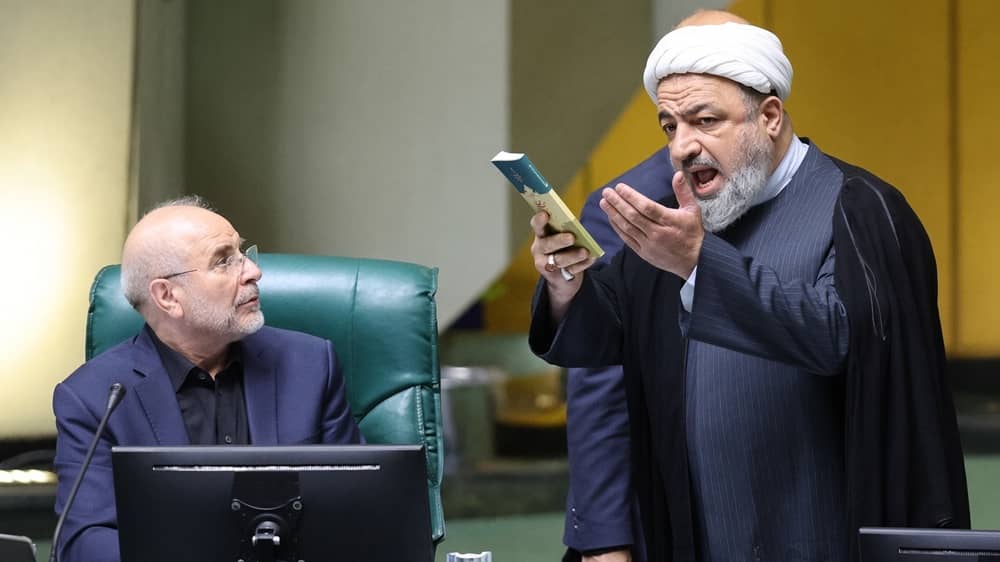
Yet the men and outlets that most loudly invoke obedience to the Leader promptly turned on Araghchi. Tasnim accused him of acting without authorization. MPs Amir-Hossein Sabeti, Ebrahim Rezaei, Hossein-Ali Haji-Deligani and Ali Khazarian demanded explanations or parliamentary action; Sabeti formally registered an impeachment motion. The hardline Nobonyad attacked the New York diplomacy as weakness, while other factional media questioned why Tehran had handed Washington the political benefit of a meeting. This was no longer one newspaper grumbling at a minister; it had become a coordinated assault from MPs, insiders and factional mouthpieces.
That is what makes the episode consequential. If Araghchi acted within a decision approved at the top—as Safavi and other insiders maintain—then the campaign against him is also a challenge to that decision. “The Leader’s wishes” begin to look less like an uncontested command than a language every faction borrows when convenient. The very people who present themselves as guardians of Mojtaba Khamenei’s authority are showing how readily they can disregard it when factional interests intervene.
Power Dynamics in Iran and #MojtabaKhamenei’s Inner Circlehttps://t.co/eTfcnFH14Z
— NCRI-FAC (@iran_policy) June 3, 2026
The Fight Spreads Beyond Araghchi
The attacks followed Masoud Pezeshkian home from New York. Rasaee accused the regime’s president in parliament of contradicting the leadership by telling American media that Iran was not seeking Trump’s assassination. “How can you give Trump a blank check?” he demanded, before asking Pezeshkian, “Which republic are you actually president of?” Hardline media simultaneously assailed Pezeshkian’s diplomatic messaging, while Nobonyad described “weak diplomacy” as a prelude to another war.
Hassan Rouhani was also drawn into the same factional fight. Rasaee demanded to know why the former president remained “free,” insisting that the judiciary pursue bigger political figures instead of limiting itself to MPs like himself, Sabeti and others. He was speaking after receiving a ten-month prison sentence—a punishment he treated almost theatrically, telling colleagues before reporting to prison: “Be sure to bring the compote.”
His levity says something about elite punishment inside the system. Rasaee could denounce rivals, mock his sentence and promise to continue fighting from within the same political order. Ordinary defendants encounter a far harsher judicial machinery: Iran still enforces corporal punishments including finger amputations for theft, and Amnesty International documented three such amputations in July 2025 after proceedings it described as grossly unfair. The contrast makes the current spectacle look less like judicial impartiality than another arena in the factional contest.
NCRI Editorial: Iran and #Mojtaba_Khamenei: Succession Without Legitimacyhttps://t.co/NPnYW3WEPT
— NCRI-FAC (@iran_policy) March 9, 2026
Impeachments and the War Inside the System
The battle is spreading through the cabinet. Labor Minister Ahmad Meydari’s impeachment has advanced after a four-hour parliamentary committee session failed to satisfy his critics; 64 lawmakers were reported to have backed the initiative, while Araghchi’s own impeachment drive is gathering signatures. A government already under wartime pressure is thus being pulled apart by rival power centers inside the establishment itself.
Yet beneath the denunciations of negotiation, Tehran has plainly not abandoned it. It continues dealing with an American administration that its own officials accuse of responsibility for the deaths of Ali Khamenei and Qassem Soleimani. Mohammad Bagher Ghalibaf stated the doctrine openly on September 20: “The dichotomy of war or negotiation is not real; we must both fight and negotiate.” Military pressure, he explained, should create advantages that diplomacy can then consolidate.
That admission strips away much of the rhetorical theater. Missiles, maritime pressure and diplomacy are not rival policies but components of the same bargaining method: impose costs, convert those costs into leverage, then negotiate over their removal. At the same time, factions that profess absolute loyalty to Mojtaba Khamenei are openly attacking decisions reportedly taken with his approval—a measure of how deeply the internal struggle is eroding the authority they publicly invoke.
"The Iranian political establishment is experiencing unprecedented institutional friction following the transition of authority to Mojtaba Khamenei," writes @MansoreGolestan.https://t.co/6UZCU4cjdx
— NCRI-FAC (@iran_policy) June 30, 2026
When Coercion Becomes the Bargaining Chip
The strategic danger is that concessions made after escalation can validate precisely this method. If threatening regional stability, disrupting trade or increasing military pressure is followed by political or economic relief, Tehran can reasonably conclude that coercion improves its bargaining position.
A pressure-centered response seeks to reverse that calculation by reducing the gains available from coercion and increasing its costs through tighter sanctions enforcement, deeper diplomatic isolation and sustained human-rights accountability.
The significance of Tehran’s present weakness is therefore not that it has abandoned confrontation, but that it is pursuing confrontation and negotiation while increasingly fractured at home. The more its factions fight over diplomacy, ministers and even the meaning of the leader’s orders, the less convincing its posture of strategic confidence becomes. The central question is whether these internal contradictions and factional conflicts within the regime are primarily the result of mounting external pressure, or whether they stem more fundamentally from the weakness of the new Supreme Leader.