

Three-minute read
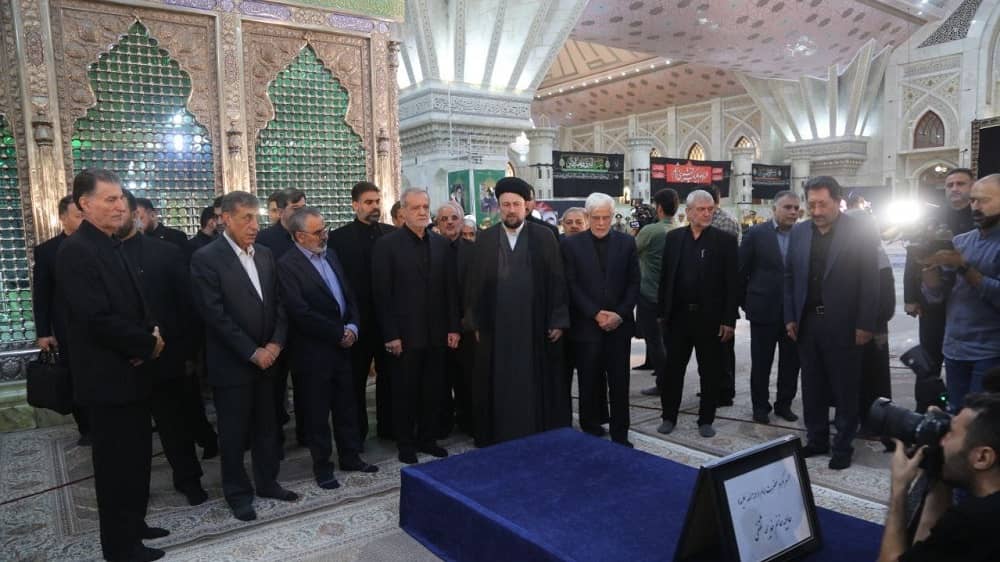
The internal power struggle within the Iranian regime continues to escalate, revealing the deepening divisions among various factions. On August 24, Masoud Pezeshkian, the regime’s newly appointed president, once again attempted to demonstrate his loyalty to Supreme Leader Ali Khamenei by taking his entire cabinet to visit the grave of Ruhollah Khomeini, the former Supreme Leader. During his visit, Pezeshkian warned rival factions against playing into “the enemies’ hands,” stating, “The enemy is trying to create division in society, and all their efforts are aimed at preventing us from becoming united… We must act to avoid falling for the enemy’s tricks and maintain unity and cohesion.”
However, Pezeshkian’s remarks in parliament about the cabinet’s formation, particularly his suggestion that all ministers were appointed by Khamenei, have sparked significant backlash. The newspaper Kayhan criticized Pezeshkian’s comments, arguing that they were misleading and provided ammunition for the enemy.
The paper, whose editorial guidelines are dictated by Khamenei’s Office, wrote, “Pezeshkian’s claims of full coordination of the cabinet with Iran’s leader led to criticism, as it suggested for the first time that the president was openly acknowledging the cabinet’s complete alignment with the leader.” This assertion has been used by outlets like Euronews to question the independence of the presidency, asking, “Is the President merely a caretaker?”
Pezeshkian’s Admission Exposes #Tehran’s Fake Democracy, Sparks Backlash Within the Regimehttps://t.co/kRiE73WRmG
— NCRI-FAC (@iran_policy) August 22, 2024
Dismissing Kayhan’s critique, Arman newspaper defended Pezeshkian, suggesting that the backlash from figures like Kayhan’s editor-in-chief reflects dissatisfaction with the approval of all the proposed ministers of the new government. “Hossein Shariatmadari’s claim reflects his displeasure with the approval of all the proposed ministers of the 14th government,” Arman noted.
Furthermore, senior regime clerics and representatives of the Supreme Leader have issued stern warnings to the new president, emphasizing the need to follow Khamenei’s directives.
Ahmad Alamolhoda, the Supreme Leader’s representative in Mashhad, cautioned on August 23, “God willing, we hope that our dear ones in the government pay attention to this point and know that their success depends on one principle: not deviating from the leadership. They should examine past governments since the victory of the revolution and take lessons from those who deviated from the leadership; they not only failed in management but also became detested by the people.”
Similarly, Majid Pourandokht, a Friday prayer leader in Zabol, said, “Since all the proposed ministers have received votes of confidence, from now on, the ball is in the government’s court, and the president and ministers can no longer say we can’t, or it’s not possible, or make excuses that someone has hindered them from undertaking things. No, it’s a strong endorsement, and your work has begun. There is no room for any excuses or justifications.”
Pezeshkian’s Cabinet Is Testament to #Khamenei’s Unquestioned Authority Over #Iran’s Governancehttps://t.co/vyebHqPZc0
— NCRI-FAC (@iran_policy) August 22, 2024
Meanwhile, Gholam-Hossein Mohseni-Eje’i, the head of the Judiciary, praised the parliamentary vote, describing it as a significant achievement, calling the approval of the cabinet a “great blessing.” However, his comments were seen as an attempt to mitigate the controversy surrounding the influence of Khamenei over the cabinet appointments.
Despite these attempts to control the narrative, the debate over the cabinet’s approval continues. Morteza Mahmoudi, a member of parliament, defended the Supreme Leader’s influence, arguing, “The cabinet approved by the parliament is not the Leader’s cabinet. We should not attribute the future weaknesses, deficiencies, and performances of this government to the Leader’s consultations.” He criticized Pezeshkian for publicly discussing the Leader’s involvement in the parliamentary session, stating, “It would have been better if Pezeshkian had refrained from mentioning these consultations in the parliamentary session.”
The controversy surrounding the cabinet appointments has also led to significant reactions from other factions. On August 23, Etemad Online reported that the Student Basij of Amirkabir University of Technology issued a statement demanding the dissolution of the Islamic Consultative Assembly. They argued, “The vote of confidence by the parliament to a candidate who has not disavowed his anti-state background, along with votes for ‘ineffective’ and ‘minimal’ options, indicates a ‘lack of independence’ and a ‘strategic mistake.’ With these circumstances, either dissolve the parliament or hand over its guardianship to the godfathers.”
Vetting #Pezeshkian’s Cabinet in #Iran Exposes Khamenei’s Grip and Regime Strifehttps://t.co/ZDQBgwc3zv
— NCRI-FAC (@iran_policy) August 20, 2024
Additionally, former parliament vice-president Ali Motahari weighed in, suggesting that Pezeshkian was not attempting to undermine the Supreme Leader but rather providing transparency about the cabinet’s formation. “It is not that Pezeshkian has used the Leader for his advantage; rather, he revealed the realities of the cabinet’s formation and provided clarification,” Motahari explained.
The faction associated with Khamenei sees Pezeshkian’s admissions about the Supreme Leader’s decisive role in appointing the cabinet as a devastating blow to the regime’s dwindling legitimacy. They are deeply concerned that these revelations could tarnish Khamenei’s authority as the government struggles and potentially fails. Meanwhile, the opposing faction is scrambling to defend Pezeshkian, framing his comments as necessary transparency rather than insubordination. Despite Pezeshkian’s continuous attempts to affirm his loyalty, those aligned with Khamenei remain wary, issuing stern warnings and insisting on strict adherence to their directives. This intense infighting and lack of cohesion among the regime’s factions suggest a grim outlook for a government already beset by internal crises and facing an uncertain future.