

Three-minute read
A growing body of admissions from senior officials, state media reports, and developments across the country suggest that Iran’s clerical establishment is grappling with more than an economic downturn. Senior officials are openly warning of external pressure and internal divisions, while state-controlled media have highlighted signs of a widening gap between the regime and society.
An Economy Under Mounting Strain
On September 15, 2026, Mohammad-Reza Aref, the regime’s first vice president, acknowledged that sanctions continue to exact a significant cost, stating that the country must buy goods “10 to 15 percent more expensive” and sell exports “10 to 15 percent cheaper.” The admission came amid growing concern over inflation, currency depreciation, and deteriorating living standards.
The government’s fiscal challenges are also becoming harder to conceal. Government spokeswoman Fatemeh Mohajerani disclosed that nearly 310 trillion tomans in projected tax revenues had not been realized during the first half of the year. She also declined to discuss oil revenues, citing wartime conditions, an indication of the sensitivity surrounding the regime’s financial position.
"Iran’s ruling establishment is confronting fresh domestic pressure as a deadly #security operation in Mehran, another state-approved tariff increase and new evidence of collapsing purchasing power expose strains on both the state and ordinary Iranians," writes @MansoreGolestan.…
— NCRI-FAC (@iran_policy) September 10, 2026
Meanwhile, Iran’s gasoline imbalance is worsening. Mohajerani acknowledged that domestic production stands at roughly 100 to 110 million liters per day while daily consumption has reached about 140 million liters. The resulting gap has forced the government to spend an estimated $7 billion on gasoline imports even as it struggles to contain rising prices and budget deficits.
Additional signs of economic distress have emerged from within the regime itself. Elias Hazrati, head of the government’s Information Council, revealed that the administration inherited massive liabilities, including 120 trillion tomans in Health Ministry debt and more than 200 trillion tomans in Energy Ministry obligations. Separately, parliamentary budget committee member Hadi Ghavami said about $3 billion in overseas funds had failed to return to the country’s banking system.
The Cost-of-Living Crisis Deepens
The burden is increasingly visible in everyday life. On September 15, 2026, Mehdi Pir-Salehi, head of the Food and Drug Administration, acknowledged that medicine prices have risen by an average of 103 percent this year, while patients’ direct expenses have increased by 35 percent. He attributed part of the pressure to reduced subsidized currency allocations and mounting obligations on insurers.
Health Minister Mohammadreza Zafarghandi similarly linked rising drug costs to sanctions and wartime conditions, stating that transportation expenses have increased tenfold in some cases because pharmaceuticals must be flown into the country rather than shipped through normal channels. “We cannot expect to live under wartime conditions as if conditions were normal,” he said.
The ruling establishment is simultaneously confronting armed insecurity, accelerating #economic pressure and an internal political struggle intense enough for its own officials to speak openly of presidential removal, a “coup” and the danger of an “explosion.”
by Dr.…— NCRI-FAC (@iran_policy) September 12, 2026
At the same time, structural problems continue to accumulate. Water officials in Mashhad warned that reservoirs supplying Iran’s second-largest city have fallen to just 2 percent of capacity, leaving only 20 million cubic meters of water in dams designed to hold 1.2 billion cubic meters.
A More Restive and Volatile Society
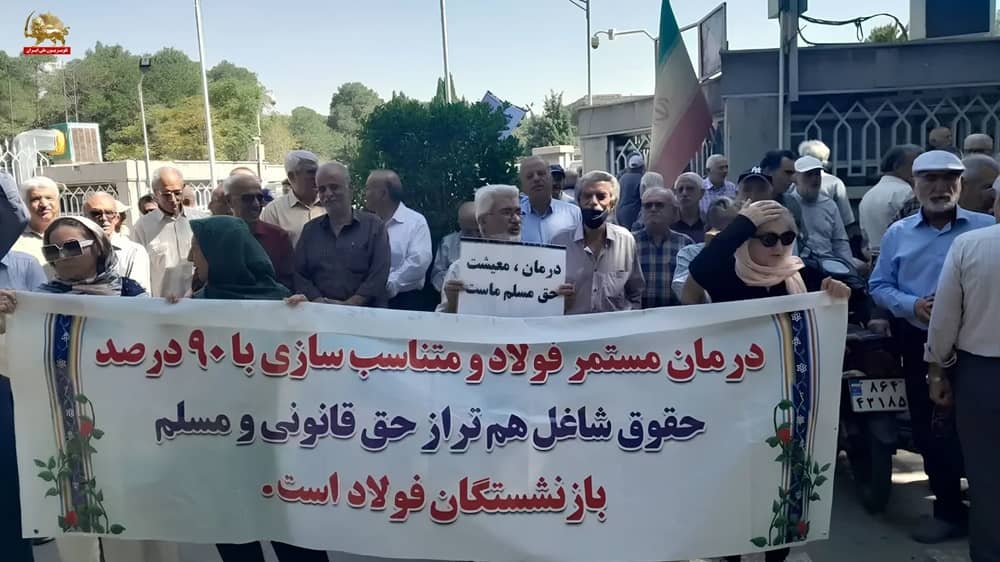
Economic pressures are increasingly being accompanied by open signs of social discontent. Retired steelworkers in Isfahan staged demonstrations demanding better living conditions, chanting, “Livelihood is our absolute right” and “Promises are enough, our table is empty.” Housing applicants protested in Kashan, while unemployed workers in Sirjan said hundreds had lost their jobs with no response from authorities.
Official concern about renewed unrest surfaced during a government press conference when a journalist warned that fresh economic pressures could repeat the “bitter experience” of last year’s protests, at a time when many families “can no longer withstand another price shock.” The warning was aired on state television, underscoring growing anxiety about the social consequences of worsening economic conditions.
"Daily #IranProtests, collapsing purchasing power, fuel imbalances, oil-sector allegations, armed clashes and factional warfare are converging—and the dominant response from hardliners is increasingly one of tighter internal control and greater confrontation rather than…
— NCRI-FAC (@iran_policy) September 13, 2026
Those concerns coincided with widespread strikes in Kurdish regions marking the anniversary of the death of Mahsa (Jina) Amini. Businesses reportedly closed across Saqqez, Sanandaj, Mahabad, Bukan, and several other cities. Reports described Saqqez as heavily securitized, with roads blocked, checkpoints established, and extensive security deployments aimed at preventing public gatherings.
The regime is also confronting continuing security challenges in peripheral regions. In Zahedan, regime-linked cleric Yousef Gorgij, who had reportedly maintained close ties with state security institutions, was killed by armed assailants outside his residence. The rapid response by the Islamic Revolutionary Guard Corps, which issued statements portraying the killing as a threat to security and unity, highlighted official concern over instability in the province.
A Crisis of Trust
Alongside economic and security pressures, the regime is admitting losing the battle over public opinion. State-affiliated ILNA reported on September 15 that between 60 and 70 percent of Iranians no longer consume state television content. The agency described the problem not merely as a decline in viewership but as a crisis of “trust” and public persuasion.
Iran's #fuel hike takes effect: station-card gasoline doubles to 10,000 tomans/liter. Pumps lack 5-digit displays; queues form. Ahvaz rail worker self-immolates after 5 months unpaid wages and dismissal. Two Basij killed in Sistan-Baluchistan. Despair and strains deepen.
by…— NCRI-FAC (@iran_policy) September 8, 2026
The regime’s president Pezeshkian appeared to acknowledge the scale of the challenge when he warned that foreign adversaries were trying to force Iran into submission while “from inside, they want to increase our differences.” His call for “unity, cohesion and solidarity” reflected growing concern that economic hardship, social unrest, security incidents, and declining legitimacy are reinforcing one another.
Taken together, recent admissions by officials and reports in the regime’s own media portray a state confronting simultaneous fiscal, economic, social, and political pressures. Inflation, debt, shortages, protests, regional unrest, and declining public confidence are no longer isolated challenges. Increasingly, they are converging into a broader crisis that Tehran can no longer contain.