

Three-minute read
Human rights conditions in Iran have deteriorated sharply in 2026. Following the nationwide protests of January 2026, the authorities have intensified arrests, torture, enforced disappearances, unfair trials and executions. Women remain at the center of both resistance and repression, while young protesters arrested during the uprising are increasingly being sent to the gallows.
Women at the Centre of Repression
Women continue to face systematic discrimination under Iranian law, including unequal rights in marriage, divorce, inheritance and child custody. Compulsory veiling remains a central instrument of state control. The so-called Chastity and Hijab Law expanded penalties beyond warnings and fines to include denial of public services, restrictions on employment and education, and criminal prosecution, while the law assigns enforcement roles to multiple state institutions and pressures businesses and public bodies to cooperate.
Iran HRM reported that the authorities continued to restrict women and girls after the 2022 protests through intensified mandatory-hijab enforcement, criminal prosecution, surveillance and pressure on women activists. The so-called Chastity and Hijab Law created broader enforcement duties for state institutions and imposed penalties on women, businesses and public bodies viewed as non-compliant.
In Isfahan’s Shohada Square case, 10 uprising prisoners—including Taraneh Rahimi—were sentenced to death, while Romina Rahimi and five other co-defendants received heavy prison terms; Leila Abolhasani was separately sentenced to death in Isfahan.
Women are also increasingly affected by the wider execution campaign. Iran HRM documented 92 executions in August 2026, including six women, and reported that women, juvenile offenders, ethnic minorities and protest-related defendants were among the victims.
Sudden Transfer of Parisa Kamali to Bandar Abbas Prison Without Prior Notice#IranHumanRights;@UN_SPExperts;@drmaisato;@profbensaul;@volker_turk;@UNHumanRights ;@AmnestyIran;https://t.co/bhrH005zUl pic.twitter.com/jUH8vdfOzt
— Iran Human Rights Society (@iranhrs_en) September 10, 2026
Executions of Young Protesters
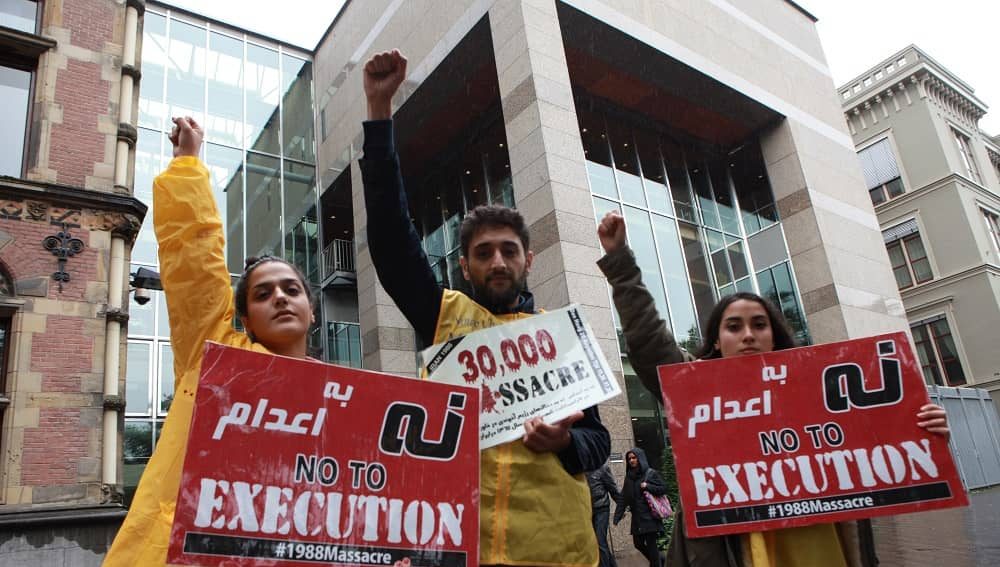
Iran HRM also reported that Iranian authorities had documented at least 38 political executions since late February 2026, including 29 protest-related or politically motivated executions and 9 PMOI-related executions, with national-security and political accusations repeatedly used to justify death sentences.
According to human rights organizations, several young protest-related defendants are among those executed or at imminent risk, including Erfan Esfandiari, 18, and Ghaem Hosseini, 21, both linked to Isfahan protest cases. NCRI also reported the execution of Arvin Kheirkhahan, a January uprising detainee, and listed other young prisoners among those executed during the late-July and early-August surge.
The regime’s Supreme Court confirmed death sentences for 12 protesters in the fabricated “Alikhani Square” case in Isfahan on 5 July, with many of the condemned described as young and some born in 2006 and 2007. On 28 July, Abolfazl Sepahi and Amir Hossein Safari were publicly executed in Isfahan.
The execution drive has continued into September. At least 22 prisoners were executed on September 2, 6, 9 and 13: eight on September 2, four on September 6, four on September 9 and six on September 13. One of those executed on September 6 was Fatemeh Jahangard, a 40-year-old woman.
Arghavan Fallahi’s Appeal has been Rejected and Death Sentence Remains in Effect
Arghavan Fallahi’s appeal, concerning the political prisoner held in Evin Prison who had previously been sentenced to death, has been rejected by Iran’s Supreme Court.
The NCRI Women’s Committee… pic.twitter.com/H4C30fdv75
— Women's Committee NCRI (@womenncri) September 15, 2026
Arghavan Fallahi: Immediate Risk
The case of Arghavan Fallahi illustrates the danger facing young female political prisoners.
The 25-year-old political prisoner and PMOI supporter was sentenced to death on July 1 by Branch 15 of the Tehran Revolutionary Court on the charge of baghi (“armed rebellion”). According to an NCRI statement, she was arrested on January 25, 2025, spent about five months in solitary confinement under interrogation and physical and psychological torture, and was later held in the women’s ward of Evin Prison. In late August, the Supreme Court upheld her sentence, and on September 11, her request for retrial was rejected, leaving her at immediate risk of execution.
Continuing Repression
The execution campaign forms part of a wider system of repression. Iran HRM described an August 2026 deterioration marked by violent prison raids, enforced disappearances, denial of medical care, inhumane detention conditions and intensified pressure on political prisoners, while the “No to Execution Tuesdays” campaign continued across dozens of prisons. Internet restrictions and threats against families have further hindered documentation and increased detainees’ vulnerability.
Iran’s human-rights crisis is a convergence of political repression, discrimination against women and an expanding use of capital punishment. The execution of teenagers and young adults, together with death sentences against women political prisoners, underscores the need for sustained international pressure to halt executions and ensure accountability for torture, enforced disappearances and grossly unfair trials.