

Three-minute read
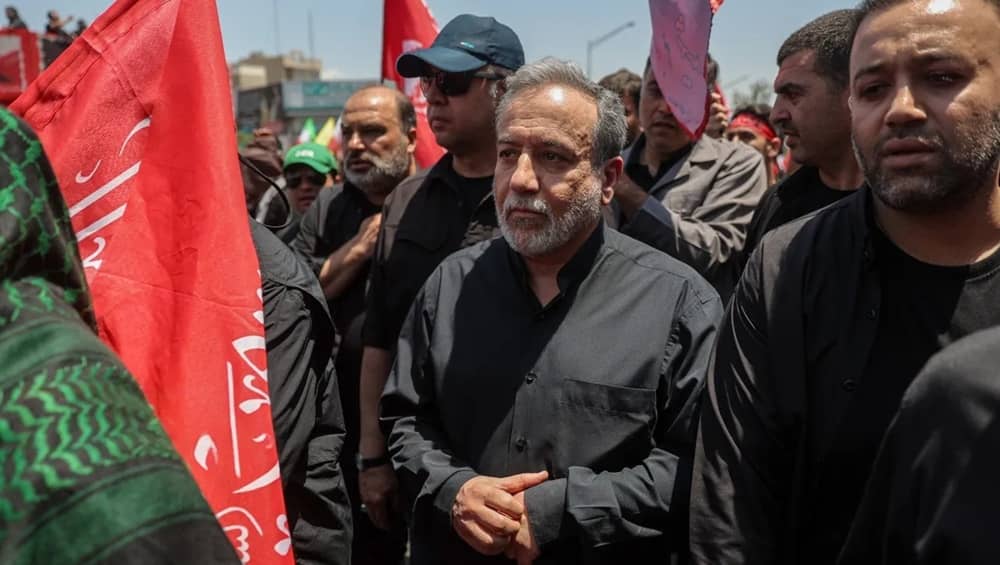
Four months after the death of Supreme Leader Ali Khamenei, the clerical regime’s desperate strategy to stabilize its fracturing dictatorship has completely backfired. In a desperate bid to dampen a multitude of intertwined domestic and international crises, the clerical dictatorship launched a massive, week-long delayed funeral simulation—a calculated political-security maneuver to forcefully install Khamenei’s son, Mojtaba Khamenei, as the hereditary successor. Yet, instead of projecting an illusion of absolute control, this highly staged theater has blown the lid off a vicious internal “war of thugs” that threatens to tear the regime apart from within.
The deep systemic cracks erupted into public violence during the ceremonies in Tehran, where the regime’s top officials faced physical assaults from state-mobilized radical factions. The regime’s president Masoud Pezeshkian and Foreign Minister Abbas Araghchi were pelted with stones by crowds chanting “Death to the compromiser,” “Dishonorable,” and “Death to the traitorous country-seller”. The state-run newspaper Mardom Salari openly verified the chaos in its July 7, 2026, edition, running the headline “Hardliners’ attack on Araghchi during the funeral procession,” exposing fierce, fundamentalist rage against any diplomatic engagement with Washington.
This political paralysis is further compounded by a devastating theological rebellion from the regime’s own religious base. On July 7, 2026, Abdollah Javadi Amoli delivered a stunning rebuke by intentionally omitting the traditional phrase, “O Allah, we know nothing but good from him,” during the funeral prayers—an explicit refusal to validate Khamenei’s bloody legacy.
"#Khamenei’s legacy is not found in the choreography of his funeral, but in the graves of protesters, the execution chambers of Iranian prisons, the blinded eyes of young demonstrators, the silenced newspapers, the persecuted minorities, the abused women, and the ruins left by…
— NCRI-FAC (@iran_policy) July 7, 2026
Meanwhile, hardline parliamentarian Hamid Rasaee took a stance on July 6, 2026, to lambast the event’s organization as “absolutely disastrous,” warning the transition team that “officials must move in such a way that it doesn’t reach the point where Imam (the leader) turn around and say: ‘In principle, I had another opinion'”. By explicitly weaponizing Mojtaba Khamenei’s hardline stance on the pending nuclear memorandum of understanding (MOU), Rasaee signaled that the new Supreme Leader holds a fundamentally different view on international commitments. He warned the rival faction that any diplomatic maneuvering is on a remarkably short leash, clarifying that any official “permission” to negotiate is merely a reluctant concession, not an endorsement.
Oil Gridlock and Inflation
While the political elite tear each other apart over the succession, a catastrophic macroeconomic blockade is suffocating the state’s finances. Following recent Iranian attacks on commercial vessels in the Strait of Hormuz, Washington retaliated by permanently cancelling its 60-day temporary sanctions waiver. Data from Bloomberg reveals that this sudden enforcement has left over 63 million barrels of Iranian crude oil hopelessly stranded on tankers across the Persian Gulf and Asian waters without secure buyers, forcing Tehran into desperate, deep-discount negotiations with independent Chinese refineries just to maintain basic liquidity.
"Since claiming leadership, #MojtabaKhamenei has remained entirely out of public view throughout the ceremonies. While the reasons for his conspicuous absence remain the subject of intense speculation, the regime’s inability to present him at such a pivotal moment—despite having…
— NCRI-FAC (@iran_policy) July 7, 2026
On the home front, the four-month economic shockwave has pushed the Iranian population to an absolute breaking point. With basic food staples like poultry skyrocketing to an astronomical 500,000 tomans due to what Rasaee himself blamed on “mismanagement” and “wrong decisions,” intense domestic fury is boiling over. This financial devastation has triggered prolonged labor revolts in the vital energy sector; most notably, the strike by daily-wage workers at the Bidboland Phase 2 Refinery in Behbahan entered its 40th consecutive day in July 2026. Rather than offering concessions, judicial authorities threatened the striking workers with arrest warrants, while the refinery’s management arrogantly told them, “do whatever you can, nothing is in your hands”.
Faced with cascading systemic failures, the regime’s judiciary has frantically accelerated its domestic apparatus of terror, handing out severe prison sentences and forced exiles to activists in Urmia, Qorveh, and Mashhad. Yet, these severe crackdowns are failing to contain the societal rage.
Four months post-Khamenei, the clerical system lacks a central arbiter to patch over these existential vulnerabilities. This structural vacuum is rapidly turning localized economic grievances and political defiance into a volatile, nationwide undercurrent, moving the country closer to an inevitable social explosion.